Shin Dong-Min, Kim Do Hyun, Yune Jong Hyeok, Kwon Hyuk Cheol, Kim Hyo Juong, Seo Han Geuk, Han Sung Gu
Department of Food Science and Biotechnology of Animal Resources, Konkuk University, Seoul 05029, Korea.
Taekyung Food and Processing R&D Center, Seoul 07057, Korea.
Food Sci Anim Resour. 2019 Jun;39(3):446-458. doi: 10.5851/kosfa.2019.e41. Epub 2019 Jun 30.
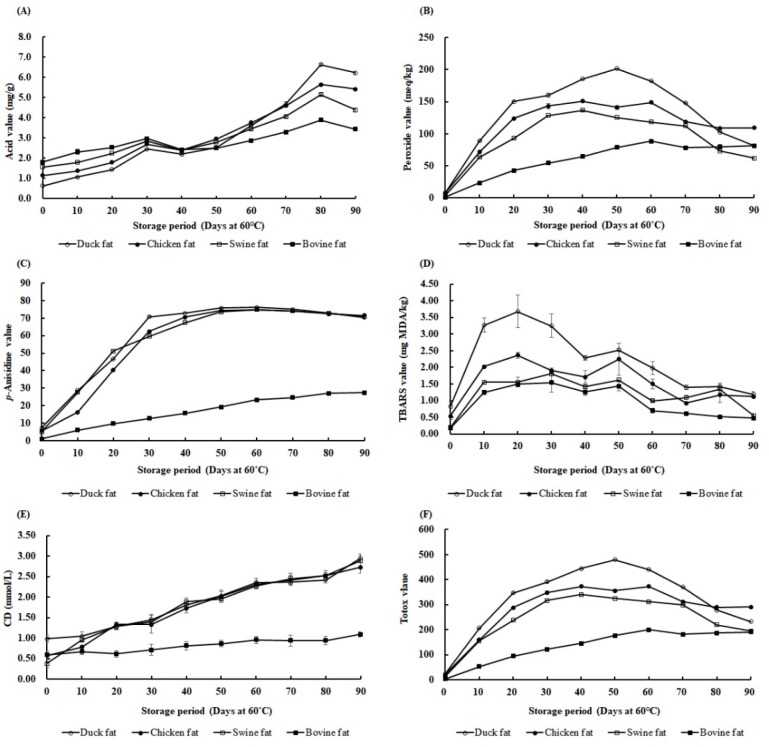
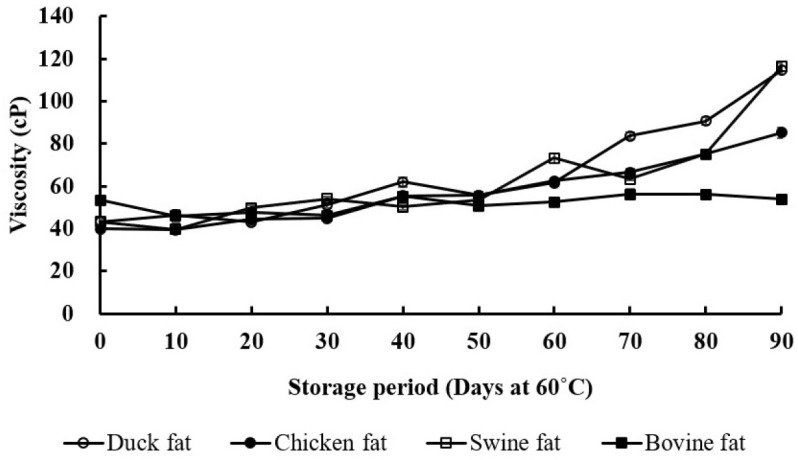
The aim of this study was to investigate the oxidative status and quality characteristics of four animal skin-derived fats extracted using an identical extraction method. Pressurized hot water extraction, a green extraction method, was used to extract animal skin fats (duck, chicken, swine, and bovine skin). Multiple experiments were performed during accelerated storage at 60°C for 90 days. Quality characteristics, such as extraction yield, iodine value (IV), fatty acid composition, and fat viscosity were determined. In addition, indicators for oxidative status, including acid value (AV), peroxide value (PV), -anisidine value (-AV), thiobarbituric acid reactive substances (TBARS), conjugated dienes (CD), and total oxidation (totox) values were evaluated. The fat extraction yield was highest in bovine fat, followed by duck, swine, and chicken fats. The IV was higher in duck and chicken fats. Duck fats contained the most unsaturated fats and the least saturated fats. Fat oxidation indicators, such as PV, TBARS, and totox values, were relatively higher in duck fats during storage compared to the other fats. Other indicators, including AV, -AV, and CD, were similar in duck, chicken, and swine fats. Viscosity was similar in all the tested fats but markedly increased after 70 days of storage in duck fats. Our data indicate that duck skin fat was more vulnerable to oxidative changes in accelerated storage conditions and this may be due to its higher unsaturated fatty acid content. Supplementation with antioxidants might be a reasonable way to solve the oxidation issue in duck skin fats.
本研究的目的是调查使用相同提取方法提取的四种动物皮源脂肪的氧化状态和质量特性。采用绿色提取方法——加压热水提取法来提取动物皮脂肪(鸭皮、鸡皮、猪皮和牛皮)。在60°C加速储存90天期间进行了多项实验。测定了提取率、碘值(IV)、脂肪酸组成和脂肪粘度等质量特性。此外,还评估了氧化状态指标,包括酸值(AV)、过氧化值(PV)、对茴香胺值(-AV)、硫代巴比妥酸反应性物质(TBARS)、共轭二烯(CD)和总氧化(totox)值。牛脂肪的脂肪提取率最高,其次是鸭脂肪、猪脂肪和鸡脂肪。鸭脂肪和鸡脂肪的碘值较高。鸭脂肪中不饱和脂肪含量最高,饱和脂肪含量最低。与其他脂肪相比,在储存期间鸭脂肪中的脂肪氧化指标,如PV、TBARS和totox值相对较高。包括AV、-AV和CD在内的其他指标在鸭脂肪、鸡脂肪和猪脂肪中相似。所有测试脂肪的粘度相似,但鸭脂肪在储存70天后粘度显著增加。我们的数据表明,在加速储存条件下,鸭皮脂肪更容易发生氧化变化,这可能是由于其不饱和脂肪酸含量较高。添加抗氧化剂可能是解决鸭皮脂肪氧化问题的合理方法。