van der Nest Ariska, Wingfield Michael J, Janoušek Josef, Barnes Irene
Forestry and Agricultural Biotechnology Institute (FABI), Department of Biochemistry, Genetics and Microbiology, University of Pretoria, Pretoria, 0002, South Africa.
Phytophthora Research Center, Mendel University in Brno, Brno, Czech Republic.
Mol Plant Pathol. 2019 Oct;20(10):1327-1364. doi: 10.1111/mpp.12853. Epub 2019 Jul 15.
Lecanosticta acicola causes brown spot needle blight (BSNB) of Pinus species. The pathogen occurs mostly in the Northern Hemisphere but has also been reported in Central America and Colombia. BSNB can lead to stunted growth and tree mortality, and has resulted in severe damage to pine plantations in the past. There have been increasingly frequent new reports of this pathogen in Europe and in North America during the course of the past 10 years. This is despite the fact that quarantine practices and eradication protocols are in place to prevent its spread.
Kingdom Fungi; Phylum Ascomycota; Subphylum Pezizomycotina; Class Dothideomycetes; Subclass Dothideomycetidae; Order Capniodales; Family Mycosphaerellaceae; Genus Lecanosticta.
Lecanosticta spp. occur on various Pinus species and are found in North America, Central America, South America (Colombia), Europe as well as Asia.
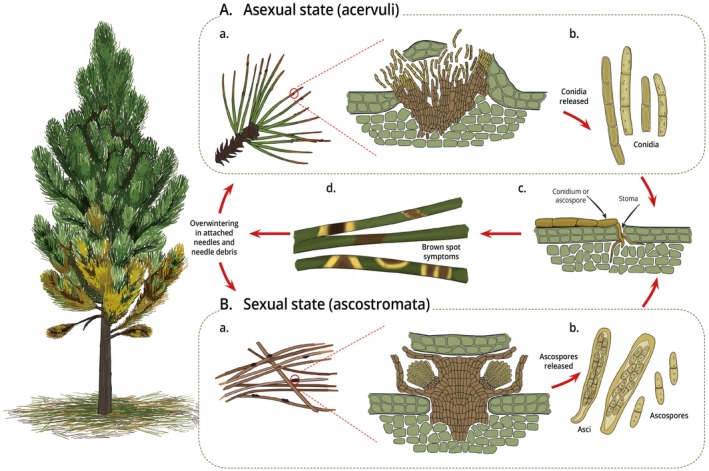
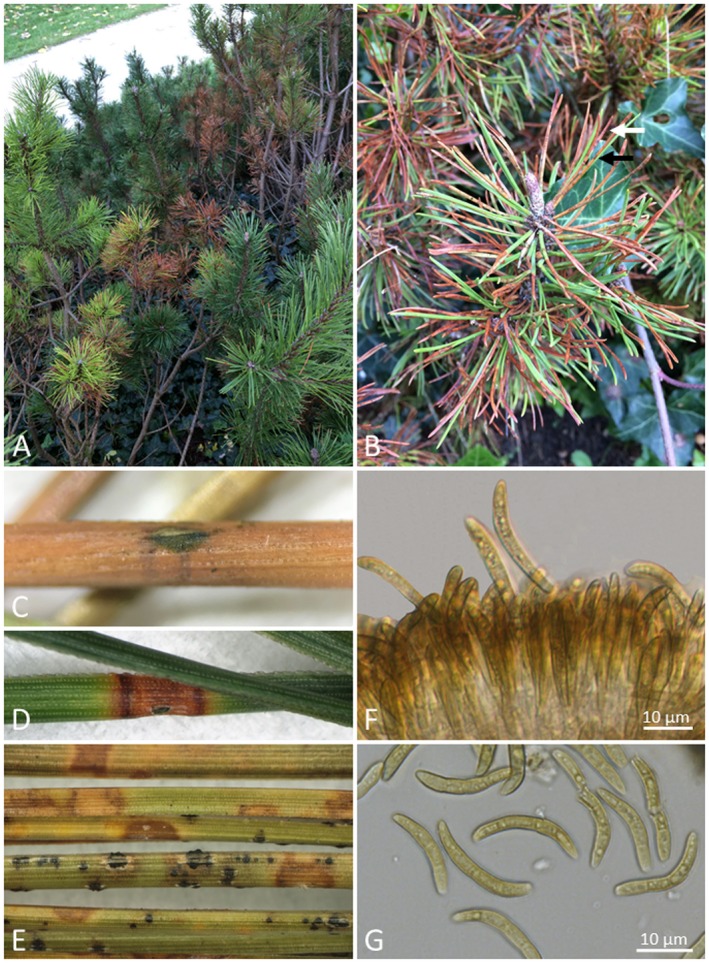
Small yellow irregular spots appear on the infected pine needles that become brown over time. They can be surrounded by a yellow halo. These characteristic brown spots develop to form narrow brown bands that result in needle death from the tips down to the point of infection. Needles are prematurely shed, leaving bare branches with tufts of new needles at the branch tips. Infection is usually most severe in the lower parts of the trees and progresses upwards into the canopies.
The EPPO global database providing information on L. acicola (https://gd.eppo.int/taxon/SCIRAC) Reference genome of L. acicola available on GenBank (https://www.ncbi.nlm.nih.gov/genome/?term=Lecanosticta+acicola) JGI Gold Genome database information sheet of L. acicola sequenced genome (https://gold.jgi.doe.gov/organism?xml:id=Go0047147).
针叶散斑壳菌可引发松属植物的褐斑叶枯病(BSNB)。该病原菌主要分布在北半球,但在中美洲和哥伦比亚也有报道。褐斑叶枯病会导致树木生长受阻甚至死亡,过去曾对松树种植园造成严重破坏。在过去10年中,欧洲和北美的这种病原菌新报告越来越频繁。尽管有检疫措施和根除方案来防止其传播,但情况依然如此。
真菌界;子囊菌门;盘菌亚门;座囊菌纲;座囊菌亚纲;小穴壳目;球腔菌科;针叶散斑壳菌属。
针叶散斑壳菌属存在于多种松属植物上,分布于北美洲、中美洲、南美洲(哥伦比亚)、欧洲以及亚洲。
受感染的松针上会出现黄色不规则小斑点,随着时间推移会变成褐色。斑点周围可能有黄色晕圈。这些典型的褐色斑点会发展形成狭窄的褐色条带,导致针叶从尖端向下直至感染部位死亡。针叶过早脱落,留下光秃秃的树枝,树枝顶端有一簇簇新针叶。感染通常在树木下部最为严重,并向上蔓延至树冠。
欧洲和地中海植物保护组织(EPPO)全球数据库提供有关针叶散斑壳菌的信息(https://gd.eppo.int/taxon/SCIRAC);GenBank上可获取针叶散斑壳菌的参考基因组(https://www.ncbi.nlm.nih.gov/genome/?term=Lecanosticta+acicola);联合基因组研究所(JGI)金色基因组数据库中针叶散斑壳菌测序基因组的信息表(https://gold.jgi.doe.gov/organism?xml:id=Go0047147)。