Kanamori Mizuho, Oikawa Kenta, Tanemura Kentaro, Hara Kenshiro
Laboratory of Animal Reproduction and Development, Graduate School of Agricultural Science Tohoku University Sendai Japan.
Reprod Med Biol. 2019 Jun 9;18(3):247-255. doi: 10.1002/rmb2.12283. eCollection 2019 Jul.
Germ cells represent one of the typical cell types that moves over a long period of time and large distance within the animal body. To continue its life cycle, germ cells must migrate to spatially distinct locations for proper development. Defects in such migration processes can result in infertility. Thus, for more than a century, the principles of germ cell migration have been a focus of interest in the field of reproductive biology.
Based on published reports (mainly from rodents), investigations of germ cell migration before releasing from the body, including primordial germ cells (PGCs), gonocytes, spermatogonia, and immature spermatozoon, were summarized.
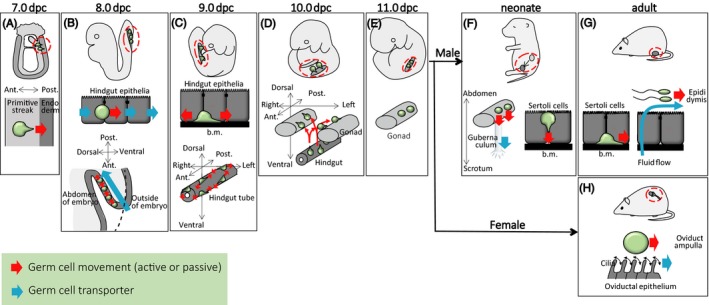
Germ cells migrate with various patterns, with each migration step regulated by distinct mechanisms. During development, PGCs actively and passively migrate from the extraembryonic region toward genital ridges through the hindgut epithelium. After sex determination, male germline cells migrate heterogeneously in a developmental stage-dependent manner within the testis.
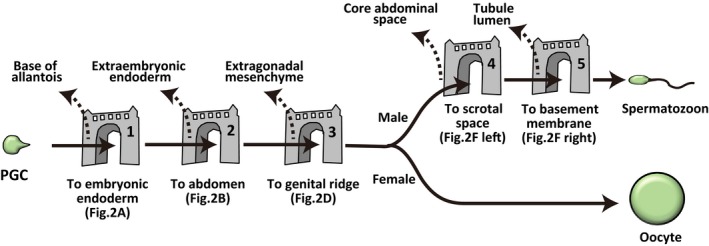
During migration, there are multiple gates that disallow germ cells from re-entering the proper developmental pathway after wandering off the original migration path. The presence of gates may ensure the robustness of germ cell development during development, growth, and homeostasis.
生殖细胞是动物体内在较长时间和较大距离内移动的典型细胞类型之一。为了延续其生命周期,生殖细胞必须迁移到空间上不同的位置以实现正常发育。这种迁移过程中的缺陷可能导致不育。因此,一个多世纪以来,生殖细胞迁移的原理一直是生殖生物学领域的研究热点。
基于已发表的报告(主要来自啮齿动物),总结了生殖细胞在脱离身体之前的迁移研究,包括原始生殖细胞(PGCs)、生殖母细胞、精原细胞和未成熟精子。
生殖细胞以多种模式迁移,每个迁移步骤都由不同的机制调控。在发育过程中,PGCs通过后肠上皮从胚外区域向生殖嵴主动和被动迁移。性别确定后,雄性生殖系细胞在睾丸内以发育阶段依赖的方式进行异质性质性迁移。
在迁移过程中,存在多个关卡,防止生殖细胞在偏离原始迁移路径后重新进入正常的发育途径。这些关卡的存在可能确保生殖细胞在发育、生长和内环境稳定过程中的发育稳健性。