Bubbico Giovanna, Di Iorio Angelo, Lauriola Mariella, Sepede Gianna, Salice Simone, Spina Eleonora, Brondi Giacomo, Esposito Roberto, Perrucci Mauro Gianni, Tartaro Armando
Department of Neuroscience, Imaging and Clinical Sciences, "G. d'Annunzio" University of Chieti-Pescara, Chieti, Italy.
Institute for Advanced Biomedical Technologies (ITAB), "G. d'Annunzio" University of Chieti-Pescara, Chieti, Italy.
Front Aging Neurosci. 2019 Jul 2;11:142. doi: 10.3389/fnagi.2019.00142. eCollection 2019.
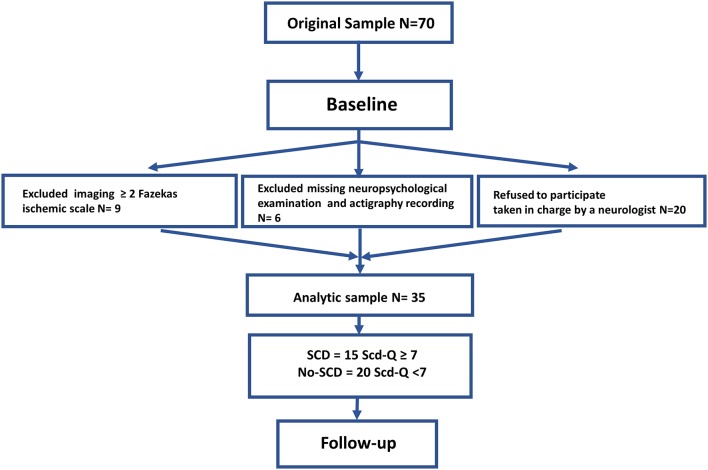
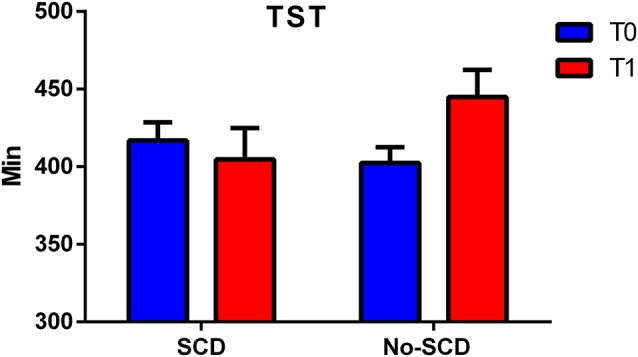
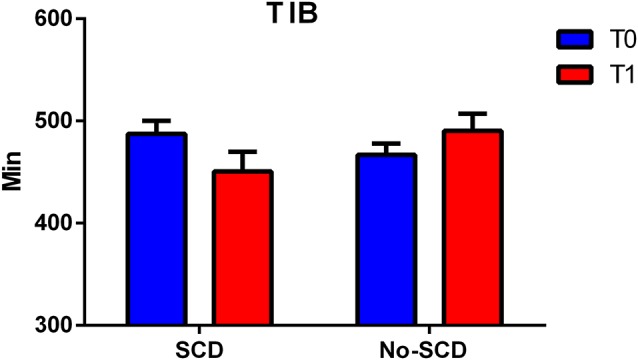
: The aim of this study was to analyze quantitative sleep changes and their implication on subjective cognitive decline (SCD). Objective sleep patterns were investigated by an actigraph and recorded at the baseline and 2-year after in order to examine specific sleep alterations in SCD. : Sleep disorders are very common among average elderly adults and an altered sleep pattern is known to be a risk factor for future development of mild cognitive impairment (MCI) and dementia. Recent studies have shown how sleep is objectively altered in average senior adults with SCD, without any other significant change in cognition and behavior or brain structure. Considering that both SCD and disrupted sleep are risk factors for future MCI and dementia, with sleep only as a modifiable risk factor, further research is required to deeply investigate the interaction between sleep and SCD. : Among 70 community-dwelling elderly individuals who had been enrolled at baseline, 35 (64.6 ± 5.6 years, 15 M/20 F) underwent a complete neuropsychological battery and 1-week wrist actigraphy recording 2 years later during the follow-up stage. Individuals were divided into two groups according to their SCD Questionnaire (SCD-Q) score. Sleep hours, sleep efficiency and onset latency, napping and time awake after sleep onset (WASO) were collected. All individuals underwent structural magnetic resonance imaging (MRI) examination to exclude brain disorders. Data collection was performed at baseline and after 2 years at the follow-up phase. : A significantly different night sleep time between the two groups was observed: SCD showed a lower total sleep time (TST) than non-SCD subjects. Moreover, a total time spent in bed (TIB) was significantly lower in SCD subjects over 2 years of observation. : Objective changes over time of the sleep pattern, specifically TIB and TST, are present in SCD individuals. The results of the study show that sleep alterations are common in SCD and underline the clinical importance of screening in order to assess sleep alterations as well as improve sleep in average adults with SCD complaints.
本研究的目的是分析睡眠的定量变化及其对主观认知衰退(SCD)的影响。通过活动记录仪调查客观睡眠模式,并在基线期和2年后进行记录,以检查SCD中的特定睡眠改变。睡眠障碍在普通老年人中非常常见,已知睡眠模式改变是未来发生轻度认知障碍(MCI)和痴呆的危险因素。最近的研究表明,患有SCD的普通老年人的睡眠在客观上发生了改变,而认知、行为或脑结构没有任何其他显著变化。鉴于SCD和睡眠紊乱都是未来发生MCI和痴呆的危险因素,且睡眠只是一个可改变的危险因素,因此需要进一步研究来深入探讨睡眠与SCD之间的相互作用。在70名基线期入选的社区居住老年人中,35名(64.6±5.6岁,15名男性/20名女性)在随访阶段2年后接受了完整的神经心理测试和为期1周的手腕活动记录。根据他们的SCD问卷(SCD-Q)得分将个体分为两组。收集睡眠时间、睡眠效率和入睡潜伏期、小睡以及睡眠开始后的清醒时间(WASO)。所有个体均接受结构磁共振成像(MRI)检查以排除脑部疾病。在基线期和随访阶段2年后进行数据收集。观察到两组之间夜间睡眠时间存在显著差异:SCD组的总睡眠时间(TST)低于非SCD组受试者。此外,在2年的观察期内,SCD组受试者的总卧床时间(TIB)显著更低。SCD个体存在睡眠模式随时间的客观变化,特别是TIB和TST。研究结果表明,睡眠改变在SCD中很常见,并强调了筛查的临床重要性,以便评估睡眠改变并改善有SCD主诉的普通成年人的睡眠。