School of Life Sciences, Ulsan National Institute of Science and Technology, Ulsan, Republic of Korea.
Elife. 2019 Jul 17;8:e40593. doi: 10.7554/eLife.40593.
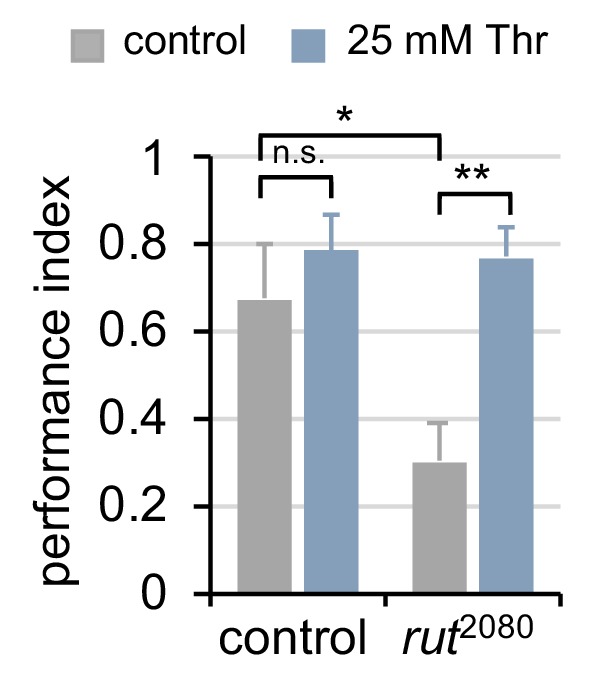
Emerging evidence indicates the role of amino acid metabolism in sleep regulation. Here we demonstrate sleep-promoting effects of dietary threonine (SPET) in . Dietary threonine markedly increased daily sleep amount and decreased the latency to sleep onset in a dose-dependent manner. High levels of synaptic GABA or pharmacological activation of metabotropic GABA receptors (GABA-R) suppressed SPET. By contrast, synaptic blockade of GABAergic neurons or transgenic depletion of GABA-R in the ellipsoid body R2 neurons enhanced sleep drive non-additively with SPET. Dietary threonine reduced GABA levels, weakened metabotropic GABA responses in R2 neurons, and ameliorated memory deficits in plasticity mutants. Moreover, genetic elevation of neuronal threonine levels was sufficient for facilitating sleep onset. Taken together, these data define threonine as a physiologically relevant, sleep-promoting molecule that may intimately link neuronal metabolism of amino acids to GABAergic control of sleep drive via the neuronal substrate of sleep homeostasis.
This article has been through an editorial process in which the authors decide how to respond to the issues raised during peer review. The Reviewing Editor's assessment is that all the issues have been addressed (see decision letter).
新出现的证据表明氨基酸代谢在睡眠调节中的作用。在这里,我们证明了膳食苏氨酸(SPET)在[研究对象]中具有促进睡眠的作用。膳食苏氨酸显著增加了每日睡眠时间,并以剂量依赖的方式降低了睡眠潜伏期。突触 GABA 水平升高或代谢型 GABA 受体(GABA-R)的药理学激活抑制了 SPET。相比之下,抑制 GABA 能神经元的突触或转染体中椭圆形体 R2 神经元中 GABA-R 的耗竭以非累加的方式增强了与 SPET 一起的睡眠驱动力。膳食苏氨酸降低了 GABA 水平,减弱了 R2 神经元中的代谢型 GABA 反应,并改善了可塑性突变体的记忆缺陷。此外,神经元苏氨酸水平的遗传升高足以促进睡眠开始。总之,这些数据将苏氨酸定义为一种具有生理相关性的、促进睡眠的分子,它可能通过睡眠稳态的神经元基质将氨基酸的神经元代谢与 GABA 能对睡眠驱动力的控制紧密联系起来。
本文已经过编辑过程,作者在该过程中决定如何处理同行评审期间提出的问题。评审编辑的评估是所有问题都已得到解决(见评审信)。