Department of Biology, Ecology and Earth Sciences, University of Calabria, 87036, Rende, Italy.
Scientific Direction, IRCCS INRCA, National Institute, Ancona, Italy.
Sci Rep. 2019 Jul 17;9(1):10395. doi: 10.1038/s41598-019-46894-2.
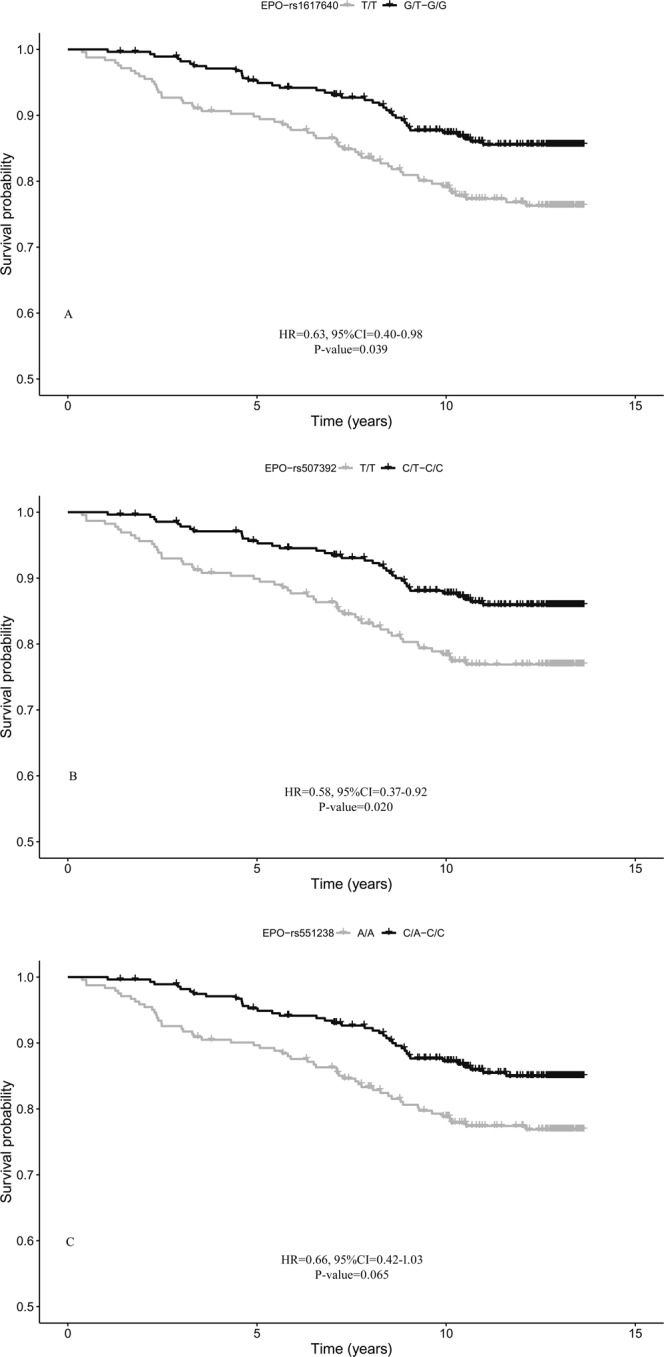
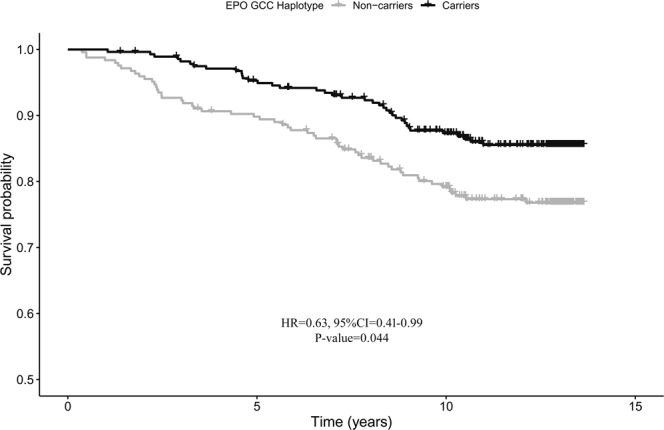
Type-2 Diabetes (T2D), diabetic complications, and their clinical risk factors harbor a substantial genetic component but the genetic factors contributing to overall diabetes mortality remain unknown. Here, we examined the association between genetic variants at 21 T2D-susceptibility loci and all-cause mortality in an elderly cohort of 542 Italian diabetic patients who were followed for an average of 12.08 years. Univariate Cox regression analyses detected age, waist-to-hip ratio (WHR), glycosylated haemoglobin (HbA1c), diabetes duration, retinopathy, nephropathy, chronic kidney disease (CKD), and anaemia as predictors of all-cause mortality. When Cox proportional hazards multivariate models adjusted for these factors were run, three erythropoietin (EPO) genetic variants in linkage disequilibrium (LD) with each other (rs1617640-T/G, rs507392-T/C and rs551238-A/C) were significantly (False Discovery Rate < 0.1) associated with mortality. Haplotype multivariate analysis revealed that patients carrying the G-C-C haplotype have an increased probability of survival, while an opposite effect was observed among subjects carrying the T-T-A haplotype. Our findings provide evidence that the EPO gene is an independent predictor of mortality in patients with T2D. Thus, understanding the mechanisms by which the genetic variability of EPO affects the mortality of T2D patients may provide potential targets for therapeutic interventions to improve the survival of these patients.
2 型糖尿病(T2D)、糖尿病并发症及其临床风险因素具有重要的遗传成分,但导致糖尿病总死亡率的遗传因素尚不清楚。在这里,我们研究了 21 个 T2D 易感性位点的遗传变异与 542 名意大利糖尿病患者全因死亡率之间的关系,这些患者的平均随访时间为 12.08 年。单变量 Cox 回归分析检测到年龄、腰臀比(WHR)、糖化血红蛋白(HbA1c)、糖尿病病程、视网膜病变、肾病、慢性肾脏病(CKD)和贫血是全因死亡率的预测因素。当对这些因素进行 Cox 比例风险多变量模型调整时,相互连锁不平衡(LD)的三个促红细胞生成素(EPO)遗传变异(rs1617640-T/G、rs507392-T/C 和 rs551238-A/C)与死亡率显著相关(假发现率 < 0.1)。单倍型多变量分析显示,携带 G-C-C 单倍型的患者存活概率增加,而携带 T-T-A 单倍型的患者则出现相反的效果。我们的研究结果表明,EPO 基因是 T2D 患者死亡率的独立预测因子。因此,了解 EPO 基因遗传变异如何影响 T2D 患者的死亡率,可能为改善这些患者的生存提供潜在的治疗干预靶点。