Behar Joachim A, Palmius Niclas, Li Qiao, Garbuio Silverio, Rizzatti Fabìola P G, Bittencourt Lia, Tufik Sergio, Clifford Gari D
Faculty of Biomedical Engineering, Technion, Israel Institute of Technology, Haifa, Israel.
Wolfson College, Oxford OX2 6UD, UK.
EClinicalMedicine. 2019 Jun 7;11:81-88. doi: 10.1016/j.eclinm.2019.05.015. eCollection 2019 May-Jun.
The growing awareness for the high prevalence of obstructive sleep apnea (OSA) coupled with the dramatic proportion of undiagnosed individuals motivates the elaboration of a simple but accurate screening test. This study assesses, for the first time, the performance of oximetry combined with demographic information as a screening tool for identifying OSA in a representative (i.e. non-referred) population sample.
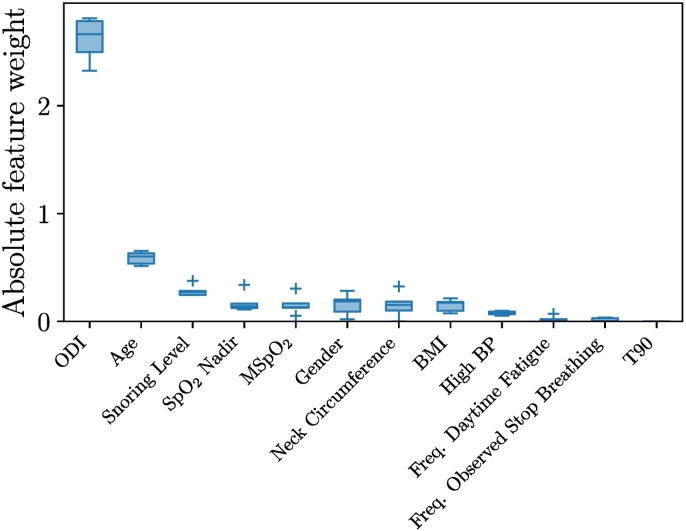
A polysomnography (PSG) clinical database of 887 individuals from a representative population sample of São Paulo's city (Brazil) was used. Using features derived from the oxygen saturation signal during sleep periods and demographic information, a logistic regression model (termed OxyDOSA) was trained to distinguish between non-OSA and OSA individuals (mild, moderate, and severe). The OxyDOSA model performance was assessed against the PSG-based diagnosis of OSA (AASM 2017) and compared to the NoSAS and STOP-BANG questionnaires.
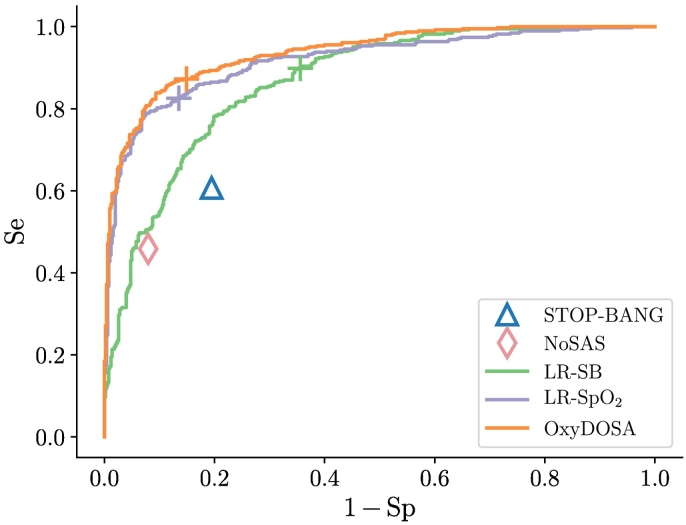
The OxyDOSA model had mean AUROC = 0.94 ± 0.02, Se = 0.87 ± 0.04 and Sp = 0.85 ± 0.03. In particular, it did not miss any of the 75 severe OSA individuals. In comparison, the NoSAS questionnaire had AUROC = 0.83 ± 0.03, and missed 23/75 severe OSA individuals. The STOP-BANG had AUROC = 0.77 ± 0.04 and missed 14/75 severe OSA individuals.
We provide strong evidence on a representative population sample that oximetry biomarkers combined with few demographic information, the OxyDOSA model, is an effective screening tool for OSA. Our results suggest that sleep questionnaires should be used with caution for OSA screening as they fail to identify many moderate and even some severe cases. The OxyDOSA model will need to be further validated on data recorded using overnight portable oximetry.
对阻塞性睡眠呼吸暂停(OSA)高患病率的认识不断提高,加上未确诊个体的比例惊人,促使人们精心设计一种简单而准确的筛查测试。本研究首次评估了脉搏血氧饱和度测定法结合人口统计学信息作为在具有代表性(即非转诊)人群样本中识别OSA的筛查工具的性能。
使用来自巴西圣保罗市代表性人群样本的887人的多导睡眠图(PSG)临床数据库。利用睡眠期间从血氧饱和度信号中提取的特征和人口统计学信息,训练了一个逻辑回归模型(称为OxyDOSA),以区分非OSA个体和OSA个体(轻度、中度和重度)。根据基于PSG的OSA诊断(AASM 2017)评估OxyDOSA模型的性能,并与NoSAS和STOP-BANG问卷进行比较。
OxyDOSA模型的平均受试者工作特征曲线下面积(AUROC)=0.94±0.02,灵敏度(Se)=0.87±0.04,特异度(Sp)=0.85±0.03。特别是,它没有遗漏75名重度OSA个体中的任何一个。相比之下,NoSAS问卷的AUROC=0.83±0.03,遗漏了23/75名重度OSA个体。STOP-BANG问卷的AUROC=0.77±0.04,遗漏了14/75名重度OSA个体。
我们在一个具有代表性的人群样本中提供了有力证据,表明脉搏血氧饱和度测定法生物标志物结合少量人口统计学信息的OxyDOSA模型是一种有效的OSA筛查工具。我们的结果表明,睡眠问卷用于OSA筛查时应谨慎使用,因为它们无法识别许多中度甚至一些重度病例。OxyDOSA模型需要在使用夜间便携式脉搏血氧饱和度测定法记录的数据上进一步验证。