Robert Frederick Smith School of Chemical and Biomolecular Engineering, Cornell University, Ithaca, NY, USA.
Adv Exp Med Biol. 2019;1215:13-43. doi: 10.1007/978-3-030-14741-9_2.
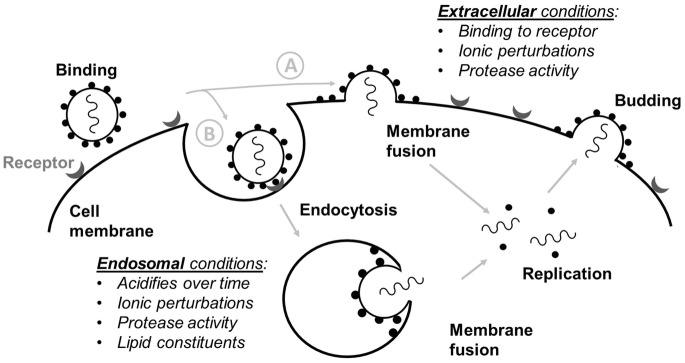
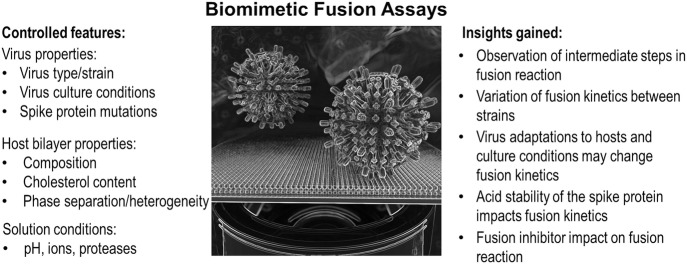
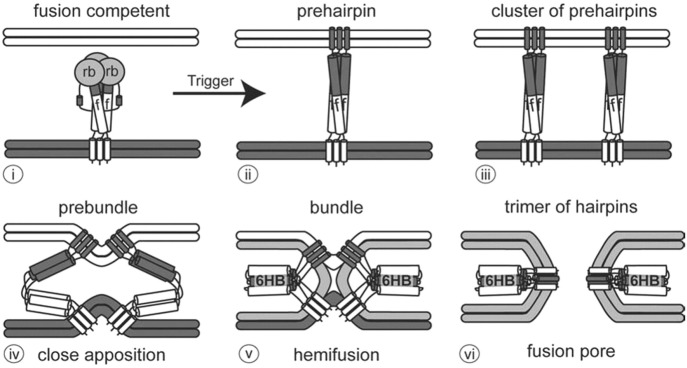
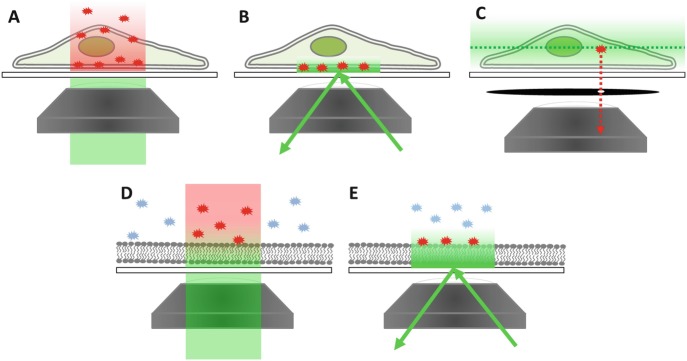
The most widely-used assays for studying viral entry, including infectivity, cofloatation, and cell-cell fusion assays, yield functional information but provide low resolution of individual entry steps. Structural characterization provides high-resolution conformational information, but on its own is unable to address the functional significance of these conformations. Single virion tracking microscopy techniques provide more detail on the intermediate entry steps than infection assays and more functional information than structural methods, bridging the gap between these methods. In addition, single virion approaches also provide dynamic information about the kinetics of entry processes. This chapter reviews single virion tracking techniques and describes how they can be applied to study specific virus entry steps. These techniques provide information complementary to traditional ensemble approaches. Single virion techniques may either probe virion behavior in live cells or in biomimetic platforms. Synthesizing information from ensemble, structural, and single virion techniques ultimately yields a more complete understanding of the viral entry process than can be achieved by any single method alone.
最常用于研究病毒进入的方法,包括感染性、共浮和细胞-细胞融合测定,提供了功能信息,但分辨率低,无法确定单个进入步骤。结构特征提供了高分辨率的构象信息,但本身无法解决这些构象的功能意义。单病毒跟踪显微镜技术比感染测定提供了更多关于中间进入步骤的细节,比结构方法提供了更多的功能信息,弥合了这些方法之间的差距。此外,单病毒方法还提供了有关进入过程动力学的动态信息。本章回顾了单病毒跟踪技术,并描述了如何将其应用于研究特定的病毒进入步骤。这些技术提供了与传统整体方法互补的信息。单病毒技术可以探测活细胞或仿生平台中病毒的行为。综合整体、结构和单病毒技术的信息,最终比任何单一方法都能更全面地了解病毒进入过程。