State Key Laboratory of Veterinary Biotechnology, National African Swine Fever Para-Reference Laboratory, Harbin Veterinary Research Institute, Chinese Academy of Agricultural Sciences, Harbin 150069, China.
CAS Key Laboratory of Pathogenic Microbiology and Immunology, Institute of Microbiology, Chinese Academy of Sciences, Beijing 100101, China.
Viruses. 2021 Dec 13;13(12):2495. doi: 10.3390/v13122495.
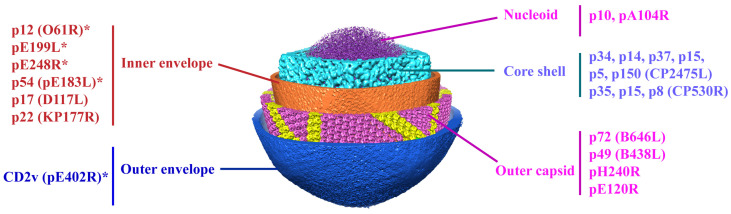
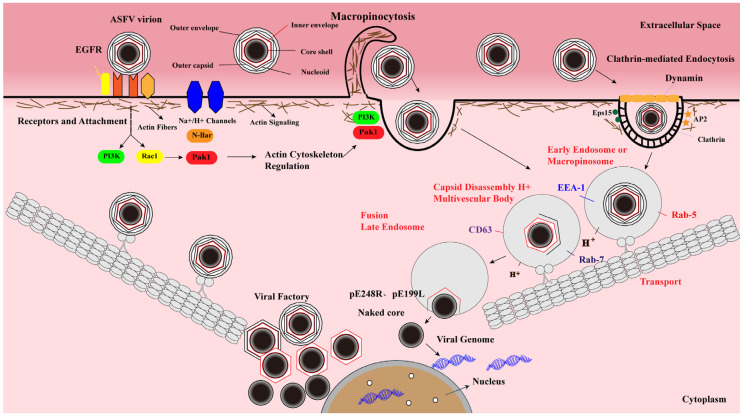
African swine fever (ASF) is a highly contagious hemorrhagic disease in domestic pigs and wild boars with a mortality of up to 100%. The causative agent, African swine fever virus (ASFV), is a member of the family of the nucleocytoplasmic large DNA viruses. The genome size of ASFV ranges from 170 to 194 kb, encoding more than 50 structural and 100 nonstructural proteins. ASFV virions are 260-300 nm in diameter and composed of complex multilayered structures, leading to an intricate internalization pathway to enter host cells. Currently, no commercial vaccines or antivirals are available, due to the insufficient knowledge of the viral receptor(s), the molecular events of ASFV entry into host cells, and the functions of virulence-associated genes. During the early stage of ASFV infection, the fundamental aspects of virus-host interactions, including virus internalization, intracellular transport through the endolysosomal system, and membrane fusion with endosome, are precisely regulated and orchestrated via a series of molecular events. In this review, we summarize the currently available knowledge on the pathways of ASFV entry into host cells and the functions of viral proteins involved in virus entry. Furthermore, we conclude with future perspectives and highlight areas that require further investigation. This review is expected to provide unique insights for further understanding ASFV entry and facilitate the development of vaccines and antivirals.
非洲猪瘟 (ASF) 是一种高传染性的猪和野猪出血性疾病,死亡率高达 100%。病原体是非洲猪瘟病毒 (ASFV),属于核质大 DNA 病毒科。ASFV 的基因组大小为 170 至 194 kb,编码 50 多种结构蛋白和 100 多种非结构蛋白。ASFV 病毒粒子的直径为 260-300nm,由复杂的多层结构组成,导致进入宿主细胞的途径复杂。目前,由于对病毒受体的了解不足、ASFV 进入宿主细胞的分子事件以及与毒力相关基因的功能,还没有商业疫苗或抗病毒药物可用。在 ASF 感染的早期阶段,病毒-宿主相互作用的基本方面,包括病毒内化、通过内体溶酶体系统的细胞内运输以及与内体的膜融合,通过一系列分子事件被精确调节和协调。在这篇综述中,我们总结了 ASFV 进入宿主细胞的途径以及参与病毒进入的病毒蛋白的功能的现有知识。此外,我们还总结了未来的展望,并强调了需要进一步研究的领域。这篇综述有望为进一步了解 ASFV 的进入提供独特的见解,并有助于疫苗和抗病毒药物的开发。