Waisman Center, University of Wisconsin-Madison, Madison, Wisconsin.
School of Social Work, University of Wisconsin-Madison, Madison, Wisconsin.
Autism Res. 2019 Oct;12(10):1541-1550. doi: 10.1002/aur.2173. Epub 2019 Jul 17.
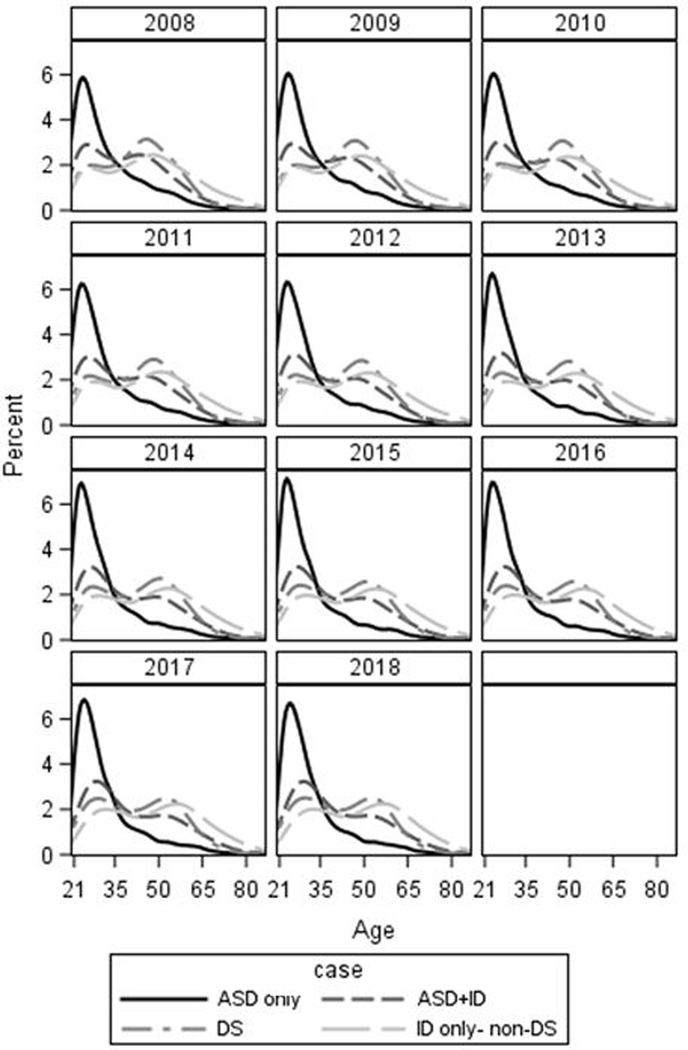
Our primary objective was to describe demographic characteristics and enrollment patterns in a unique 11-year full sample of adult Wisconsin Medicaid beneficiaries with identified autism spectrum disorder (ASD) or intellectual disability (ID). We obtained de-identified Medicaid claims data for adults with a recorded ASD or ID diagnosis aged 21 and older with any Medicaid fee-for-service claims between January 1, 2008 and December 31, 2018. We assessed enrollment, age, number of visits, and paid amount per year using generalized linear models with a random intercept for each beneficiary. We identified claims for 4,775 autistic adults without ID, 2,738 autistic adults with ID, 14,945 adults with ID, and 3,484 adults with Down syndrome. The age distribution of the diagnostic group with ASD diagnoses was right skewed with a majority of beneficiaries less than age 30. The ASD without ID diagnostic group had the least visits and paid amount per person per year compared to other groups. In each age category, the ASD with ID diagnostic group had the most paid amount per person per year compared to other groups. It is urgent that we identify the health and health service needs of autistic adults from young adulthood through old age. Our findings have implications for ensuring adequate health coverage across the lifespan and highlight the importance of a strong and accessible health care system for autistic people. Autism Res 2019, 12: 1541-1550. © 2019 International Society for Autism Research, Wiley Periodicals, Inc. LAY SUMMARY: Medicaid provides health insurance to disabled people who meet income requirements. We assessed patterns of enrollment and service use among autistic adults and adults with developmental disabilities in Wisconsin Medicaid. We found a consistent influx of new young autistic adults without intellectual disability into the Medicaid system, with fewer visits and lower paid amounts compared to other developmental disability groups. The changing population of autistic people using Medicaid has implications for providing health care to autistic adults in the future.
我们的主要目标是描述在威斯康星州 Medicaid 中一个独特的 11 年全样本中患有自闭症谱系障碍(ASD)或智力残疾(ID)的成年受益人的人口统计学特征和登记模式。我们获取了 Medicaid 为年龄在 21 岁及以上、有记录的 ASD 或 ID 诊断的成年人提供的匿名数据,他们在 2008 年 1 月 1 日至 2018 年 12 月 31 日期间有任何 Medicaid 按服务收费的索赔。我们使用具有每个受益人的随机截距的广义线性模型评估登记、年龄、就诊次数和每年支付的金额。我们确定了 4775 名没有 ID 的自闭症成年人、2738 名有 ID 的自闭症成年人、14945 名有 ID 的成年人和 3484 名唐氏综合征成年人的索赔。有 ASD 诊断的诊断组的年龄分布呈右偏态,大多数受益人年龄小于 30 岁。与其他组相比,没有 ID 的 ASD 诊断组的就诊次数和每人每年支付的金额最少。在每个年龄类别中,有 ID 的 ASD 诊断组的每人每年支付的金额均高于其他组。我们急需确定从青年期到老年期自闭症成年人的健康和卫生服务需求。我们的研究结果对确保整个生命周期的充分健康保险具有重要意义,并强调了为自闭症患者建立强大和可及的医疗保健系统的重要性。自闭症研究 2019 年,12:1541-1550. © 2019 自闭症国际研究协会,Wiley 期刊,公司。