Kantonsspital Graubuenden, Internal medicine, Chur, Switzerland.
Kantonsspital Graubuenden, Internal medicine, Department of Nephrology, Loestr. 170, Chur, Switzerland.
BMC Neurol. 2019 Jul 18;19(1):169. doi: 10.1186/s12883-019-1393-4.
Cerebral salt wasting (CSW) is a rare metabolic disorder with severe hyponatremia and volume depletion usually caused by brain injury like trauma, cerebral lesion, tumor or a cerebral hematoma. The renal function is normal with excretion of very high amounts of sodium in the urine. Diagnosis is made by excluding other reasons for hyponatremia, mainly the syndrome of inappropriate antidiuretic hormone secretion (SIADH).
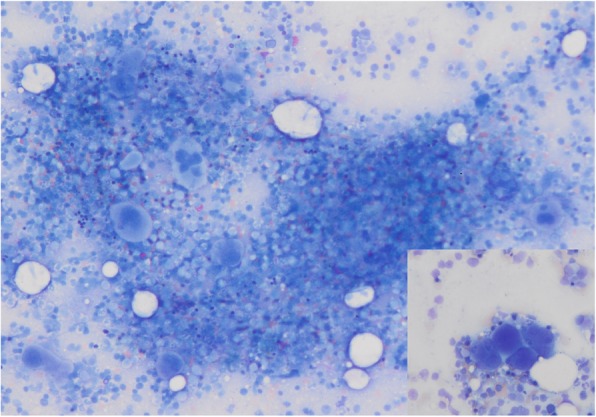
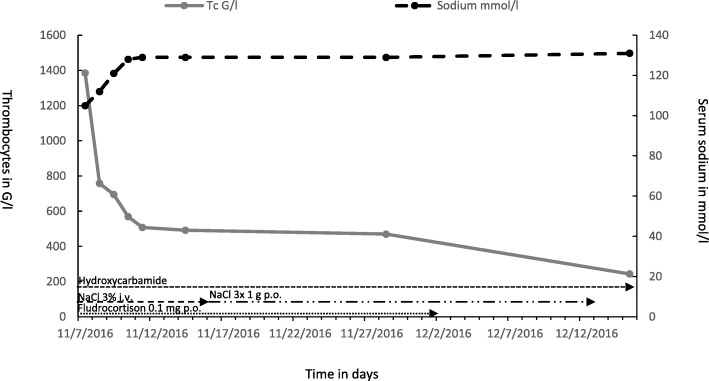
A 60-year-old patient was admitted to the emergency room with pain in the upper abdomen and visual disturbance two weeks after knee replacement. The patient was confused with severe hematoma at the site of the knee endoprosthesis. Laboratory values showed massive thrombocytosis, leukocytosis, anemia, severe hyponatremia and no evidence of infection. CT scan of the abdomen was inconspicuous. Head MRI showed no ischemia or bleeding, but a mild microangiopathy. A myeloproliferative neoplasm (MPN) was suspected and confirmed by bone marrow biopsy. Cerebral salt wasting syndrome was identified as the cause of severe hyponatremia most likely provoked by cerebral microcirculatory disturbance. The hematoma at the operation site was interpreted as a result of a secondary von Willebrand syndrome (vWS) due to the myeloproliferative neoplasm with massive thrombocytosis. After starting cytoreductive therapy with hydroxycarbamide, thrombocytosis and blood sodium slowly improved along with normalization of his mental condition.
To the best of our knowledge this is the first description of a patient with CSW most likely caused by a microcirculatory disturbance due to a massive thrombocytosis in the context of a myeloproliferative neoplasm.
脑性盐耗综合征(CSW)是一种罕见的代谢紊乱,通常由脑损伤引起,如创伤、脑病变、肿瘤或脑血肿,导致严重低钠血症和容量耗竭。肾功能正常,尿中排出大量钠。诊断通过排除其他低钠血症的原因,主要是抗利尿激素分泌不当综合征(SIADH)来确定。
一名 60 岁患者在膝关节置换术后两周因上腹痛和视力障碍被收入急诊室。患者因膝关节假体部位有严重血肿而出现意识混乱。实验室检查值显示大量血小板增多、白细胞增多、贫血、严重低钠血症,且无感染迹象。腹部 CT 扫描无明显异常。头部 MRI 显示无缺血或出血,但有轻度微血管病。怀疑为骨髓增殖性肿瘤(MPN),并通过骨髓活检得到证实。脑性盐耗综合征被认为是导致严重低钠血症的原因,最有可能是由脑微循环障碍引起的。手术部位的血肿被解释为继发性血管性血友病(vWS),原因是骨髓增殖性肿瘤伴有大量血小板增多。开始用羟基脲进行细胞减少治疗后,血小板增多和血钠缓慢改善,精神状态也随之恢复正常。
据我们所知,这是首例因骨髓增殖性肿瘤导致大量血小板增多引起的微循环障碍而引发 CSW 的患者描述。