Liu Chao, Xu Bin, Li Qian, Li Aijie, Li Lan, Yue Jinbo, Hu Qinyong, Yu Jinming
1Department of Oncology, Renmin Hospital of Wuhan University, Wuhan, 430060 China.
2Department of Radiation Oncology, Shandong Cancer Hospital and Institute, Shandong First Medical University and Shandong Academy of Medical Sciences, Jinan, 250117 Shandong China.
Cancer Cell Int. 2019 Jul 9;19:176. doi: 10.1186/s12935-019-0899-6. eCollection 2019.
Considering the effect of smoking on tumor immunity, we attempted to investigate the impact of smoking history on the prognostic value of circulating naïve and memory CD4+ and CD8+ T cells in advanced non-small cell lung cancer (NSCLC) treated with chemo(radio)therapy.
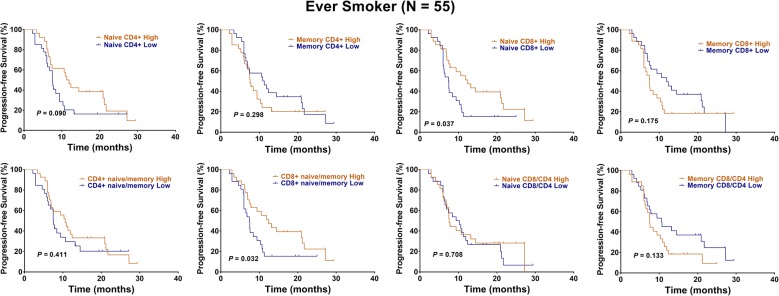
Of 196 histologically confirmed advanced NSCLC, 98 eligible ones were enrolled. Naïve and memory CD4+ and CD8+ T cells from peripheral blood were measured by flow cytometry. Kaplan-Meier curves helped estimate patients' survival. The uni- and multivariate Cox proportional hazards regression model was employed in the assessment of the prognostic value of factors.
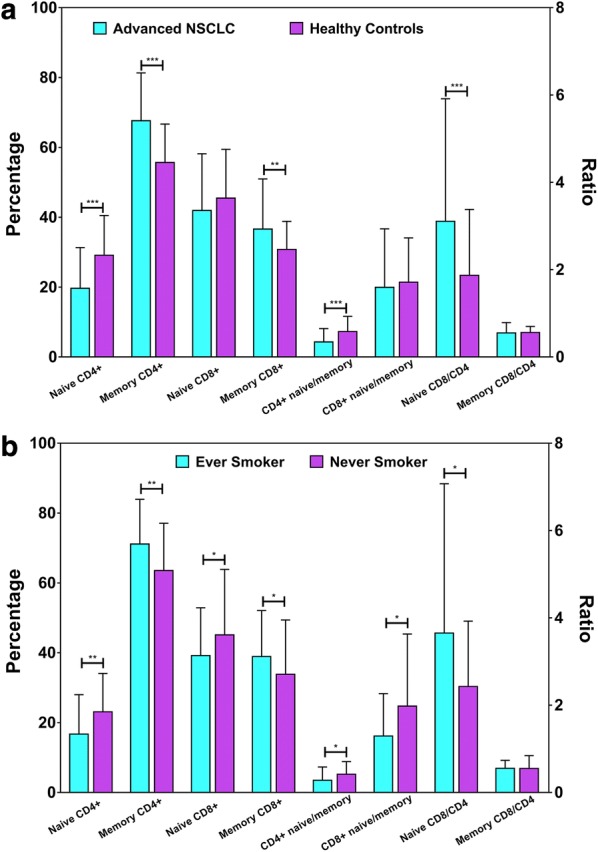
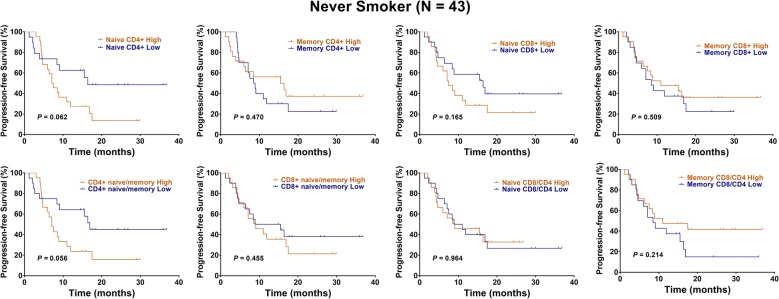
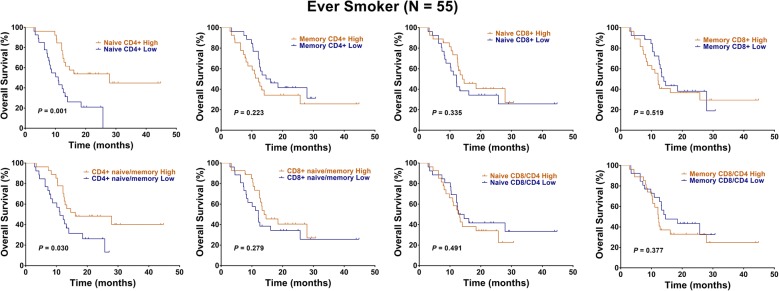
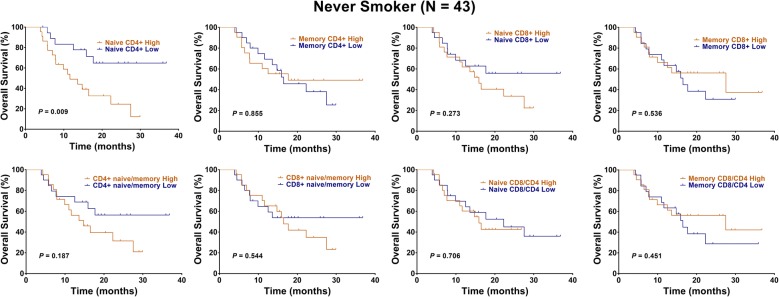
Multivariate survival analyses showed that peripheral naïve CD4+ T cells independently predicted favorable overall survival (OS) in ever smokers with advanced NSCLC (P = 0.007), but unfavorable OS in never smokers with the same ailment (P = 0.012). Ever smokers presented a different distribution of naïve and memory T cells: low expression levels of naïve CD4+ T (P = 0.005), naïve CD8+ T (P = 0.031), CD4+ naïve/memory ratio (P = 0.020), and CD8+ naïve/memory ratio (P = 0.019), and high distributions of memory CD4 + T (P = 0.004), memory CD8 + T (P = 0.034), and naïve CD8/CD4 ratio (P = 0.020), when compared to never smokers.
We revealed the impact of cigarette-smoking on peripheral naïve CD4+ T cells' prognostic value in advanced NSCLC patients. These results could help in refining personalized treatment for advanced NSCLC patients.
考虑到吸烟对肿瘤免疫的影响,我们试图研究吸烟史对接受化疗(放疗)的晚期非小细胞肺癌(NSCLC)患者循环中初始和记忆性CD4+及CD8+T细胞预后价值的影响。
在196例经组织学确诊的晚期NSCLC患者中,纳入了98例符合条件的患者。通过流式细胞术检测外周血中的初始和记忆性CD4+及CD8+T细胞。采用Kaplan-Meier曲线评估患者的生存率。使用单因素和多因素Cox比例风险回归模型评估各因素的预后价值。
多因素生存分析显示,外周初始CD4+T细胞可独立预测晚期NSCLC现吸烟者的良好总生存期(OS)(P = 0.007),但对同病况的既往不吸烟者则提示不良OS(P = 0.012)。现吸烟者的初始和记忆性T细胞分布不同:与既往不吸烟者相比,初始CD4+T细胞(P = 0.005)、初始CD8+T细胞(P = 0.031)、CD4+初始/记忆比例(P = 0.020)和CD8+初始/记忆比例(P = 0.019)的表达水平较低,而记忆性CD4+T细胞(P = 0.004)、记忆性CD8+T细胞(P = 0.034)和初始CD8/CD4比例(P = 0.020)的分布较高。
我们揭示了吸烟对晚期NSCLC患者外周初始CD4+T细胞预后价值的影响。这些结果有助于优化晚期NSCLC患者的个体化治疗。