Department of Oncology, Changzhou No.2 People's Hospital, Affiliated Hospital of Nanjing Medical University, Changzhou, Jiangsu, China.
JC School of Public Health and Primary Care, Chinese University of Hong Kong, Hong Kong, China.
Cancer Med. 2019 Mar;8(3):1326-1335. doi: 10.1002/cam4.1988. Epub 2019 Feb 14.
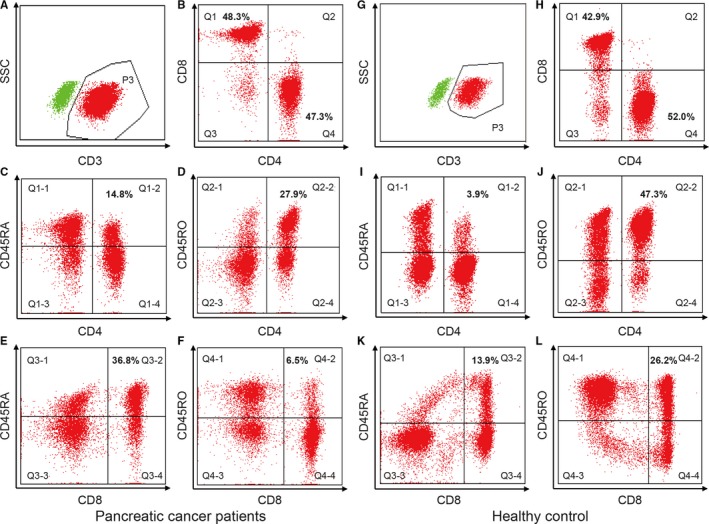
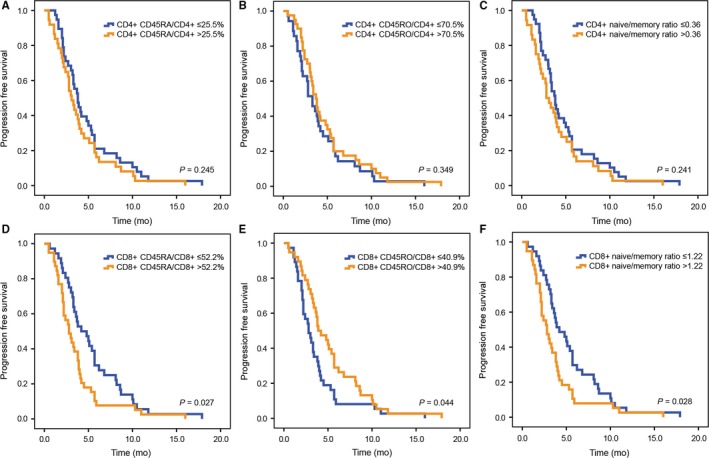
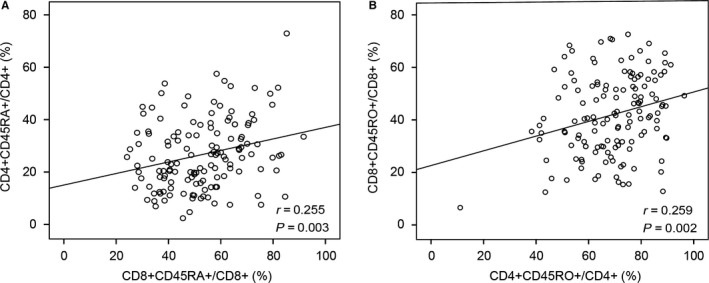
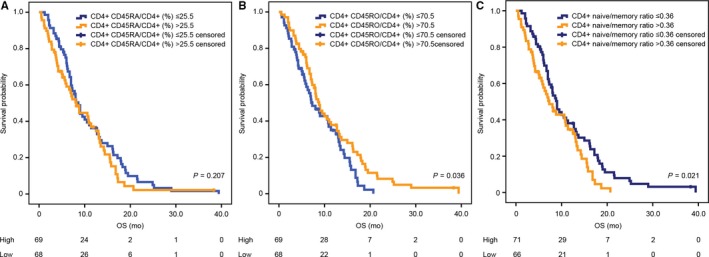
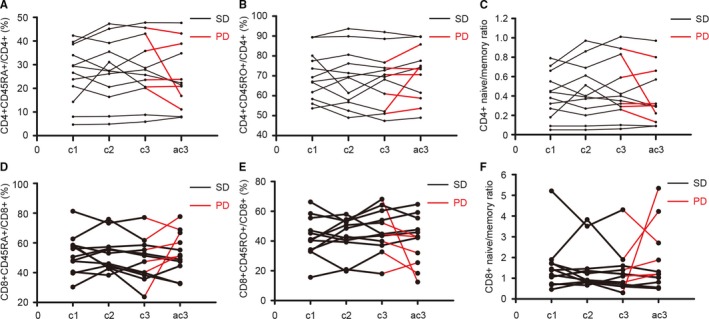
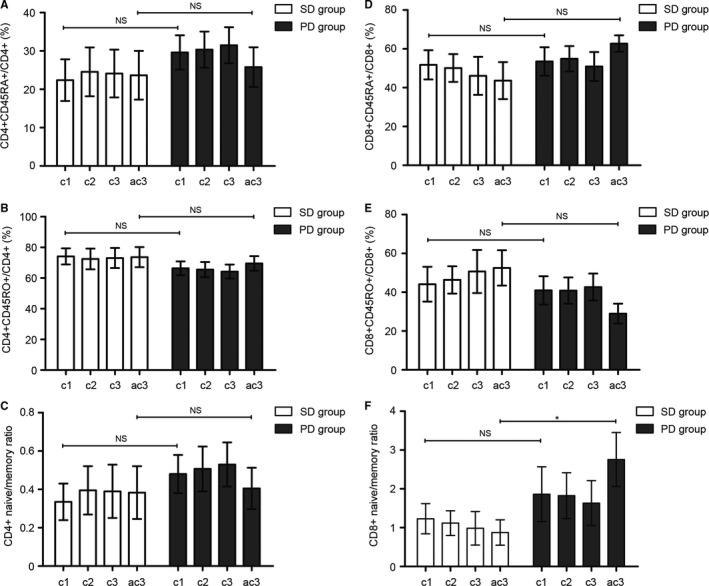
Naïve and memory T cells play a pivotal role in solid tumor pathogenesis but their role in pancreatic cancer progression remains elusive. Thus, we aimed to investigate their clinical potential in advanced pancreatic cancer (APC). Flow cytometry was performed to evaluate the level of baseline peripheral naïve and memory T cells from 137 APC patients before receiving first-line chemotherapy. Interrelationships between naïve, memory T cells and clinicopathological variables were evaluated using Pearson's correlation. The prognostic impact of naïve and memory T cells were assessed by Kaplan-Meier analysis and Cox regression. The correlation between naïve/memory T cells and tumor progression was investigated by Student's t test. CD4 naïve/memory ratio showed close correlations with hemoglobin, red blood cell (RBC), absolute neutrophil count (ANC) and platelet while CD8 naïve/memory ratio was correlated with hemoglobin, RBC and CEA. Higher baseline lever of CD4 CD45RO /CD4 was correlated with better overall survival (OS) (P = 0.036). Patients with CD4 naïve/memory ratio ≥0.36 had a poorer OS than those with CD4 naïve/memory ratio <0.36 (P = 0.021). In addition, CD4 naïve/memory ratio showed independent prognostic impact (HR 1.427, 95% CI 1.033-1.973, P = 0.031). Furthermore, poorer clinical response was correlated with higher level of CD8 naïve/memory ratio after the third cycle of chemotherapy (P = 0.01). Besides, patients with a lower level of CD8 naïve/memory ratio had longer progression-free survival (PFS) (P = 0.028). We propose CD4 naïve/memory ratio as a novel prognostic biomarker for APC. In addition, CD8 naïve/memory ratio can be a candidate marker for predicting PFS and the change of its level may reflect the progression of APC.
幼稚 T 细胞和记忆 T 细胞在实体瘤发病机制中发挥着关键作用,但它们在胰腺癌进展中的作用仍难以捉摸。因此,我们旨在研究它们在晚期胰腺癌(APC)中的临床潜力。我们对 137 名接受一线化疗前的 APC 患者的外周血幼稚 T 细胞和记忆 T 细胞基线水平进行了流式细胞术检测。采用 Pearson 相关性分析评估幼稚 T 细胞、记忆 T 细胞与临床病理变量之间的相互关系。Kaplan-Meier 分析和 Cox 回归评估幼稚 T 细胞和记忆 T 细胞的预后影响。采用学生 t 检验研究幼稚 T 细胞/记忆 T 细胞与肿瘤进展的相关性。CD4 幼稚/记忆比值与血红蛋白、红细胞(RBC)、绝对中性粒细胞计数(ANC)和血小板密切相关,而 CD8 幼稚/记忆比值与血红蛋白、RBC 和 CEA 相关。较高的基线 CD4 CD45RO/CD4 水平与更好的总生存期(OS)相关(P=0.036)。CD4 幼稚/记忆比值≥0.36 的患者 OS 差于 CD4 幼稚/记忆比值<0.36 的患者(P=0.021)。此外,CD4 幼稚/记忆比值具有独立的预后影响(HR 1.427,95%CI 1.033-1.973,P=0.031)。此外,化疗第 3 周期后 CD8 幼稚/记忆比值较高与较差的临床反应相关(P=0.01)。此外,CD8 幼稚/记忆比值较低的患者无进展生存期(PFS)较长(P=0.028)。我们提出 CD4 幼稚/记忆比值作为 APC 的一种新的预后生物标志物。此外,CD8 幼稚/记忆比值可能是预测 PFS 的候选标志物,其水平的变化可能反映 APC 的进展。