Pedrosa Barbara Cristina de Sousa, Maia Juliana Netto, Ferreira Ana Paula de Lima, de Araújo Maria das Graças Rodrigues, Montenegro Eduardo José Nepomuceno, da Silva Fernando Leonel, de Castro Célia Maria Machado Barbosa, Andrade Maria do Amparo
Universidade Federal de Pernambuco - UFPE, Laboratório de Imunopatologia Keizo Asami - LIKA, Recife, PE, Brasil.
Universidade Federal de Pernambuco - UFPE, Departamento de Fisioterapia, Recife, PE, Brasil.
J Vasc Bras. 2019 May 7;18:e20180066. doi: 10.1590/1677-5449.006618.
Lymphedema of the lower limbs is a chronic disease caused by damage to the lymphatic system that influences people's mobility, functionality, and quality of life. Questionnaires and physical test are very practical, easy to apply, and low cost methods that provide important data for evaluation of these patients.
To evaluate the influence of unilateral lower limb lymphedema on functionality and quality of life, correlating 3 assessment tools.
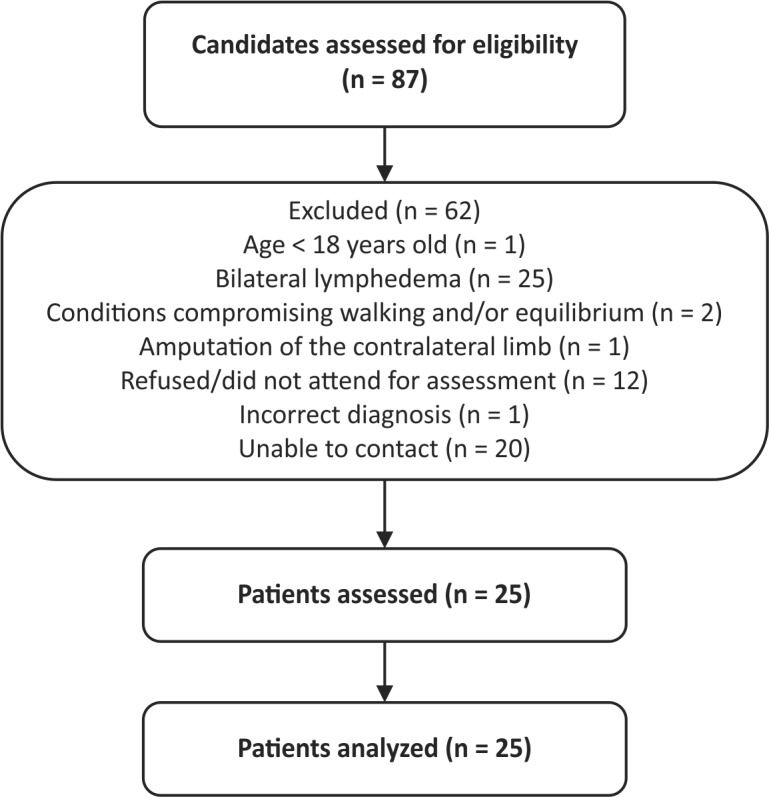
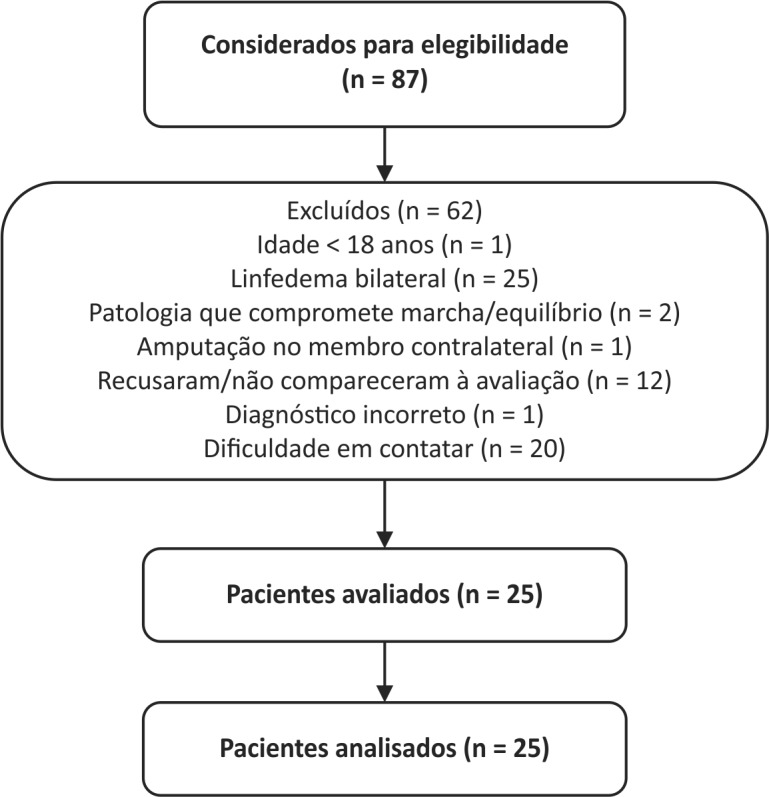
This was a descriptive study investigating 25 patients of both sexes with unilateral lymphedema in a lower limb. Limb volume was assessed using circumferential tape measurements, the Medical Outcomes Study Short Form-36 Health Survey (SF-36) was used to assess quality of life, the Lymphoedema Functioning, Disability and Health Questionnaire for Lower Limb Lymphoedema (Lymph-ICF-LL) was used to assess physical, mental, and social skills related to lymphedema, and the Timed Up and Go (TUG) test was used for functional assessment.
Lymphedema was present throughout the affected lower limb of participants. The domains most affected by lymphedema were physical aspects (25.0 ± 31.4) and emotional aspects (36.0 ± 42.9) from the SF-36 and the mobility domain (6.0 ± 2.6) from the Lymph -ICF-LL. Patients performed the TUG in 9.88 ± 1.98 seconds. The TUG was correlated with the questionnaires and the questionnaires were correlated with each other.
People with unilateral lower limb lymphedema exhibited negative impacts on quality of life and functionality, as evaluated by questionnaires, which were correlated with each other. TUG performance was within normal limits, but results correlated with the questionnaires used.
下肢淋巴水肿是一种由淋巴系统受损引起的慢性疾病,会影响人们的行动能力、功能和生活质量。问卷调查和体格检查是非常实用、易于实施且成本低廉的方法,可为评估这些患者提供重要数据。
通过关联3种评估工具,评估单侧下肢淋巴水肿对功能和生活质量的影响。
这是一项描述性研究,调查了25例单侧下肢淋巴水肿的患者,男女不限。使用卷尺测量肢体体积,采用医学结局研究简明健康调查(SF-36)评估生活质量,采用下肢淋巴水肿功能、残疾和健康问卷(Lymph-ICF-LL)评估与淋巴水肿相关的身体、心理和社交技能,采用计时起立行走测试(TUG)进行功能评估。
参与者受影响的整个下肢均存在淋巴水肿。受淋巴水肿影响最大的领域是SF-36中的身体方面(25.0±31.4)和情感方面(36.0±42.9),以及Lymph-ICF-LL中的活动领域(6.0±2.6)。患者完成TUG测试的时间为9.88±1.98秒。TUG测试结果与问卷调查结果相关,且问卷调查结果之间也相互相关。
通过问卷调查评估,单侧下肢淋巴水肿患者的生活质量和功能受到负面影响,且这些问卷结果相互关联。TUG测试表现处于正常范围内,但结果与所使用的问卷调查相关。