Africa Health Research Institute, Durban, South Africa.
Institute for Global Health, University College London, London, United Kingdom.
BMC Public Health. 2019 Jul 19;19(1):969. doi: 10.1186/s12889-019-7277-0.
To realize the full benefits of treatment as prevention in many hyperendemic African contexts, there is an urgent need to increase uptake of HIV testing and HIV treatment among men to reduce the rate of HIV transmission to (particularly young) women. This trial aims to evaluate the effect of two interventions - micro-incentives and a tablet-based male-targeted HIV decision support application - on increasing home-based HIV testing and linkage to HIV care among men with the ultimate aim of reducing HIV-related mortality in men and HIV incidence in young women.
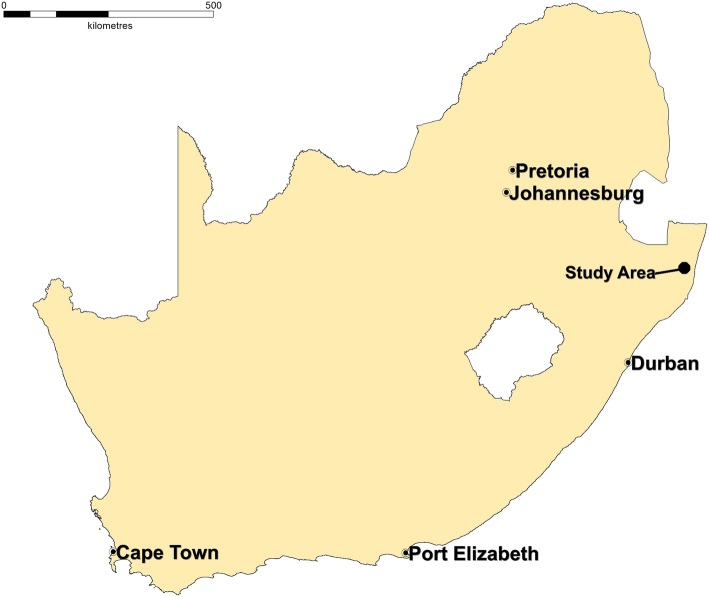
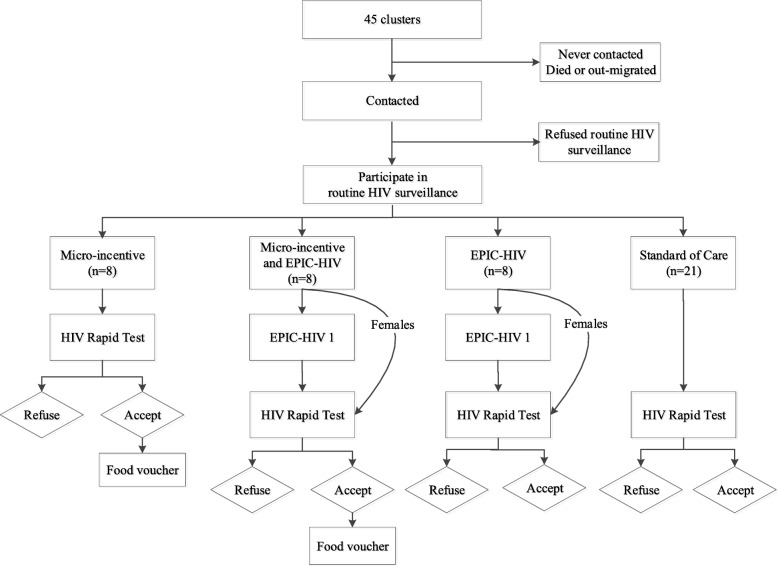
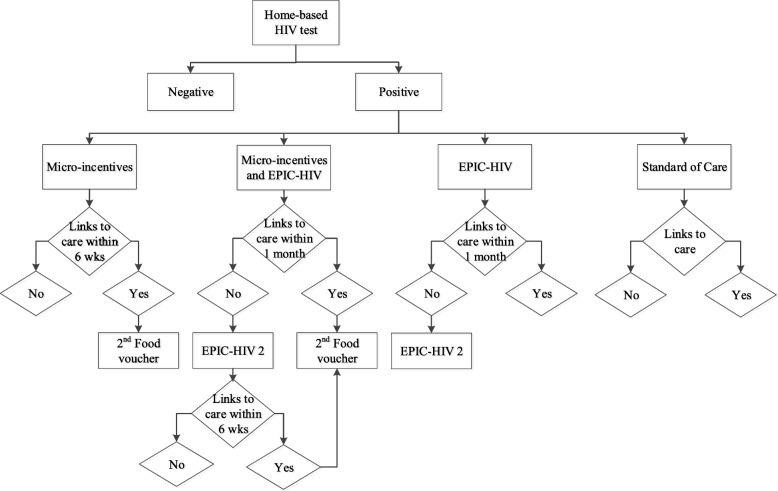
METHODS/DESIGN: This is a cluster randomized trial of 45 communities (clusters) in a rural area in the uMkhanyakude district of KwaZulu Natal, South Africa (2018-2021). The study is built upon the Africa Health Research Institute (AHRI)'s HIV testing platform, which offers annual home-based rapid HIV testing to individuals aged 15 years and above. In a 2 × 2 factorial design, individuals aged ≥15 years living in the 45 clusters are randomly assigned to one of four arms: i) a financial micro-incentive (food voucher) (n = 8); ii) male-targeted HIV specific decision support (EPIC-HIV) (n = 8); iii) both the micro incentives and male-targeted decision support (n = 8); and iv) standard of care (n = 21). The EPIC-HIV application is developed and delivered via a tablet to encourage HIV testing and linkage to care among men. A mixed method approach is adopted to supplement the randomized control trial and meet the study aims.
The findings of this trial will provide evidence on the feasibility and causal impact of two interventions - micro-incentives and a male-targeted HIV specific decision support - on uptake of home-based HIV testing, linkage to care, as well as population health outcomes including population viral load, HIV related mortality in men, and HIV incidence in young women (15-30 years of age).
This trial was registered on 28 November 2018 on, identifier https://clinicaltrials.gov/ .
为了在许多艾滋病毒高度流行的非洲环境中实现治疗即预防的全部效益,迫切需要增加艾滋病毒检测和艾滋病毒治疗的采用率,以降低艾滋病毒传播给(特别是年轻)妇女的速度。这项试验旨在评估两种干预措施——微激励和基于平板电脑的男性艾滋病毒决策支持应用程序——对增加男性家庭艾滋病毒检测和艾滋病毒护理联系的效果,最终目的是降低男性艾滋病毒相关死亡率和年轻女性的艾滋病毒发病率。
方法/设计:这是在南非夸祖鲁-纳塔尔省乌姆坎亚库德区的一个农村地区的 45 个社区(集群)进行的一项集群随机试验(2018-2021 年)。该研究建立在非洲健康研究所(AHRI)的艾滋病毒检测平台之上,该平台为年龄在 15 岁及以上的个人提供年度家庭快速艾滋病毒检测。采用 2×2 析因设计,居住在 45 个集群中的年龄≥15 岁的个人被随机分配到以下四个组之一:i)财务微激励(食品券)(n=8);ii)针对男性的艾滋病毒特定决策支持(EPIC-HIV)(n=8);iii)微激励和男性特定决策支持(n=8);和 iv)标准护理(n=21)。EPIC-HIV 应用程序是通过平板电脑开发和提供的,以鼓励男性进行艾滋病毒检测和与护理机构联系。采用混合方法来补充随机对照试验并实现研究目标。
这项试验的结果将提供关于两种干预措施——微激励和男性特定的艾滋病毒决策支持——对家庭艾滋病毒检测、护理联系以及包括人群病毒载量、男性艾滋病毒相关死亡率和年轻女性(15-30 岁)艾滋病毒发病率在内的人口健康结果的可行性和因果影响的证据。
这项试验于 2018 年 11 月 28 日在 注册,标识符为 https://clinicaltrials.gov/ 。