Department of Microbiology and Biotechnology, University of Hamburg, Hamburg, Germany.
Department of Microbiology and Biotechnology, University of Hamburg, Hamburg, Germany
Appl Environ Microbiol. 2019 Sep 17;85(19). doi: 10.1128/AEM.01095-19. Print 2019 Oct 1.
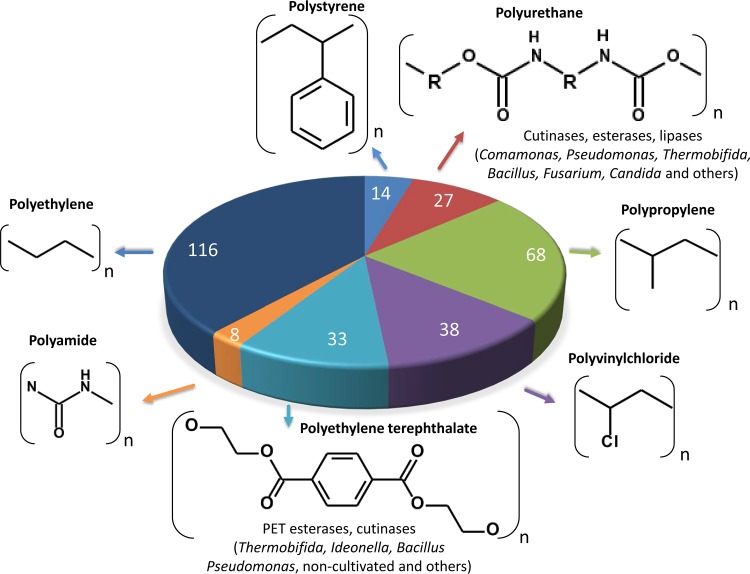
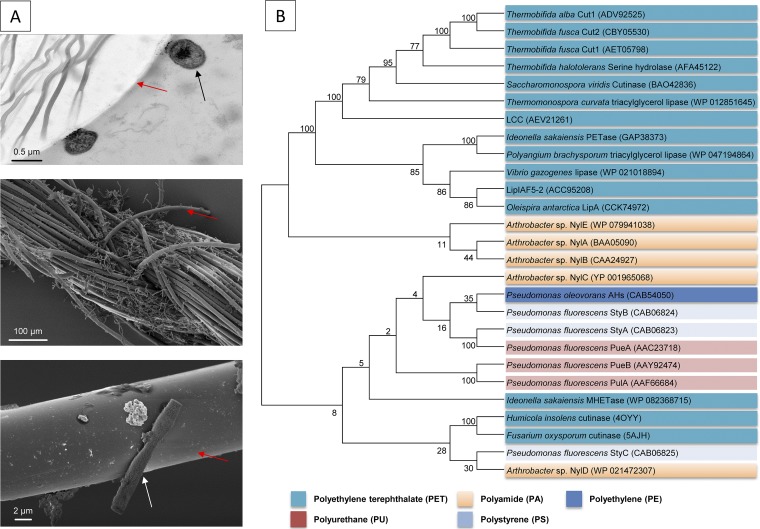
Plastics are widely used in the global economy, and each year, at least 350 to 400 million tons are being produced. Due to poor recycling and low circular use, millions of tons accumulate annually in terrestrial or marine environments. Today it has become clear that plastic causes adverse effects in all ecosystems and that microplastics are of particular concern to our health. Therefore, recent microbial research has addressed the question of if and to what extent microorganisms can degrade plastics in the environment. This review summarizes current knowledge on microbial plastic degradation. Enzymes available act mainly on the high-molecular-weight polymers of polyethylene terephthalate (PET) and ester-based polyurethane (PUR). Unfortunately, the best PUR- and PET-active enzymes and microorganisms known still have moderate turnover rates. While many reports describing microbial communities degrading chemical additives have been published, no enzymes acting on the high-molecular-weight polymers polystyrene, polyamide, polyvinylchloride, polypropylene, ether-based polyurethane, and polyethylene are known. Together, these polymers comprise more than 80% of annual plastic production. Thus, further research is needed to significantly increase the diversity of enzymes and microorganisms acting on these polymers. This can be achieved by tapping into the global metagenomes of noncultivated microorganisms and dark matter proteins. Only then can novel biocatalysts and organisms be delivered that allow rapid degradation, recycling, or value-added use of the vast majority of most human-made polymers.
塑料在全球经济中被广泛应用,每年至少有 3.5 亿至 4 亿吨被生产出来。由于回收利用不佳和循环利用率低,每年有数百万吨塑料在陆地或海洋环境中堆积。如今,人们已经清楚地认识到塑料会对所有生态系统造成不良影响,而微塑料尤其对我们的健康构成威胁。因此,最近的微生物研究已经开始探讨微生物是否以及在何种程度上可以在环境中降解塑料。本综述总结了当前关于微生物塑料降解的知识。可用的酶主要作用于高分子量的聚对苯二甲酸乙二醇酯 (PET) 和酯基聚氨酯 (PUR)。不幸的是,目前已知的最有效的 PUR 和 PET 活性酶和微生物的周转率仍然较低。虽然已经有很多描述降解化学添加剂的微生物群落的报道,但还没有已知的能够作用于高分子量聚合物聚苯乙烯、聚酰胺、聚氯乙烯、聚丙烯、醚基聚氨酯和聚乙烯的酶。这些聚合物加起来占每年塑料产量的 80%以上。因此,需要进一步研究以显著增加作用于这些聚合物的酶和微生物的多样性。这可以通过利用未培养微生物和暗物质蛋白质的全球宏基因组来实现。只有这样,才能提供新型的生物催化剂和生物体,实现对大多数人造聚合物的快速降解、回收或增值利用。