Bergmans Rachel S
University of Michigan Medical School, Department of Psychiatry, Ann Arbor, MI 48109, United States of America.
Prev Med. 2019 Sep;126:105784. doi: 10.1016/j.ypmed.2019.105784. Epub 2019 Jul 17.
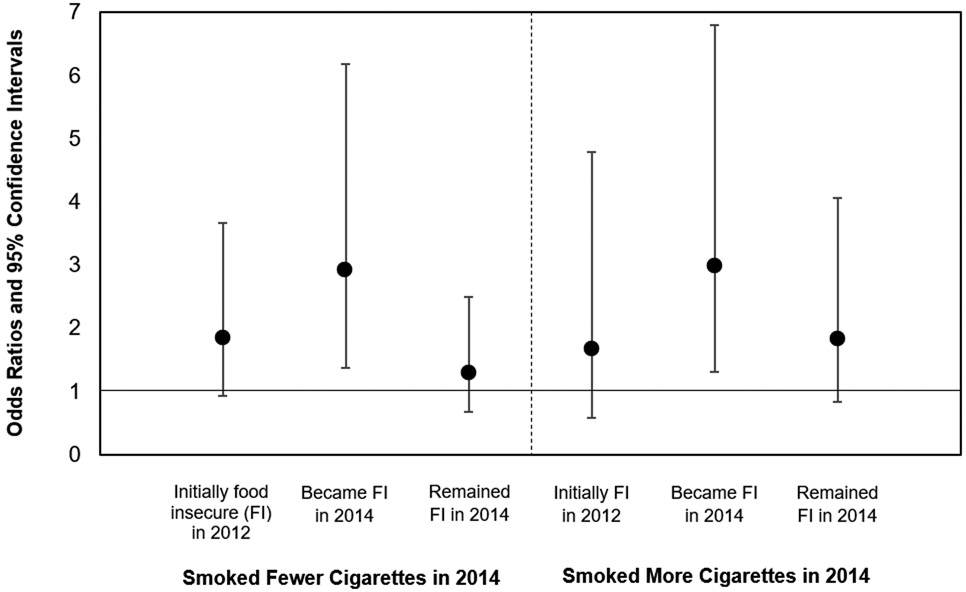
Cross-sectional data reveal that smoking cigarettes is highly prevalent among those who are food insecure. However, there is limited and conflicting evidence concerning whether causal factors may influence associations of food insecurity with smoking behavior. Additionally, temporality is a core feature of food insecurity that should be considered when examining linkages between food insecurity and health behaviors like smoking cessation. In 2019, data were extracted from waves 2012 and 2014 of the Health and Retirement Study-a representative sample of U.S. adults ≥50. Analyses were limited to those who smoked cigarettes in 2012 (n = 2197). Food insecurity was assessed in 2012 and 2014 to indicate food insecurity transitions: (1) initially food insecure (food insecure in 2012 only); (2) became food insecure (food insecure in 2014 only); (3) remained food insecure (food insecure in 2012 and 2014), and; (4) not food insecure (reference group). Multivariable logistic regression examined odds of smoking cessation in 2014 due to food insecurity transition. Becoming food insecure was associated with a 2.0 (95% confidence interval = 1.1-3.4) higher odds of smoking cessation. Employment loss or retirement (p < 0.020) and diagnosis of a new chronic condition (p = 0.026) were also associated with higher odds of smoking cessation. In older U.S. adults, smoking cessation was associated with decreased spending power and new health problems. Future studies should examine whether findings of this study may be similar among younger adults and; whether those who quit smoking due to food insecurity are more susceptible to relapse than those who quit due to other factors.
横断面数据显示,在粮食不安全人群中吸烟非常普遍。然而,关于因果因素是否可能影响粮食不安全与吸烟行为之间的关联,证据有限且相互矛盾。此外,时间顺序是粮食不安全的一个核心特征,在研究粮食不安全与戒烟等健康行为之间的联系时应予以考虑。2019年,数据取自《健康与退休研究》2012年和2014年的调查——这是美国50岁及以上成年人的代表性样本。分析仅限于2012年吸烟的人群(n = 2197)。在2012年和2014年评估粮食不安全情况,以表明粮食不安全状况的转变:(1)最初粮食不安全(仅在2012年粮食不安全);(2)变得粮食不安全(仅在2014年粮食不安全);(3)仍然粮食不安全(2012年和2014年粮食不安全),以及;(4)非粮食不安全(参照组)。多变量逻辑回归分析了2014年因粮食不安全状况转变而戒烟的几率。变得粮食不安全与戒烟几率高出2.0(95%置信区间 = 1.1 - 3.4)相关。失业或退休(p < 0.020)以及新慢性病的诊断(p = 0.026)也与戒烟几率较高相关。在美国老年成年人中,戒烟与消费能力下降和新的健康问题有关。未来的研究应探讨本研究结果在年轻成年人中是否可能相似;以及因粮食不安全而戒烟的人是否比因其他因素戒烟的人更容易复发。