Department of Emergency Medicine, University of Pittsburgh, Pittsburgh, PA, USA.
Department of Critical Care Medicine, University of Pittsburgh, Pittsburgh, PA, USA.
Resuscitation. 2019 Sep;142:82-90. doi: 10.1016/j.resuscitation.2019.07.007. Epub 2019 Jul 17.
We tested the impact of antiepileptic drug (AED) administration on post-cardiac arrest epileptiform electroencephalographic (EEG) activity.
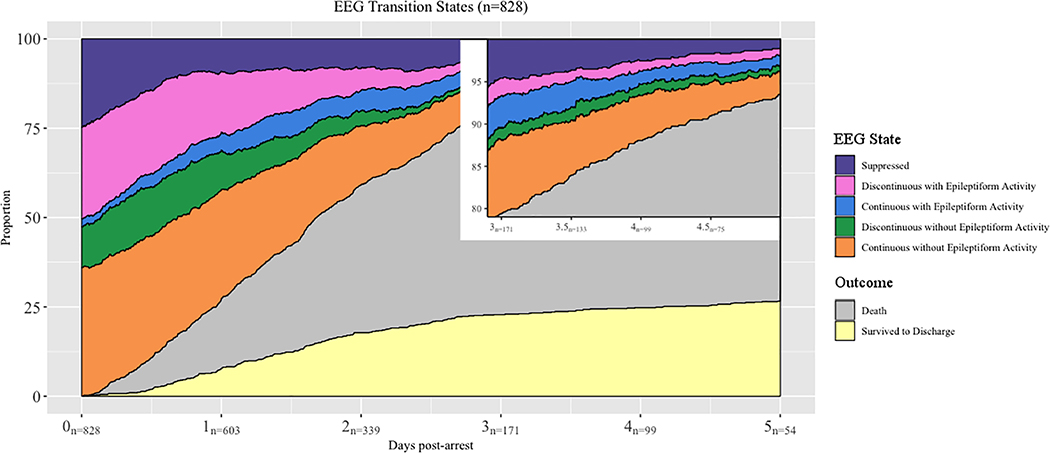
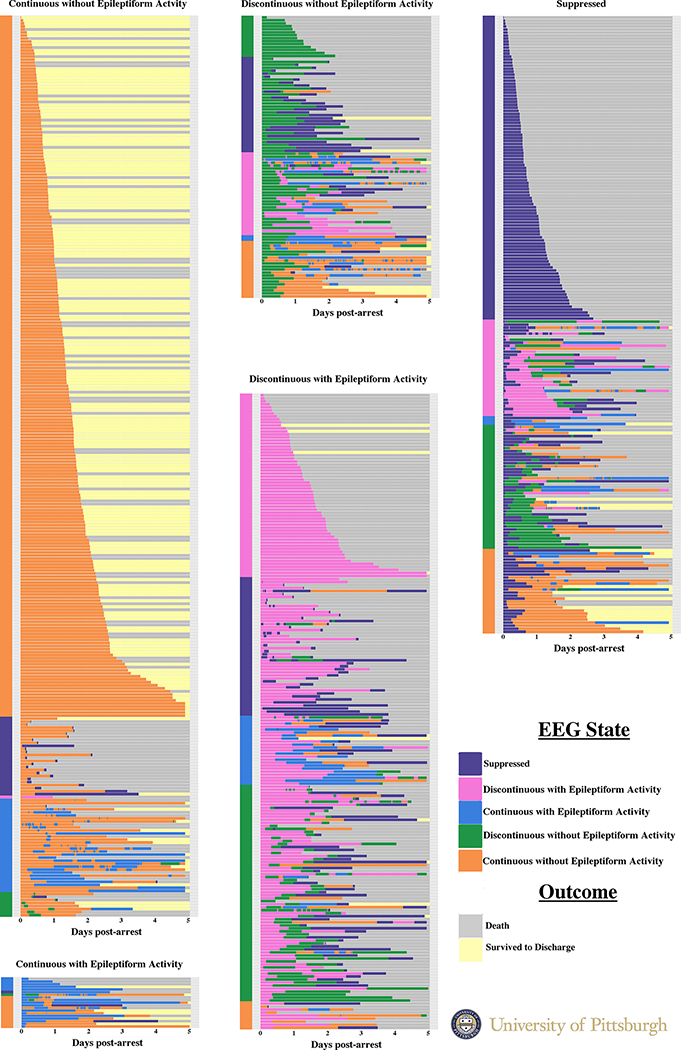
We studied an observational cohort of comatose subjects treated at a single academic medical center after cardiac arrest from September 2010 to January 2018. We aggregated the observed EEG patterns into 5 categories: suppressed; discontinuous background with superimposed epileptiform activity; discontinuous background without epileptiform features; continuous background with epileptiform activity; and continuous background without epileptiform activity. We calculated overall probabilities of transitions between EEG states in a multistate model, then used Aalen's additive regression to test if AEDs or hypothermia are associated with a change in these probabilities.
Overall, 828 subjects had EEG-monitoring for 42,840 h with a median of 40 [IQR 23-64] h per subject. Among patients with epileptiform findings on initial monitoring, 50% transitioned at least once to a non-epileptiform, non-suppressed state. By contrast, 19% with non-epileptiform initial activity transitioned to an epileptiform state at least once. Overall, 568 (78%) patients received at least one AED. Among patients with continuous EEG background activity, valproate, levetiracetam and lower body temperature were each associated with an increased probability of transition from epileptiform states to non-epileptiform states, where patients with discontinuous EEG background activity no agent linked to an increased probability of transitioning from epileptiform states.
After cardiac arrest, the impact of AEDs may depend on the presence of continuous cortical background activity. These data serve to inform experimental work to better define the opportunities to improve neurologic care post-cardiac arrest.
我们测试了抗癫痫药物(AED)给药对心脏骤停后癫痫样脑电图(EEG)活动的影响。
我们研究了一个观察性队列,该队列由 2010 年 9 月至 2018 年 1 月在一家学术医疗中心接受治疗的昏迷心脏骤停患者组成。我们将观察到的 EEG 模式分为 5 类:抑制;背景不连续,伴有癫痫样活动;背景不连续,无癫痫样特征;背景连续,伴有癫痫样活动;背景连续,无癫痫样活动。我们在多状态模型中计算 EEG 状态之间的总体转移概率,然后使用 Aalen 的加法回归来检验 AED 或低温是否与这些概率的变化相关。
总体而言,828 例患者进行了 42840 小时的 EEG 监测,中位数为每个患者 40 [IQR 23-64] 小时。在初始监测中存在癫痫样发现的患者中,有 50%至少有一次向非癫痫样、非抑制状态转变。相比之下,初始活动无癫痫样的患者中有 19%至少有一次转变为癫痫样状态。总体而言,568 例(78%)患者至少接受了一种 AED 治疗。在具有连续 EEG 背景活动的患者中,丙戊酸、左乙拉西坦和较低的体温均与从癫痫样状态向非癫痫样状态转变的概率增加相关,而在具有不连续 EEG 背景活动的患者中,没有一种药物与从癫痫样状态转变的概率增加相关。
心脏骤停后,AED 的影响可能取决于皮质背景活动的连续性。这些数据有助于为改善心脏骤停后神经护理的实验工作提供信息。