Department of Neurology, Chung-Ang University Hospital, Chung-Ang University College of Medicine, Seoul, Korea.
Center for Food and Bioconvergence, College of Agriculture and Life Sciences, Seoul National University, Seoul, Korea.
J Korean Med Sci. 2019 Jul 22;34(28):e197. doi: 10.3346/jkms.2019.34.e197.
Multiple sclerosis (MS) is an immune-associated inflammatory disorder of the central nervous system and results in serious disability. Although many disease-modifying therapy drugs have been developed, these drugs have shown limited clinical efficacy and some adverse effects in previous studies, therefore, there has been reasonable need for less harmful and cost-effective therapeutics. Herein, we tested the anti-inflammatory effect of sulforaphane (SFN) in a mouse model of experimental autoimmune encephalomyelitis (EAE).
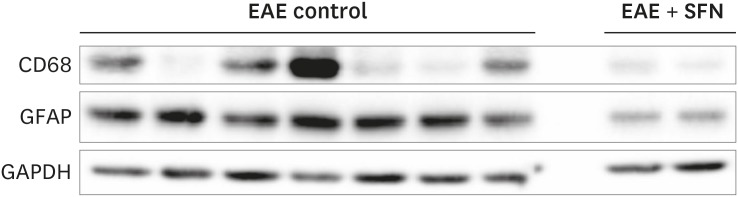
The EAE mice were randomly assigned into two experimental groups: the phosphate-buffered saline (PBS)-treated EAE group and SFN-treated EAE group. After EAE mice induction by auto-immunization against the myelin oligodendrocyte glycoprotein peptide, we evaluated EAE symptom scores and biochemical analyses such as infiltration of inflammatory cells and demyelination of the spinal cord. Furthermore, western blotting was performed using the spinal cords of EAE mice.
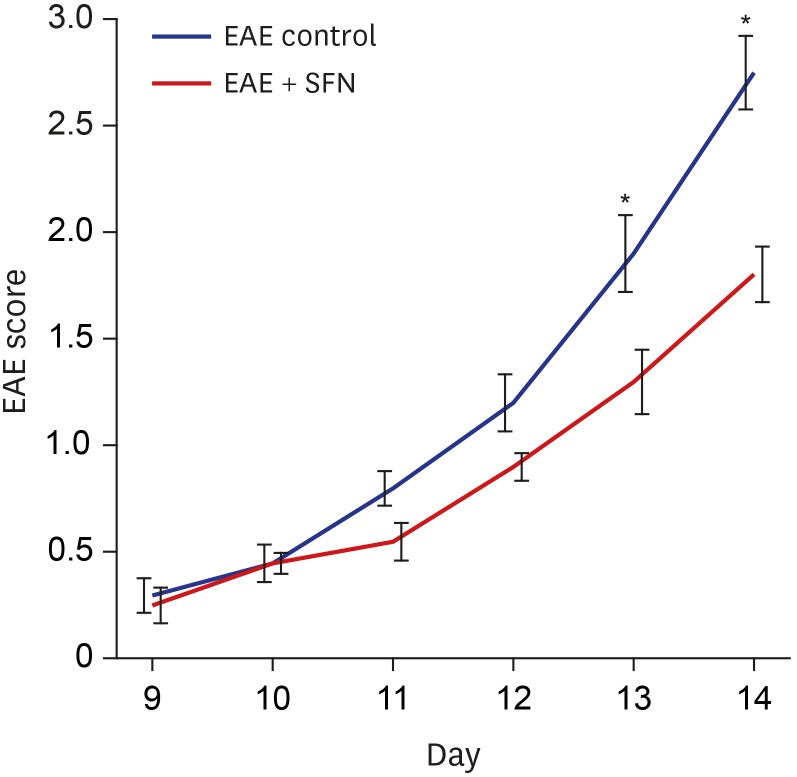
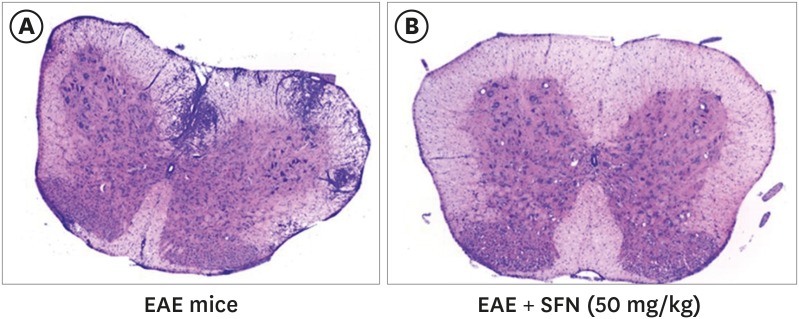
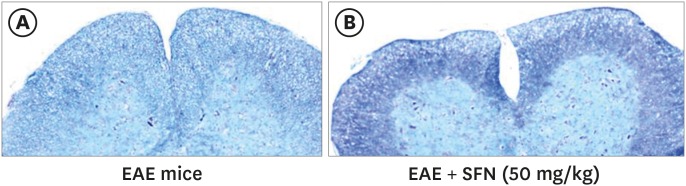
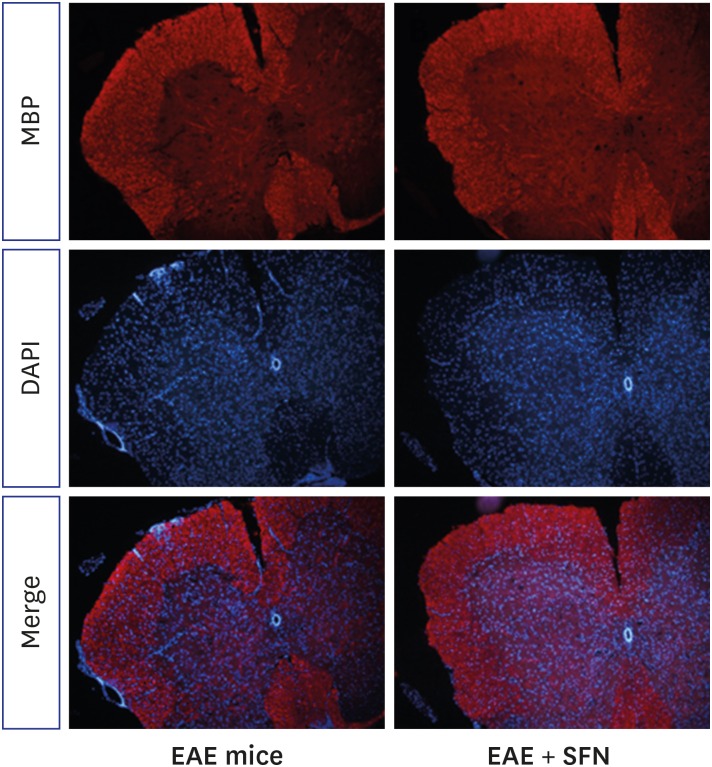
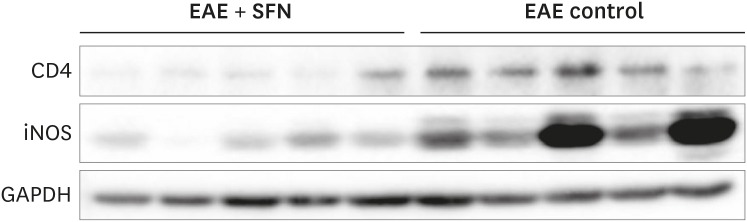
In the behavioral study, the SFN-treated EAE mice showed favorable clinical scores compared with PBS-treated EAE mice at the 13th day (1.30 ± 0.15 vs. 1.90 ± 0.18; = 0.043) and 14th day (1.80 ± 0.13 vs. 2.75 ± 0.17; = 0.003). Additionally, the biochemical studies revealed that SFN treatment inhibited the inflammatory infiltration, demyelinating injury of the spinal cords, and the up-regulation of inducible nitric oxide synthase in the EAE mice.
The SFN treatment showed anti-inflammatory and anti-oxidative effects in the EAE mice. Conclusively, this study suggests that SFN has neuroprotective effects via anti-inflammatory processing, so it could be a new therapeutic or nutritional supplement for MS.
多发性硬化症(MS)是一种中枢神经系统免疫相关炎症性疾病,可导致严重残疾。尽管已经开发出许多疾病修饰治疗药物,但在之前的研究中,这些药物的临床疗效有限,且存在一些不良反应,因此,人们合理地需要更安全且具有成本效益的治疗方法。在此,我们在实验性自身免疫性脑脊髓炎(EAE)小鼠模型中测试了萝卜硫素(SFN)的抗炎作用。
EAE 小鼠随机分为两组:磷酸盐缓冲液(PBS)处理的 EAE 组和 SFN 处理的 EAE 组。在通过自身免疫针对髓鞘少突胶质细胞糖蛋白肽诱导 EAE 小鼠后,我们评估了 EAE 症状评分和生化分析,例如炎症细胞浸润和脊髓脱髓鞘。此外,使用 EAE 小鼠的脊髓进行了 Western 印迹分析。
在行为研究中,与 PBS 处理的 EAE 小鼠相比,SFN 处理的 EAE 小鼠在第 13 天(1.30 ± 0.15 与 1.90 ± 0.18; = 0.043)和第 14 天(1.80 ± 0.13 与 2.75 ± 0.17; = 0.003)的临床评分更好。此外,生化研究表明,SFN 治疗抑制了 EAE 小鼠的炎症浸润、脊髓脱髓鞘损伤以及诱导型一氧化氮合酶的上调。
SFN 治疗在 EAE 小鼠中表现出抗炎和抗氧化作用。综上所述,这项研究表明 SFN 通过抗炎处理具有神经保护作用,因此它可能成为 MS 的一种新的治疗或营养补充剂。