Department of Paediatrics and Child Health, Aga Khan University, Karachi, Pakistan.
Department of Pediatrics, Division of Gastroenterology, Hepatology, & Nutrition, University of Virginia, Charlottesville, United States of America.
PLoS Negl Trop Dis. 2018 Feb 7;12(2):e0006224. doi: 10.1371/journal.pntd.0006224. eCollection 2018 Feb.
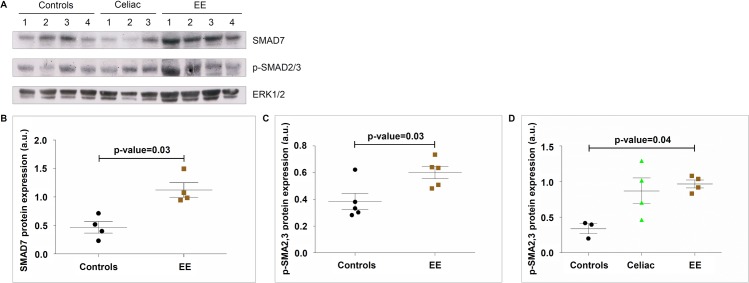
Enteropathies such as Crohn's disease are associated with enteric inflammation characterized by impaired TGF-β signaling, decreased expression of phosphorylated (p)-SMAD2,3 and increased expression of SMAD7 (an inhibitor of SMAD3 phosphorylation). Environmental enteropathy (EE) is an acquired inflammatory disease of the small intestine (SI), which is associated with linear growth disruption, cognitive deficits, and reduced oral vaccine responsiveness in children <5 y in resource-poor countries. We aimed to characterize EE inflammatory pathways by determining SMAD7 and p-SMAD2,3 levels (using Western blotting) in EE duodenal biopsies (N = 19 children, 7 from Pakistan, 12 from Zambia) and comparing these with healthy controls (Ctl) and celiac disease (CD) patients from Italy. Densitometric analysis of immunoblots showed that EE SI biopsies expressed higher levels of both SMAD7 (mean±SD in arbitrary units [a.u.], Ctl = 0.47±0.20 a.u., EE = 1.13±0.25 a.u., p-value = 0.03) and p-SMAD2,3 (mean±SD, Ctl = 0.38±0.14 a.u., EE = 0.60±0.10 a.u., p-value = 0.03). Immunohistochemistry showed that, in EE, SMAD7 is expressed in both the epithelium and in mononuclear cells of the lamina propria (LP). In contrast, p-SMAD3 in EE is expressed much more prominently in epithelial cells than in the LP. The high SMAD7 immunoreactivity and lack of p-SMAD3 expression in the LP suggests defective TGF-β signaling in the LP in EE similar to a previously reported SMAD7-mediated inflammatory pathway in refractory CD and Crohn's disease. However, Western blot densitometry showed elevated p-SMAD2,3 levels in EE, possibly suggesting a different inflammatory pathway than Crohn's disease but more likely reflecting cumulative protein expression from across all compartments of the mucosa as opposed to the LP alone. Further studies are needed to substantiate these preliminary results and to illustrate the relationship between SMAD proteins, TGF-β signaling, and inflammatory cytokine production, all of which may be potential therapeutic targets.
肠病,如克罗恩病,与肠内炎症有关,其特征是 TGF-β信号受损、磷酸化 SMAD2、3 的表达减少以及 SMAD7(SMAD3 磷酸化的抑制剂)的表达增加。环境相关性肠病(EE)是一种发生于小肠(SI)的获得性炎症性疾病,与发展中国家<5 岁儿童的线性生长障碍、认知缺陷和口服疫苗反应性降低有关。我们旨在通过测定 EE 十二指肠活检中的 SMAD7 和 p-SMAD2、3 水平(使用 Western blot)来描述 EE 的炎症途径(N=19 名儿童,7 名来自巴基斯坦,12 名来自赞比亚),并将这些结果与来自意大利的健康对照组(Ctl)和乳糜泻(CD)患者进行比较。免疫印迹的密度分析显示,EE SI 活检表达了更高水平的 SMAD7(以任意单位[a.u.]表示的均值±标准差,Ctl=0.47±0.20 a.u.,EE=1.13±0.25 a.u.,p 值=0.03)和 p-SMAD2、3(均值±标准差,Ctl=0.38±0.14 a.u.,EE=0.60±0.10 a.u.,p 值=0.03)。免疫组织化学显示,在 EE 中,SMAD7 在肠上皮细胞和固有层的单核细胞中均有表达。相比之下,EE 中的 p-SMAD3 在肠上皮细胞中的表达比固有层中更为明显。EE 中 SMAD7 的高免疫反应性和固有层中 p-SMAD3 的缺乏表达表明,与之前报道的难治性 CD 和克罗恩病中的 SMAD7 介导的炎症途径相似,EE 中的 TGF-β 信号在固有层中存在缺陷。然而,Western blot 密度分析显示 EE 中 p-SMAD2、3 水平升高,这可能表明与克罗恩病不同的炎症途径,但更可能反映了黏膜所有层的累积蛋白表达,而不仅仅是固有层。需要进一步的研究来证实这些初步结果,并说明 SMAD 蛋白、TGF-β 信号和炎症细胞因子产生之间的关系,所有这些都可能是潜在的治疗靶点。