Tang Li-Juan, Sun Guo-Kang, Zhang Ting-Juan, Wu De-Hong, Zhou Jing-Dong, Ma Bei-Bei, Xu Zi-Jun, Wen Xiang-Mei, Chen Qin, Yao Dong-Ming, Qian Jun, Ma Ji-Chun, Lin Jiang
1Laboratory Center, Affiliated People's Hospital of Jiangsu University, 8 Dianli Rd., Zhenjiang, 212002 People's Republic of China.
The Key Lab of Precision Diagnosis and Treatment of Zhenjiang City, Zhenjiang, Jiangsu People's Republic of China.
Cancer Cell Int. 2019 Jul 10;19:177. doi: 10.1186/s12935-019-0894-y. eCollection 2019.
MicroRNA-29c (miR-29c) is abnormally expressed in several cancers and serves as an important predictor of tumor prognosis. Herein, we investigate the effects of abnormal miR-29c expression and analyze its clinical significance in acute myeloid leukemia (AML) patients. In addition, decitabine (DAC) has made great progress in the treatment of AML in recent years, but DAC resistance is still common phenomenon and the mechanism of resistance is still unclear. We further analyze the influences of miR-29c to leukemic cells treated with DAC.
Real-time quantitative PCR (RQ-PCR) was carried out to detect miR-29c transcript level in 102 de novo AML patients and 25 normal controls. miR-29c/shRNA-29c were respectively transfected into K562 cells and HEL cells. Cell viability after transfection was detected by cell counting Kit-8 assays. Flow cytometry was used to detect apoptosis.
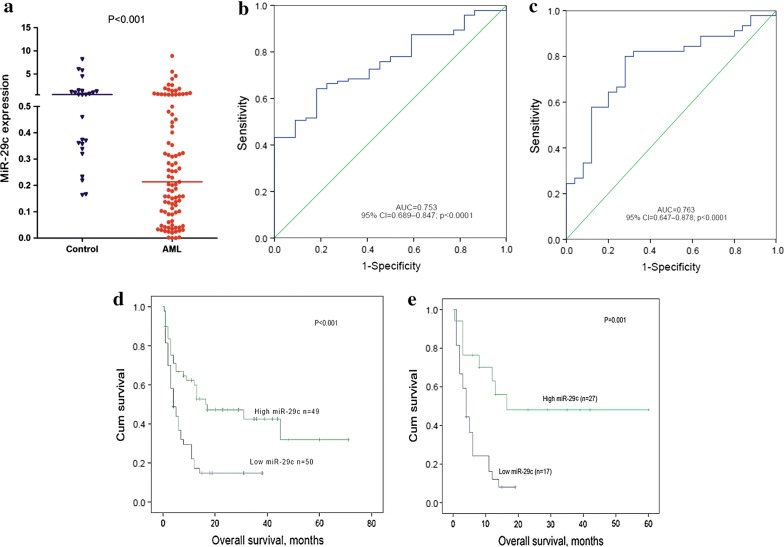
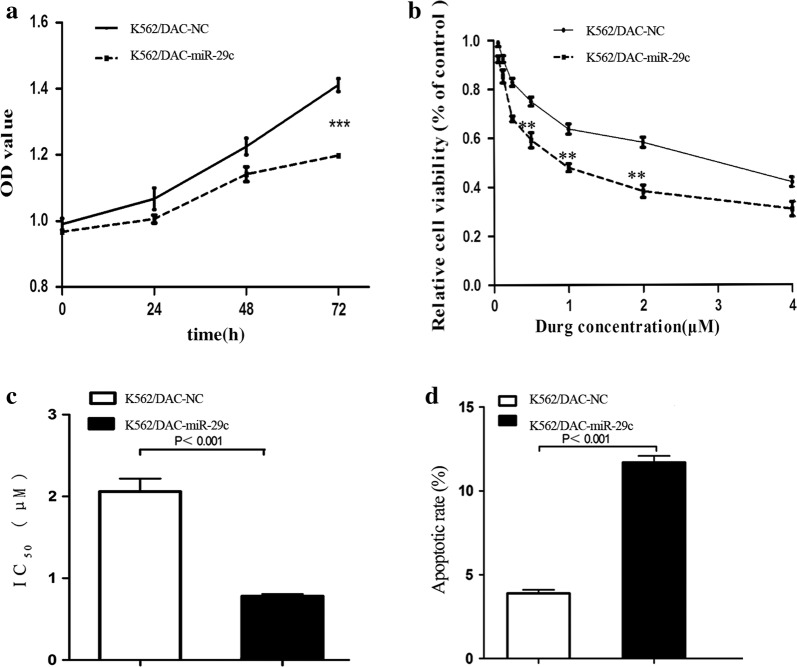
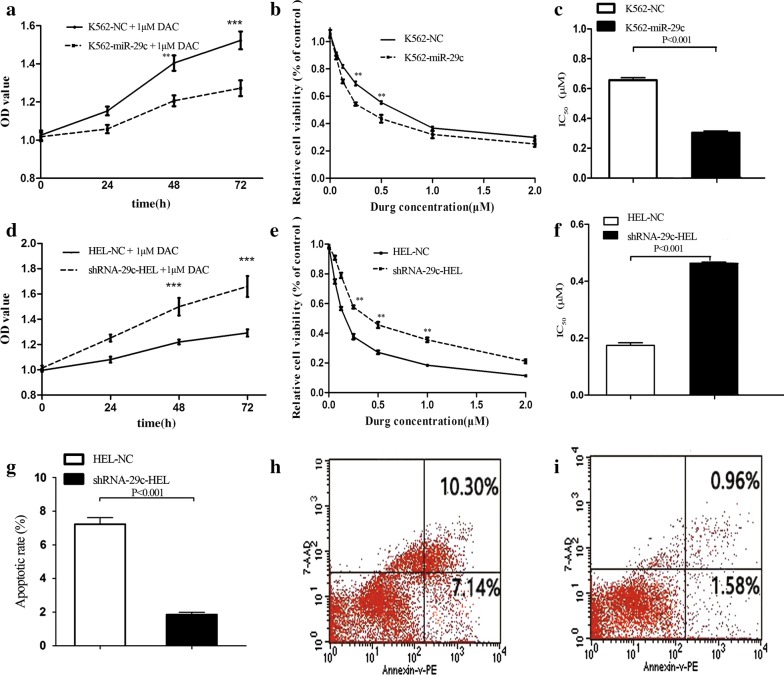
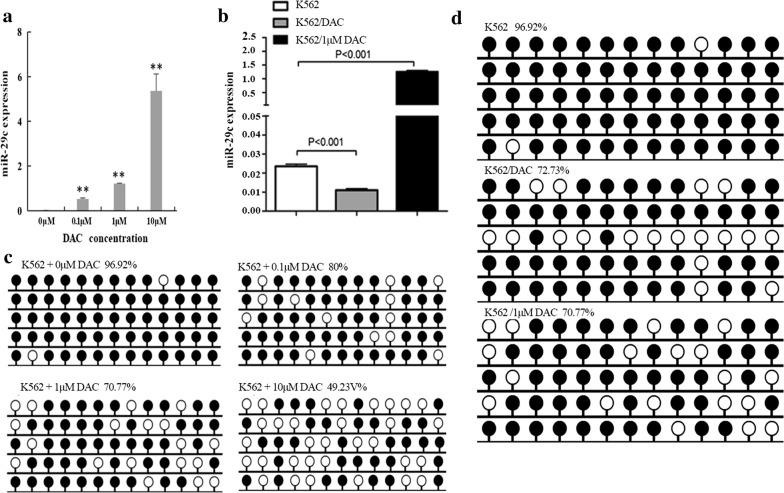
MiR-29c was significantly down-regulated in AML (< 0.001). Low miR-29c expression was frequently observed in patients with poor karyotype and high risk (= 0.006 and 0.013, respectively). Patients with low miR-29c expression had a markedly shorter overall survival (OS) than those with high miR-29c expression (< 0.001). Multivariate analysis confirmed the independent prognostic value of low miR-29c expression in both the whole cohort as well as the cytogenetically normal AML (CN-AML) subset. Over-expression of miR-29c in K562 treated with DAC inhibited growth, while silencing of miR-29c in HEL promoted growth and inhibited apoptosis. MiR-29c overexpression decreased the half maximal inhibitory concentration (IC) of DAC in K562, while miR-29c silencing increased the IC of DAC in HEL. The demethylation of the miR-29c promoter was associated with its up-regulated expression. Although miR-29c demethylation was also observed in DAC-resistant K562 (K562/DAC), miR-29c expression was down-regulated. MiR-29c transfection also promoted apoptosis and decreased the IC of DAC in K562/DAC cells.
Our results suggest that miR-29c down-regulation may act as an independent prognostic biomarker in AML patients, and miR-29c over-expression can increase the sensitivity of both non-resistant and resistant of leukemic cells to DAC.
微小RNA-29c(miR-29c)在多种癌症中异常表达,是肿瘤预后的重要预测指标。在此,我们研究miR-29c异常表达的影响,并分析其在急性髓系白血病(AML)患者中的临床意义。此外,近年来地西他滨(DAC)在AML治疗中取得了很大进展,但DAC耐药仍是常见现象,耐药机制尚不清楚。我们进一步分析miR-29c对经DAC处理的白血病细胞的影响。
采用实时定量PCR(RQ-PCR)检测102例初发AML患者和25例正常对照者中miR-29c的转录水平。将miR-29c/shRNA-29c分别转染至K562细胞和HEL细胞。转染后通过细胞计数试剂盒-8法检测细胞活力。采用流式细胞术检测细胞凋亡。
AML患者中miR-29c显著下调(<0.001)。核型差和高危患者中经常观察到低miR-29c表达(分别为=0.006和0.013)。miR-29c表达低的患者总生存期(OS)明显短于miR-29c表达高的患者(<0.001)。多因素分析证实低miR-29c表达在整个队列以及细胞遗传学正常的AML(CN-AML)亚组中均具有独立的预后价值。用DAC处理的K562细胞中miR-29c的过表达抑制生长,而HEL细胞中miR-29c的沉默促进生长并抑制凋亡。miR-29c过表达降低了K562细胞中DAC的半数最大抑制浓度(IC),而miR-29c沉默则增加了HEL细胞中DAC的IC。miR-29c启动子的去甲基化与其表达上调有关。尽管在DAC耐药的K562(K562/DAC)中也观察到miR-29c去甲基化,但miR-29c表达下调。miR-29c转染还促进了K562/DAC细胞的凋亡并降低了DAC的IC。
我们的结果表明,miR-29c下调可能是AML患者的独立预后生物标志物,miR-29c过表达可增加白血病细胞对DAC的非耐药和耐药敏感性。