Zeng Chenming, Zhu Difeng, You Jun, Dong Xiaowu, Yang Bo, Zhu Hong, He Qiaojun
Hangzhou Institute of Innovative Medicine, College of Pharmaceutical Sciences, Zhejiang University, Hangzhou, China.
College of Pharmaceutical Sciences, Center for Drug Safety Evaluation and Research of Zhejiang University, Zhejiang University, Hangzhou, China.
Front Physiol. 2019 Jul 3;10:833. doi: 10.3389/fphys.2019.00833. eCollection 2019.
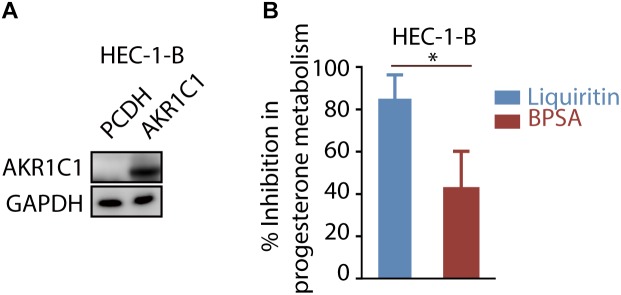
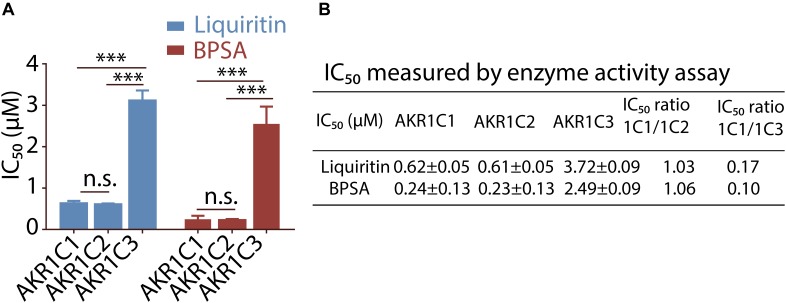
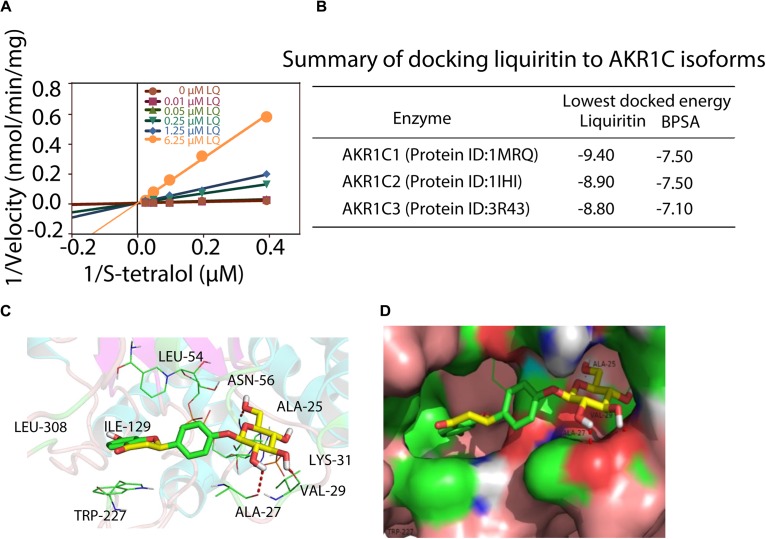
Low progesterone level is always linked with pre-term birth. Therefore, maintaining of progesterone level is vital during pregnancy. Aldo-keto reductase family one member C1 (AKR1C1) catalyzes the reduction of progesterone to its inactive form of 20-alpha-hydroxy-progesterone and thus limits the biological effect of progesterone. In our effort to identify the natural compound that would specifically inhibit AKR1C1, liquiritin was found to be a selective and potent inhibitor of AKR1C1. Kinetic analyses in the S-(+)-1,2,3,4-tetrahydro-1-naphthol (s-tetralol) catalyzed by AKR1C1 in the presence of the inhibitors suggest that liquiritin is a competitive inhibitor by targeting the residues Ala-27, Val-29, Ala-25, and Asn-56 of AKR1C1. In HEC-1-B cells, treatment with liquiritin results in 85.00% of reduction in progesterone metabolism, which is mediated by AKR1C1 enzymatic activity. Overall, our study not only identify liquiritin as an inhibitor against AKR1C1, but also reveal that liquiritin may be served as a potential intervention strategy for preventing pre-term birth caused by low progesterone level.
孕酮水平低总是与早产有关。因此,孕期维持孕酮水平至关重要。醛酮还原酶家族1成员C1(AKR1C1)催化孕酮还原为其无活性形式的20-α-羟基孕酮,从而限制了孕酮的生物学效应。在我们寻找能特异性抑制AKR1C1的天然化合物的过程中,发现甘草苷是AKR1C1的一种选择性强效抑制剂。在抑制剂存在的情况下,对AKR1C1催化的S-(+)-1,2,3,4-四氢-1-萘酚(s-四氢萘酚)进行动力学分析表明,甘草苷通过靶向AKR1C1的Ala-27、Val-29、Ala-25和Asn-56残基而成为竞争性抑制剂。在HEC-1-B细胞中,用甘草苷处理导致孕酮代谢降低85.00%,这是由AKR1C1酶活性介导的。总体而言,我们的研究不仅确定了甘草苷是一种针对AKR1C1的抑制剂,还揭示了甘草苷可能作为一种潜在的干预策略,用于预防因孕酮水平低引起的早产。