Melzer Ayelet, Shafir Tal, Tsachor Rachelle Palnick
Faculty of Social Welfare and Health Sciences, The Graduate School of Creative Arts Therapies, University of Haifa, Haifa, Israel.
The Emili Sagol Creative Arts Therapies Research Center, University of Haifa, Haifa, Israel.
Front Psychol. 2019 Jul 3;10:1389. doi: 10.3389/fpsyg.2019.01389. eCollection 2019.
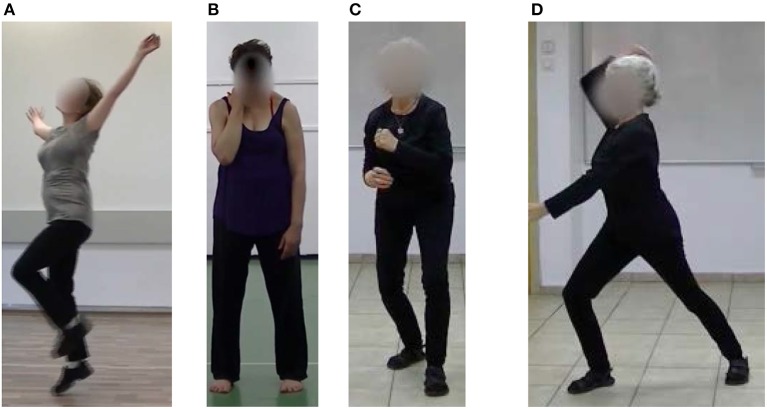
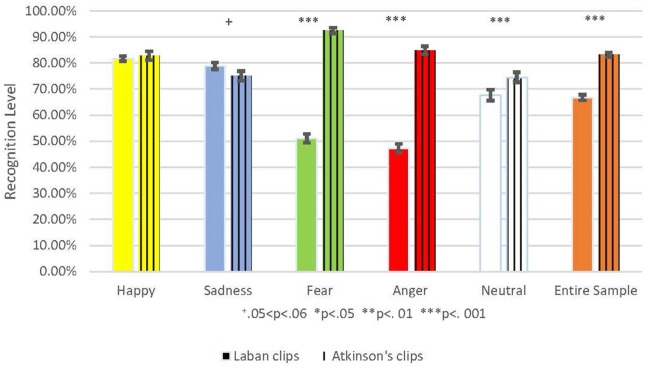
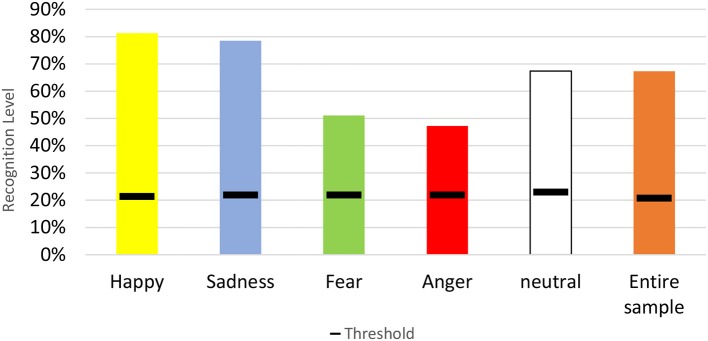
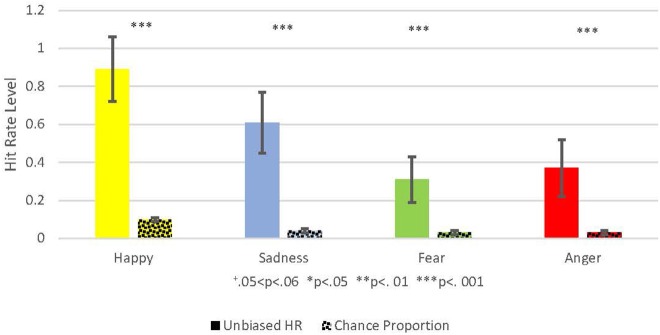
Are there movement features that are recognized as expressing each basic emotion by most people, and what are they? In our previous study we identified sets of Laban movement components that, when moved, elicited the basic emotions of anger, sadness, fear, and happiness. Our current study aimed to investigate if movements composed from those sets would be recognized as expressing those emotions, regardless of any instruction to the mover to portray emotion. Our stimuli included 113 video-clips of five Certified Laban Movement Analysts (CMAs) moving combinations of two to four movement components from each set associated with only one emotion: happiness, sadness, fear, or anger. Each three second clip showed one CMA moving a single combination. The CMAs moved only the combination's required components. Sixty-two physically and mentally healthy men ( = 31) and women ( = 31), ages 19-48, watched the clips and rated the perceived emotion and its intensity. To confirm participants' ability to recognize emotions from movement and to compare our stimuli to existing validated emotional expression stimuli, participants rated 50 additional clips of bodily motor expressions of these same emotions validated by Atkinson et al. (2004). Results showed that for both stimuli types, all emotions were recognized far above chance level. Comparing recognition accuracy of the two clip types revealed better recognition of anger, fear, and neutral emotion from Atkinson's clips of actors expressing emotions, and similar levels of recognition accuracy for happiness and sadness. Further analysis was performed to determine the contribution of specific movement components to the recognition of the studied emotions. Our results indicated that these specific Laban motor components not only enhance feeling the associated emotions when moved, but also contribute to recognition of the associated emotions when being observed, even when the mover was not instructed to portray emotion, indicating that the presence of these movement components alone is sufficient for emotion recognition. This research-based knowledge regarding the relationship between Laban motor components and bodily emotional expressions can be used by dance-movement and drama therapists for better understanding of clients' emotional movements, for creating appropriate interventions, and for enhancing communication with other practitioners regarding bodily emotional expression.
是否存在大多数人都认为能表达每种基本情绪的运动特征?这些特征是什么?在我们之前的研究中,我们确定了几组拉班动作要素,当这些要素被移动时,会引发愤怒、悲伤、恐惧和快乐等基本情绪。我们当前的研究旨在调查由这些要素组合而成的动作是否会被识别为表达了这些情绪,而不考虑对动作执行者有任何描绘情绪的指示。我们的刺激材料包括113个视频片段,由五位认证的拉班动作分析师(CMA)进行演示,他们移动每组中两到四个与单一情绪(快乐、悲伤、恐惧或愤怒)相关的动作要素的组合。每个三秒的片段展示一位CMA移动一个单一的组合。这些CMA只移动组合中所需的要素。62名身心健康的男性(n = 31)和女性(n = 31),年龄在19至48岁之间,观看了这些片段,并对所感知到的情绪及其强度进行评分。为了确认参与者从动作中识别情绪的能力,并将我们的刺激材料与现有的经过验证的情绪表达刺激材料进行比较,参与者对另外50个由阿特金森等人(2004年)验证的相同情绪的身体动作表达视频片段进行了评分。结果表明,对于两种刺激类型,所有情绪的识别准确率都远高于随机水平。比较两种片段类型的识别准确率发现,从阿特金森的演员表达情绪的片段中对愤怒、恐惧和中性情绪的识别更好,而对快乐和悲伤的识别准确率水平相似。进行了进一步分析以确定特定动作要素对所研究情绪识别的贡献。我们的结果表明,这些特定的拉班动作要素不仅在被移动时能增强对相关情绪的感受,而且在被观察时也有助于对相关情绪的识别,即使动作执行者没有被指示去描绘情绪,这表明仅这些动作要素的存在就足以进行情绪识别。舞蹈动作和戏剧治疗师可以利用这些基于研究的关于拉班动作要素与身体情绪表达之间关系的知识,来更好地理解客户的情绪动作,制定适当的干预措施,并加强与其他从业者关于身体情绪表达的沟通。