Sickinghe Ariane A, Korporaal Suzanne J A, den Ruijter Hester M, Kessler Elise L
Laboratory of Experimental Cardiology, University Medical Center Utrecht, Utrecht, Netherlands.
Front Endocrinol (Lausanne). 2019 Jul 3;10:442. doi: 10.3389/fendo.2019.00442. eCollection 2019.
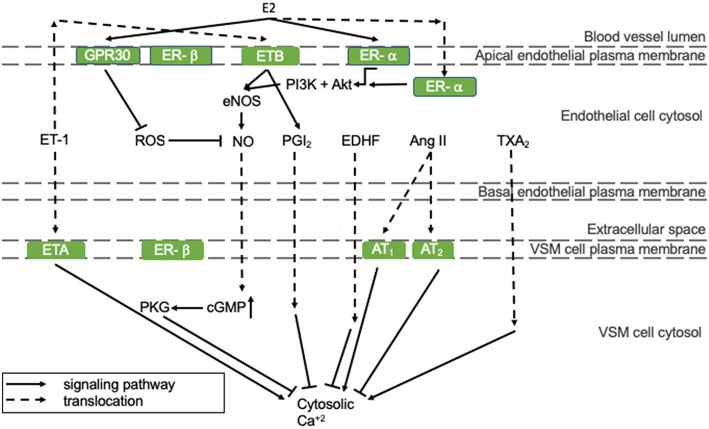
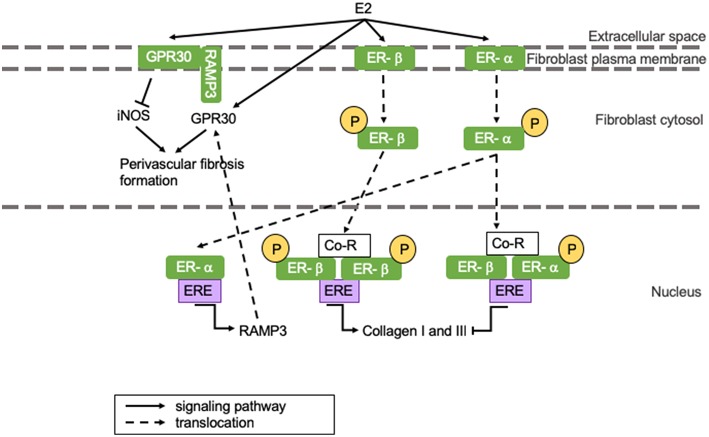
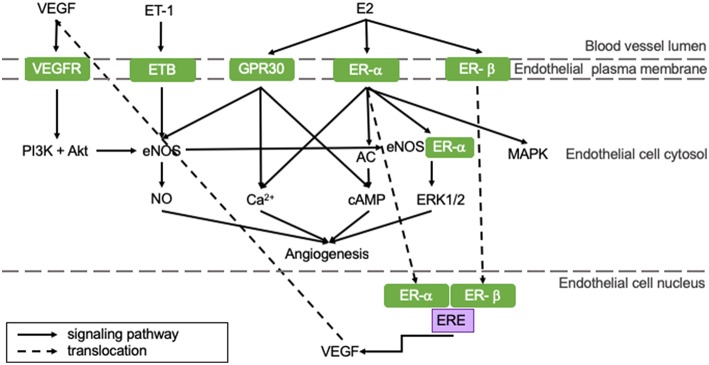
Heart failure with preserved ejection fraction (HFpEF) is a syndrome involving microvascular dysfunction. No treatment is available yet and as the HFpEF patient group is expanding due to the aging population, more knowledge on dysfunction of the cardiac microvasculature is required. Endothelial dysfunction, impaired angiogenesis, (perivascular) fibrosis and the pruning of capillaries (rarefaction) may all contribute to microvascular dysfunction in the heart and other organs, e.g., the kidneys. The HFpEF patient group consists mainly of post-menopausal women and female sex itself is a risk factor for this syndrome. This may point toward a role of estrogen depletion after menopause in the development of HFpEF. Estrogens favor the ratio of vasodilating over vasoconstricting factors, which results in an overall lower blood pressure in women than in men. Furthermore, estrogens improve angiogenic capacity and attenuate (perivascular) fibrosis formation. Therefore, we hypothesize that the drop of estrogen levels after menopause contributes to myocardial microvascular dysfunction and renders post-menopausal women more vulnerable for heart diseases that involve the microvasculature. This review provides a detailed summary of molecular targets of estrogen, which might guide future research and treatment options.
射血分数保留的心力衰竭(HFpEF)是一种涉及微血管功能障碍的综合征。目前尚无有效的治疗方法,而且由于人口老龄化,HFpEF患者群体正在扩大,因此需要更多关于心脏微血管功能障碍的知识。内皮功能障碍、血管生成受损、(血管周围)纤维化以及毛细血管的修剪(稀疏化)都可能导致心脏和其他器官(如肾脏)的微血管功能障碍。HFpEF患者群体主要由绝经后女性组成,女性本身就是该综合征的一个危险因素。这可能表明绝经后雌激素缺乏在HFpEF的发生发展中起作用。雌激素有利于血管舒张因子与血管收缩因子的比例,这导致女性的总体血压低于男性。此外,雌激素可提高血管生成能力并减轻(血管周围)纤维化形成。因此,我们推测绝经后雌激素水平的下降会导致心肌微血管功能障碍,并使绝经后女性更容易患涉及微血管的心脏病。本综述详细总结了雌激素的分子靶点,这可能为未来的研究和治疗选择提供指导。