Ruiz Bryan, Le Scornet Alexandre, Sauviac Laurent, Rémy Antoine, Bruand Claude, Meilhoc Eliane
Laboratoire des Interactions Plantes-Microorganismes (LIPM), INRA, CNRS, INSA, Université de Toulouse, Castanet-Tolosan, France.
Front Microbiol. 2019 Jul 3;10:1526. doi: 10.3389/fmicb.2019.01526. eCollection 2019.
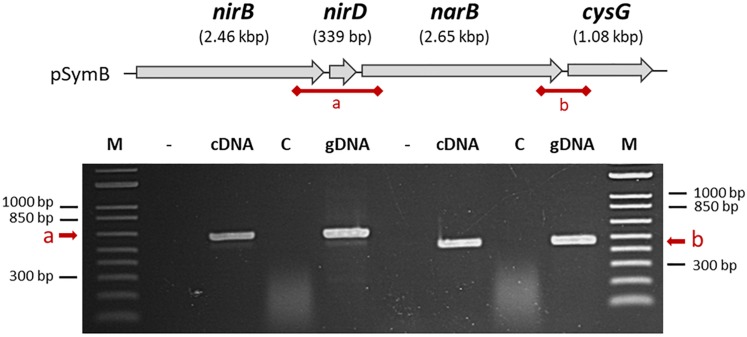
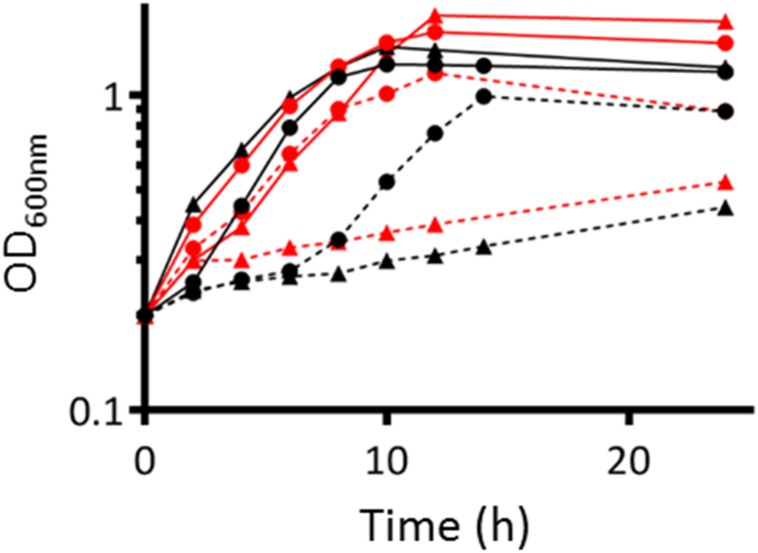
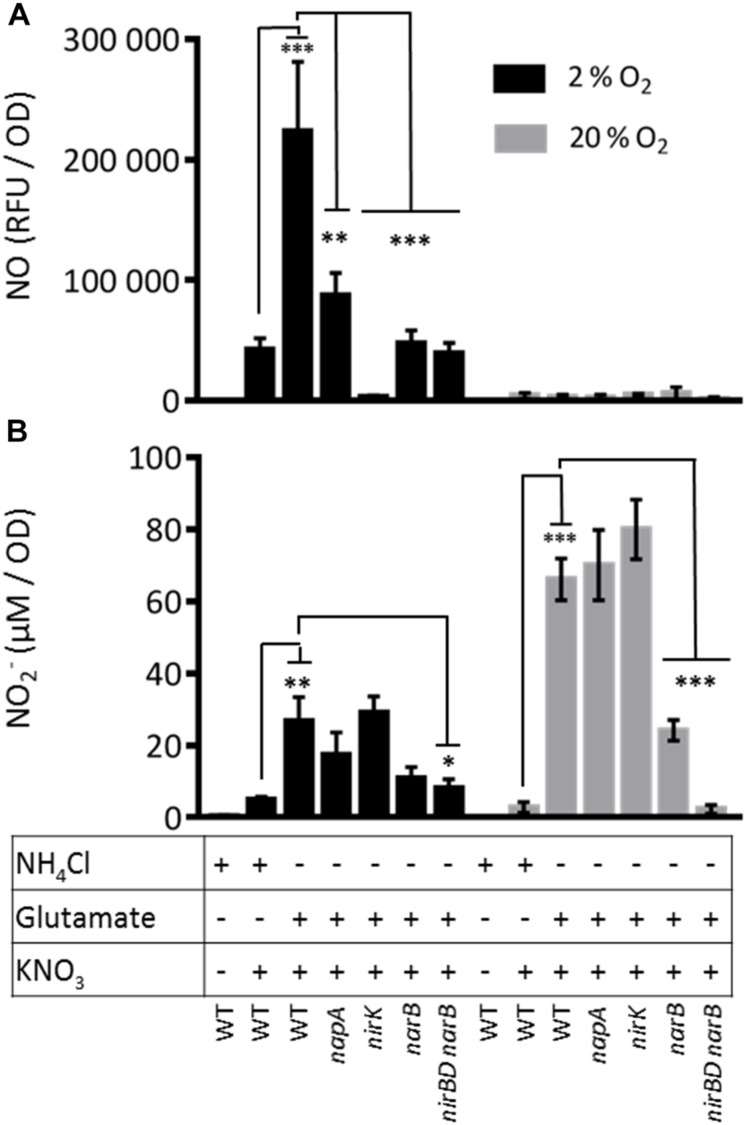
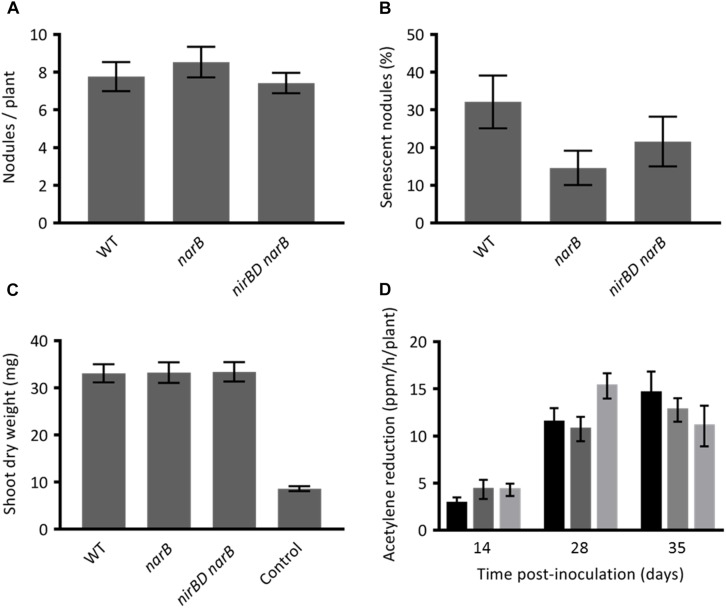
The interaction between rhizobia and their legume host plants culminates in the formation of specialized root organs called nodules in which differentiated endosymbiotic bacteria (bacteroids) fix atmospheric nitrogen to the benefit of the plant. Interestingly, nitric oxide (NO) has been detected at various steps of the rhizobium-legume symbiosis where it has been shown to play multifaceted roles. It is recognized that both bacterial and plant partners of the - symbiosis are involved in NO synthesis in nodules. can also produce NO from nitrate when living as free cells in the soil. does not possess any NO synthase gene in its genome. Instead, the denitrification pathway is often described as the main driver of NO production with nitrate as substrate. This pathway includes the periplasmic nitrate reductase (Nap) which reduces nitrate into nitrite, and the nitrite reductase (Nir) which reduces nitrite into NO. However, additional genes encoding putative nitrate and nitrite reductases (called and , respectively) have been identified in the genome. Here we examined the conditions where these genes are expressed, investigated their involvement in nitrate assimilation and NO synthesis in culture and their potential role . We found that and are expressed under aerobic conditions in absence of ammonium in the medium and most likely belong to the nitrate assimilatory pathway. Even though these genes are clearly expressed in the fixation zone of legume root nodule, they do not play a crucial role in symbiosis. Our results support the hypothesis that in , denitrification remains the main enzymatic way to produce NO while the assimilatory pathway involving NarB and NirB participates indirectly to NO synthesis by cooperating with the denitrification pathway.
根瘤菌与其豆科宿主植物之间的相互作用最终形成了一种特殊的根器官,称为根瘤,其中分化的内共生细菌(类菌体)固定大气中的氮,从而使植物受益。有趣的是,在根瘤菌 - 豆科植物共生的各个阶段都检测到了一氧化氮(NO),并且已证明它具有多方面的作用。人们认识到,共生关系中的细菌和植物伙伴都参与根瘤中NO的合成。当在土壤中作为自由细胞生活时,根瘤菌也可以从硝酸盐产生NO。根瘤菌基因组中不具备任何一氧化氮合酶基因。相反,反硝化途径通常被描述为以硝酸盐为底物产生NO的主要驱动因素。该途径包括将硝酸盐还原为亚硝酸盐的周质硝酸盐还原酶(Nap),以及将亚硝酸盐还原为NO的亚硝酸盐还原酶(Nir)。然而,在根瘤菌基因组中已经鉴定出另外一些分别编码假定的硝酸盐和亚硝酸盐还原酶(分别称为NarB和NirB)的基因。在这里,我们研究了这些基因表达的条件,调查了它们在培养物中参与硝酸盐同化和NO合成的情况以及它们的潜在作用。我们发现,NarB和NirB在培养基中没有铵的有氧条件下表达,并且很可能属于硝酸盐同化途径。尽管这些基因在豆科植物根瘤的固氮区明显表达,但它们在共生中并不起关键作用。我们的结果支持了这样一种假设,即在根瘤菌中,反硝化作用仍然是产生NO的主要酶促途径,而涉及NarB和NirB的同化途径通过与反硝化途径合作间接参与NO的合成。