Baliza Ingrid R S, Silva Suellen L R, Santos Luciano de S, Neto João H Araujo, Dias Rosane B, Sales Caroline B S, Rocha Clarissa A Gurgel, Soares Milena B P, Batista Alzir A, Bezerra Daniel P
Gonçalo Moniz Institute, Oswaldo Cruz Foundation (IGM-FIOCRUZ/BA), Salvador, Brazil.
Department of Chemistry, Federal University of São Carlos, São Carlos, Brazil.
Front Oncol. 2019 Jul 3;9:582. doi: 10.3389/fonc.2019.00582. eCollection 2019.
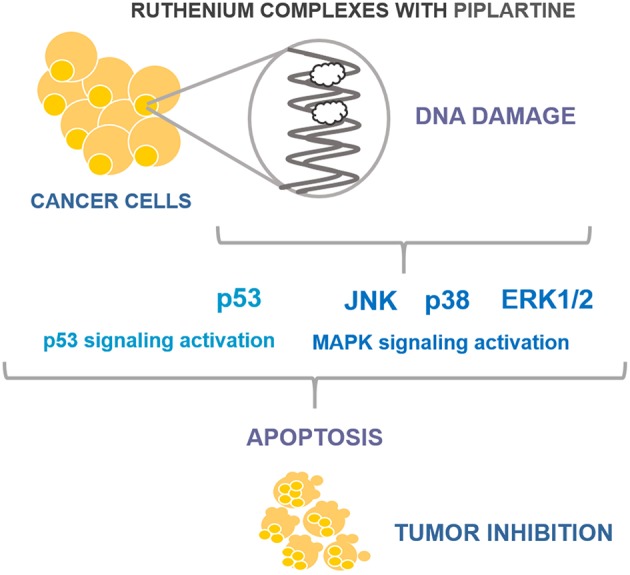
Ruthenium complexes with piplartine, Ru(piplartine)(dppf)(bipy) () and Ru(piplartine)(dppb)(bipy) () (dppf = 1,1-bis(diphenylphosphino) ferrocene; dppb = 1,4-bis(diphenylphosphino)butane and bipy = 2,2'-bipyridine), were recently synthesized and displayed more potent cytotoxicity than piplartine in different cancer cells, regulated RNA transcripts of several apoptosis-related genes, and induced reactive oxygen species (ROS)-mediated apoptosis in human colon carcinoma HCT116 cells. The present work aimed to explore the underlying mechanisms through which these ruthenium complexes induce cell death in HCT116 cells , as well as their action in a xenograft model. Both complexes significantly increased the percentage of apoptotic HCT116 cells, and co-treatment with inhibitors of JNK/SAPK, p38 MAPK, and MEK, which inhibits the activation of ERK1/2, significantly reduced the apoptosis rate induced by these complexes. Moreover, significant increase in phospho-JNK2 (T183/Y185), phospho-p38α (T180/Y182), and phospho-ERK1 (T202/Y204) expressions were observed in cells treated with these complexes, indicating MAPK-mediated apoptosis. In addition, co-treatment with a p53 inhibitor (cyclic pifithrin-α) and the ruthenium complexes significantly reduced the apoptosis rate in HCT116 cells, and increased phospho-p53 (S15) and phospho-histone H2AX (S139) expressions, indicating induction of DNA damage and p53-dependent apoptosis. Both complexes also reduced HCT116 cell growth in a xenograft model. Tumor mass inhibition rates were 35.06, 29.71, and 32.03% for the complex (15 μmol/kg/day), complex (15 μmol/kg/day), and piplartine (60 μmol/kg/day), respectively. These data indicate these ruthenium complexes as new anti-colon cancer drugs candidates.
钌与哌普他定形成的配合物,Ru(哌普他定)(二(二苯基膦基)铁茂)(2,2'-联吡啶) () 和 Ru(哌普他定)(1,4-二(二苯基膦基)丁烷)(2,2'-联吡啶) () (二(二苯基膦基)铁茂 = 1,1-双(二苯基膦基)铁茂;1,4-二(二苯基膦基)丁烷 = 1,4-双(二苯基膦基)丁烷,2,2'-联吡啶 = 2,2'-联吡啶),最近被合成出来,并且在不同癌细胞中显示出比哌普他定更强的细胞毒性,调节了几个凋亡相关基因的RNA转录本,并在人结肠癌HCT116细胞中诱导了活性氧(ROS)介导的凋亡。目前的工作旨在探索这些钌配合物在HCT116细胞中诱导细胞死亡的潜在机制,以及它们在异种移植模型中的作用。两种配合物均显著增加了凋亡HCT116细胞的百分比,并且与抑制JNK/SAPK、p38 MAPK和MEK(其抑制ERK1/2的激活)的抑制剂共同处理,显著降低了这些配合物诱导的凋亡率。此外,在用这些配合物处理的细胞中观察到磷酸化JNK2 (T183/Y185)、磷酸化p38α (T180/Y182) 和磷酸化ERK1 (T202/Y204) 表达显著增加,表明是MAPK介导的凋亡。此外,用p53抑制剂(环磷酰胺-α)与钌配合物共同处理显著降低了HCT116细胞的凋亡率,并增加了磷酸化p53 (S15) 和磷酸化组蛋白H2AX (S139) 的表达,表明诱导了DNA损伤和p53依赖性凋亡。两种配合物在异种移植模型中也降低了HCT116细胞的生长。配合物 (15 μmol/kg/天)、配合物 (15 μmol/kg/天)和哌普他定(60 μmol/kg/天)的肿瘤块抑制率分别为35.06%、29.71%和32.03%。这些数据表明这些钌配合物是新的抗结肠癌药物候选物。