Department for Microbiology and Immunology, Center for Molecular Medicine and Stem Cell Research, Faculty of Medical Sciences, University of Kragujevac, 69 Svetozar Markovic Street, 34000 Kragujevac, Serbia.
Department of Internal medicine, Faculty of Medical Sciences, University of Kragujevac, 69 Svetozar Markovic Street, 34000 Kragujevac, Serbia.
Cells. 2019 Jul 12;8(7):709. doi: 10.3390/cells8070709.
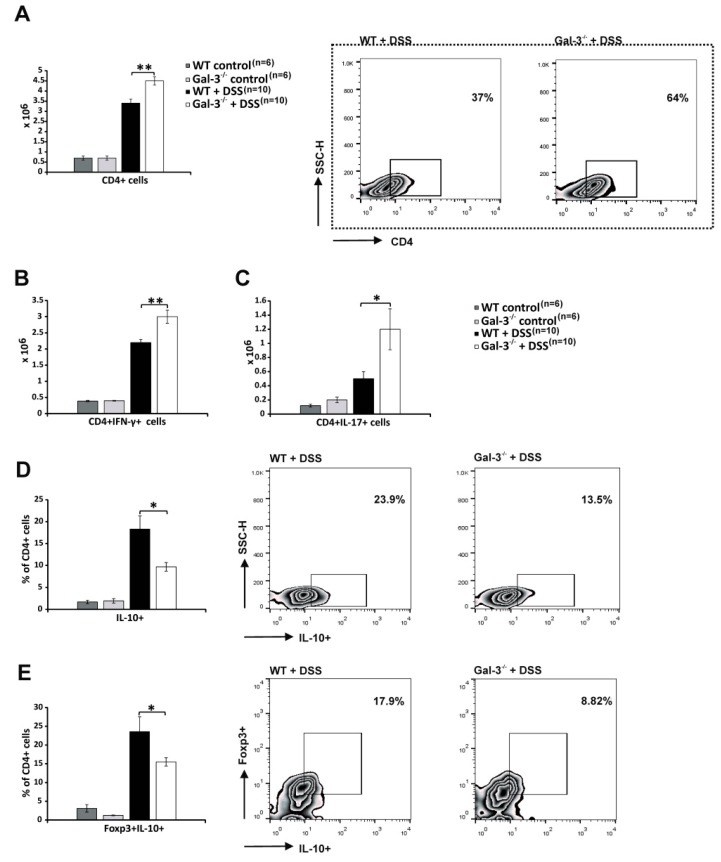
Galectin-3 regulates numerous biological processes in the gut. We investigated molecular mechanisms responsible for the Galectin-3-dependent regulation of colon inflammation and evaluated whether Galectin-3 may be used as biomarker for monitoring the progression of ulcerative colitis (UC). The differences in disease progression between dextran sodium sulphate-treated wild type and Galectin-3-deficient mice were investigated and confirmed in clinical settings, in 65 patients suffering from mild, moderate, and severe colitis. During the induction phase of colitis, Galectin-3 promoted interleukin-1β-induced polarization of colonic macrophages towards inflammatory phenotype. In the recovery phase of colitis, Galectin-3 was required for the immunosuppressive function of regulatory dendritic cells (DCs). Regulatory DCs in Galectin-3:Toll-like receptor-4:Kynurenine-dependent manner promoted the expansion of colon-infiltrated T regulatory cells (Tregs) and suppressed Th1 and Th17 cell-driven colon inflammation. Concentration of Galectin-3 in serum and stool samples of UC patients negatively correlated with clinical, endoscopic, and histological parameters of colitis. The cutoff serum values of Galectin-3 that allowed the discrimination of mild from moderate and moderate from severe colitis were 954 pg/mL and 580 pg/mL, respectively. Fecal levels of Galectin-3 higher than 553.44 pg/mL indicated attenuation of UC. In summing up, Galectin-3 regulates the cross-talk between colon-infiltrating DCs and Tregs and represents a new biomarker for monitoring the progression of UC.
半乳糖凝集素-3 调节肠道中的许多生物学过程。我们研究了负责半乳糖凝集素-3 依赖性调节结肠炎症的分子机制,并评估了半乳糖凝集素-3 是否可作为监测溃疡性结肠炎(UC)进展的生物标志物。在临床环境中,在 65 名患有轻度、中度和重度结肠炎的患者中,研究并证实了葡聚糖硫酸钠处理的野生型和半乳糖凝集素-3 缺陷型小鼠之间疾病进展的差异。在结肠炎的诱导阶段,半乳糖凝集素-3 促进白细胞介素-1β诱导的结肠巨噬细胞向炎症表型极化。在结肠炎的恢复期,半乳糖凝集素-3 是调节树突状细胞(DC)免疫抑制功能所必需的。半乳糖凝集素-3:Toll 样受体-4:犬尿氨酸依赖性调节性 DC 促进了浸润结肠的 T 调节细胞(Tregs)的扩增,并抑制了 Th1 和 Th17 细胞驱动的结肠炎症。UC 患者血清和粪便样本中半乳糖凝集素-3 的浓度与结肠炎的临床、内镜和组织学参数呈负相关。允许区分轻度与中度和中度与重度结肠炎的半乳糖凝集素-3 的血清截断值分别为 954pg/ml 和 580pg/ml。粪便中半乳糖凝集素-3 水平高于 553.44pg/ml 表明 UC 缓解。总之,半乳糖凝集素-3 调节浸润结肠的 DC 和 Tregs 之间的串扰,是监测 UC 进展的新生物标志物。