Lee Young-Ik, Leem Yea-Hyun
J Exerc Nutrition Biochem. 2019 Jun 30;23(2):1-6. doi: 10.20463/jenb.2019.0009.
Strenuous exercise often induces skeletal muscle damage, which results in impaired performance. Sphingolipid metabolism contributes to various cellular processes, including apoptosis, stress response, and inflammation. However, the relationship between exercise-induced muscle damage and ceramide (a key component of sphingolipid metabolism), is rarely studied. The present study aimed to explore the regulatory role of sphingolipid metabolism in exercise-induced muscle damage.
Mice were subjected to strenuous exercise by treadmill running with gradual increase in intensity. The blood and gastrocnemius muscles (white and red portion) were collected immediately after and 24 h post exercise. For 3 days, imipramine was intraperitoneally injected 1 h prior to treadmill running.
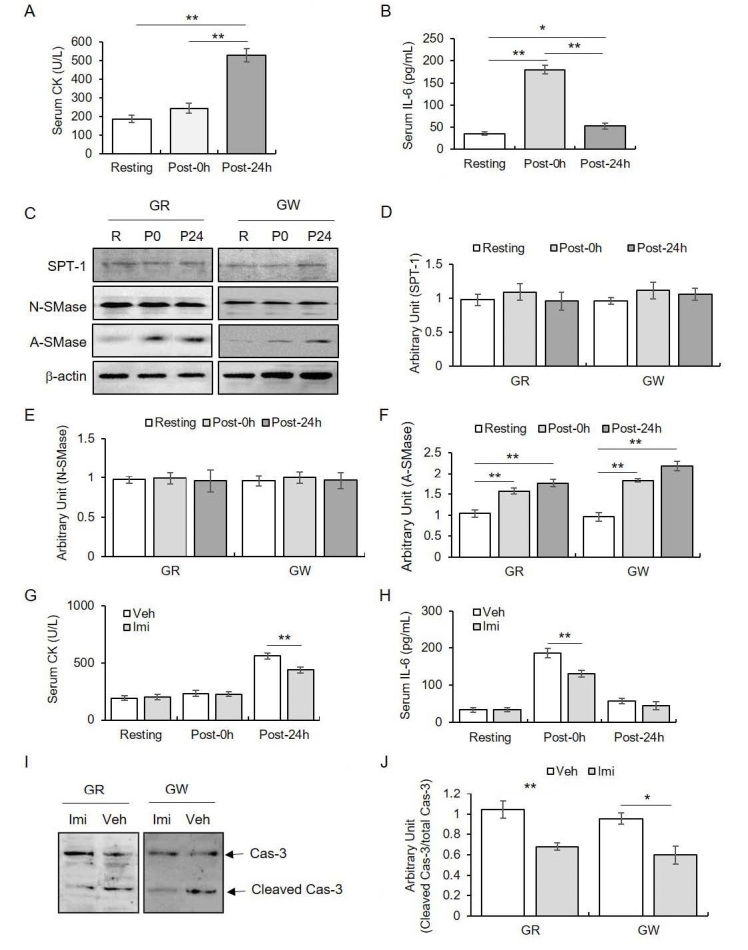
Interleukin 6 (IL-6) and serum creatine kinase (CK) levels were enhanced immediately after and 24 h post exercise (relative to those of resting), respectively. Acidic sphingomyelinase (A-SMase) protein expression in gastrocnemius muscles was significantly augmented by exercise, unlike, serine palmitoyltransferase-1 (SPT-1) and neutral sphingomyelinase (N-SMase) expressions. Furthermore, imipramine (a selective A-SMase inhibitor) treatment reduced the exercise-induced CK and IL-6 elevations, along with a decrease in cleaved caspase-3 (Cas-3) of gastrocnemius muscles.
We found the crucial role of A-SMase in exercise-induced muscle damage.
剧烈运动常诱发骨骼肌损伤,导致运动能力受损。鞘脂代谢参与多种细胞过程,包括细胞凋亡、应激反应和炎症。然而,运动诱导的肌肉损伤与神经酰胺(鞘脂代谢的关键成分)之间的关系鲜有研究。本研究旨在探讨鞘脂代谢在运动诱导的肌肉损伤中的调节作用。
通过逐渐增加强度的跑步机跑步使小鼠进行剧烈运动。在运动后即刻和运动后24小时收集血液和腓肠肌(白色和红色部分)。在跑步机跑步前1小时腹腔注射丙咪嗪,持续3天。
运动后即刻和运动后24小时,白细胞介素6(IL-6)和血清肌酸激酶(CK)水平分别升高(相对于静息水平)。与丝氨酸棕榈酰转移酶-1(SPT-1)和中性鞘磷脂酶(N-SMase)的表达不同,运动显著增加了腓肠肌中酸性鞘磷脂酶(A-SMase)的蛋白表达。此外,丙咪嗪(一种选择性A-SMase抑制剂)治疗降低了运动诱导的CK和IL-6升高,同时腓肠肌中裂解的半胱天冬酶-3(Cas-3)减少。
我们发现A-SMase在运动诱导的肌肉损伤中起关键作用。