Physical Activity and Performance Institute, Konkuk University, 120 Neungdong-ro, Gwangjin-gu, Seoul 05029, Korea.
Department of Sports Medicine and Science, Graduate School, Konkuk University, 120 Neungdong-ro, Gwangjin-gu, Seoul 05029, Korea.
Int J Environ Res Public Health. 2020 Mar 16;17(6):1934. doi: 10.3390/ijerph17061934.
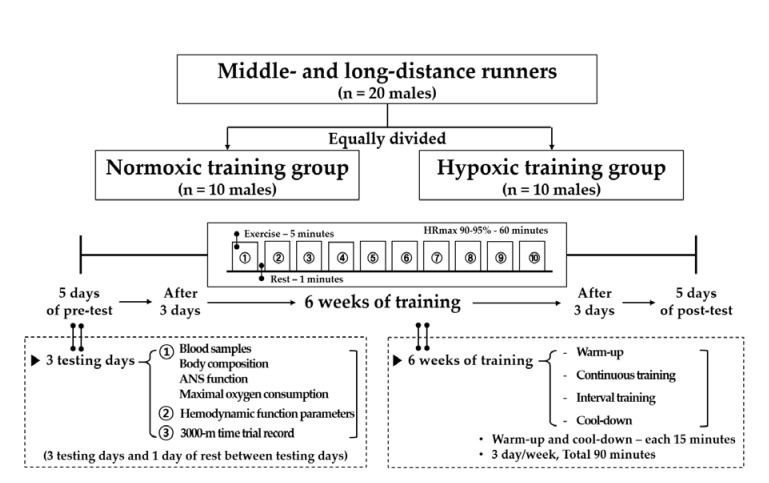
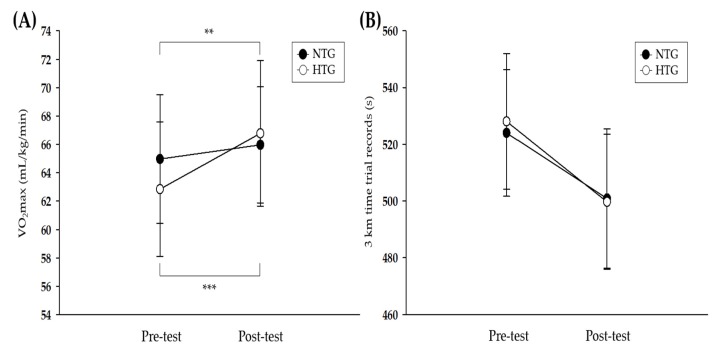
This study evaluated the effects of intermittent interval training in hypoxic conditions for six weeks compared with normoxic conditions, on hemodynamic function, autonomic nervous system (ANS) function, immune function, and athletic performance in middle- and long-distance runners. Twenty athletes were divided into normoxic training (normoxic training group (NTG); = 10; residing and training at sea level) and hypoxic training (hypoxic training group (HTG); = 10; residing at sea level but training in 526-mmHg hypobaric hypoxia) groups. All dependent variables were measured before, and after, training. The training frequency was 90 min, 3 d per week for six weeks. Body composition showed no significant difference between the two groups. However, the HTG showed more significantly improved athletic performance (e.g., maximal oxygen uptake). The hemodynamic function (e.g., oxygen uptake, oxygen pulse, and cardiac output) during submaximal exercise and ANS function (e.g., standard deviation and root mean square of successive differences, high frequency, and low/high frequency) improved more in the HTG. Immune function parameters were stable within the normal range before and after training in both groups. Therefore, hypoxic training was more effective in enhancing athletic performance, and improving hemodynamic and ANS function; further, it did not adversely affect immune function in competitive runners.
这项研究评估了六周的间歇性间歇训练在低氧条件下与常氧条件相比对中长跑运动员的血液动力学功能、自主神经系统 (ANS) 功能、免疫功能和运动表现的影响。20 名运动员被分为常氧训练组(常氧训练组,NTG;n=10;居住和训练在海平面)和低氧训练组(低氧训练组,HTG;n=10;居住在海平面,但在 526mmHg 低气压缺氧环境中训练)。所有的因变量都在训练前后进行了测量。训练频率为每周 3 天,每次 90 分钟,共 6 周。两组间的身体成分无显著差异。然而,HTG 表现出更显著的运动表现改善(例如最大摄氧量)。低氧训练组在亚最大运动期间的血液动力学功能(例如摄氧量、摄氧量脉搏和心输出量)和 ANS 功能(例如标准差和连续差异的均方根、高频和低/高频)改善更明显。两组的免疫功能参数在训练前后均在正常范围内保持稳定。因此,低氧训练在提高运动表现、改善血液动力学和 ANS 功能方面更为有效;此外,它不会对竞技跑步者的免疫功能产生不利影响。