Division of Molecular Diagnostics, Department of Laboratory Medicine, Zhejiang Cancer Hospital, Hangzhou 310022, P.R. China.
Department of Otorhinolaryngology, Head and Neck Surgery, Berlin Institute of Health, Charité- Universitätsmedizin Berlin, corporate member of Freie Universität Berlin, Humboldt-Universität zu Berlin, Campus Benjamin Franklin, Berlin 12200, Germany.
Int J Biol Sci. 2019 May 12;15(7):1336-1344. doi: 10.7150/ijbs.33329. eCollection 2019.
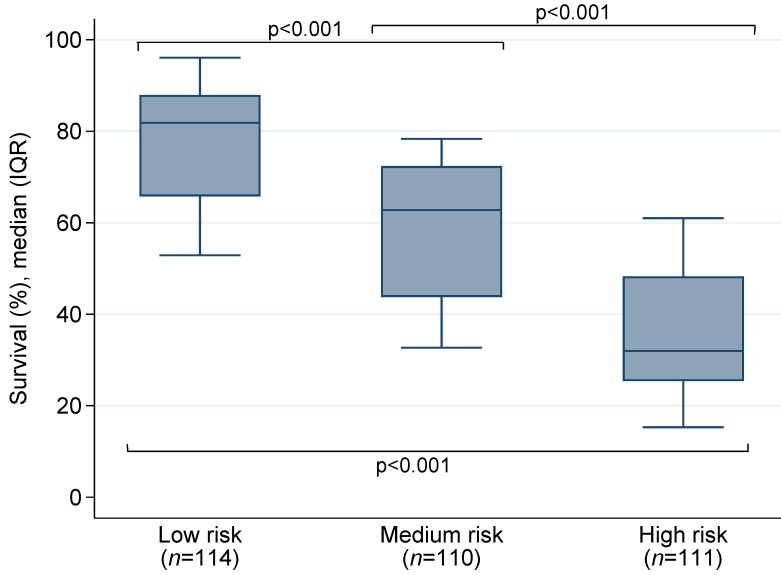
Although patients having head and neck squamous cell carcinoma (HNSCC) have high mortality, standardized prognostic tools are unavailable. As such, having a validated simple prognostic scoring system to help predict mortality in these high-risk patients is urgently needed. The current study aimed to develop and internally validate a prognostic scoring system for overall mortality in human papillomavirus (HPV)-independent HNSCC patients. Data on 400 consecutive patients from the Cancer Genome Atlas database with a known HPV-RNA negative status were analyzed. A prognostic model to predict patient overall mortality was developed using the logistic regression beta coefficients and a simple risk score was created. The model was internally validated using bootstrap validation with 2000 replications. Five covariates (age, pT, pN, perineural invasion, and EAp53 score) were used in the development of the mortality risk score in the final model. Three risk groups were stratified based on the prognostic scores: low-risk (<96 points), medium-risk (96-121 points), and high-risk (≥122 points) with a survival of 76%, 62% and 35%, respectively. The proposed model presented good discrimination in both the development (AUC = 0.76; 95% CI 0.70, 0.81) and bootstrap validation (AUC = 0.76; 95% CI 0.70, 0.81) with a non-significant Hosmer-Lemeshow chi-square of 6.17 (p = 0.63). The proposed prognostic scoring system is easy to use to predict patient overall mortality and could also help in the appropriate allocation of medical resources while managing HNSCC patients. External validation (including re-calibration if needed) should be conducted to test the model's generalizability in different populations.
尽管患有头颈部鳞状细胞癌(HNSCC)的患者死亡率较高,但目前尚无标准化的预后工具。因此,迫切需要开发一种经过验证的简单预后评分系统,以帮助预测这些高危患者的死亡率。本研究旨在开发和内部验证一种用于预测 HPV 独立的 HNSCC 患者总体死亡率的预后评分系统。分析了来自癌症基因组图谱数据库的 400 例连续患者的数据,这些患者均具有已知的 HPV-RNA 阴性状态。使用逻辑回归β系数开发了一种预测患者总体死亡率的预后模型,并创建了一个简单的风险评分。该模型通过 2000 次重复的自举验证进行内部验证。在最终模型中,使用 5 个协变量(年龄、pT、pN、神经周围侵犯和 EAp53 评分)开发了死亡率风险评分。根据预后评分将患者分为三个风险组:低危(<96 分)、中危(96-121 分)和高危(≥122 分),其生存率分别为 76%、62%和 35%。该模型在开发(AUC = 0.76;95%CI 0.70,0.81)和自举验证(AUC = 0.76;95%CI 0.70,0.81)中均具有良好的区分度,且 Hosmer-Lemeshow χ2 检验无统计学意义(p = 0.63)。所提出的预后评分系统易于使用,可用于预测患者的总体死亡率,并有助于在管理 HNSCC 患者时合理分配医疗资源。应进行外部验证(包括必要时重新校准),以测试该模型在不同人群中的泛化能力。