• 文献检索
  • 文档翻译
  • 深度研究
  • 学术资讯
  • Suppr Zotero 插件Zotero 插件
  • 邀请有礼
  • 套餐&价格
  • 历史记录
应用&插件
Suppr Zotero 插件Zotero 插件浏览器插件Mac 客户端Windows 客户端微信小程序
定价
高级版会员购买积分包购买API积分包
服务
文献检索文档翻译深度研究API 文档MCP 服务
关于我们
关于 Suppr公司介绍联系我们用户协议隐私条款
关注我们

Suppr 超能文献

核心技术专利:CN118964589B侵权必究
粤ICP备2023148730 号-1Suppr @ 2026

文献检索

告别复杂PubMed语法,用中文像聊天一样搜索,搜遍4000万医学文献。AI智能推荐,让科研检索更轻松。

立即免费搜索

文件翻译

保留排版,准确专业,支持PDF/Word/PPT等文件格式,支持 12+语言互译。

免费翻译文档

深度研究

AI帮你快速写综述,25分钟生成高质量综述,智能提取关键信息,辅助科研写作。

立即免费体验

头颈部鳞状细胞癌的组织病理学图像和基因表达模式分析预测分子特征和预后。

Histopathological image and gene expression pattern analysis for predicting molecular features and prognosis of head and neck squamous cell carcinoma.

机构信息

Department of Biotherapy, Cancer Center, State Key Laboratory of Biotherapy, West China Hospital, Sichuan University, Chengdu, China.

West China School of Medicine, West China Hospital, Sichuan University, Chengdu, China.

出版信息

Cancer Med. 2021 Jul;10(13):4615-4628. doi: 10.1002/cam4.3965. Epub 2021 May 13.

DOI:10.1002/cam4.3965
PMID:33987946
原文链接:https://pmc.ncbi.nlm.nih.gov/articles/PMC8267162/
Abstract

BACKGROUND

Histopathological image features offer a quantitative measurement of cellular morphology, and probably help for better diagnosis and prognosis in head and neck squamous cell carcinoma (HNSCC).

METHODS

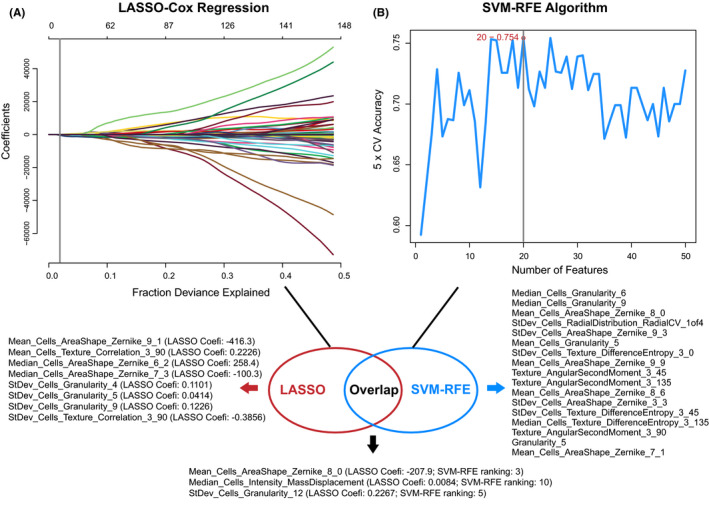
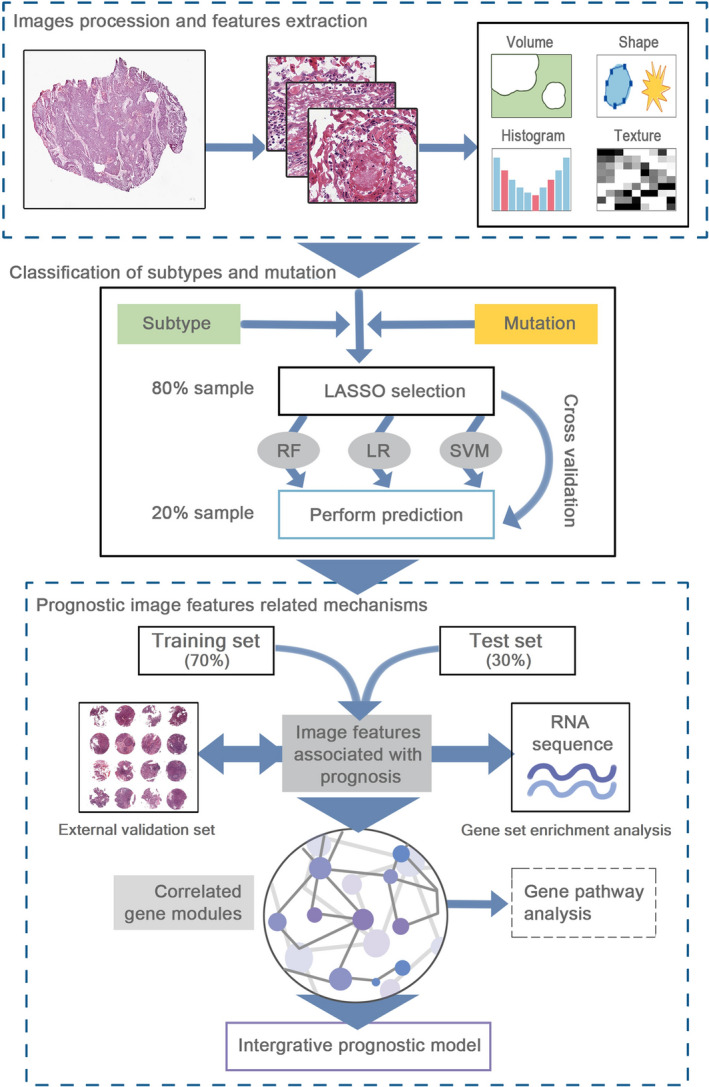
We first used histopathological image features and machine-learning algorithms to predict molecular features of 212 HNSCC patients from The Cancer Genome Atlas (TCGA). Next, we divided TCGA-HNSCC cohort into training set (n = 149) and test set (n = 63), and obtained tissue microarrays as an external validation set (n = 126). We identified the gene expression profile correlated to image features by bioinformatics analysis.

RESULTS

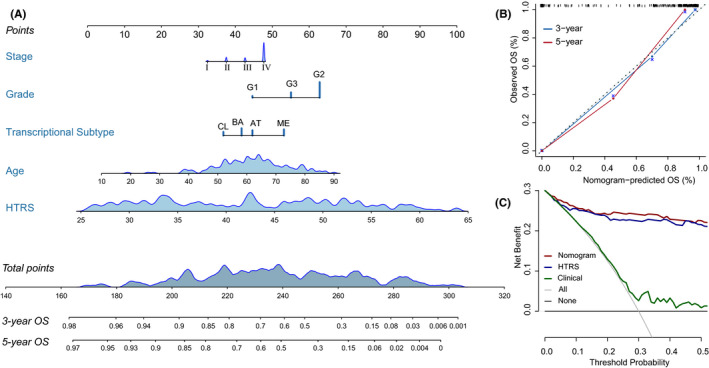
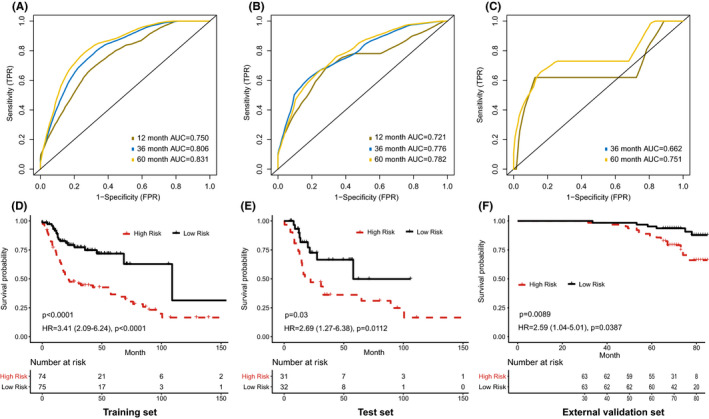
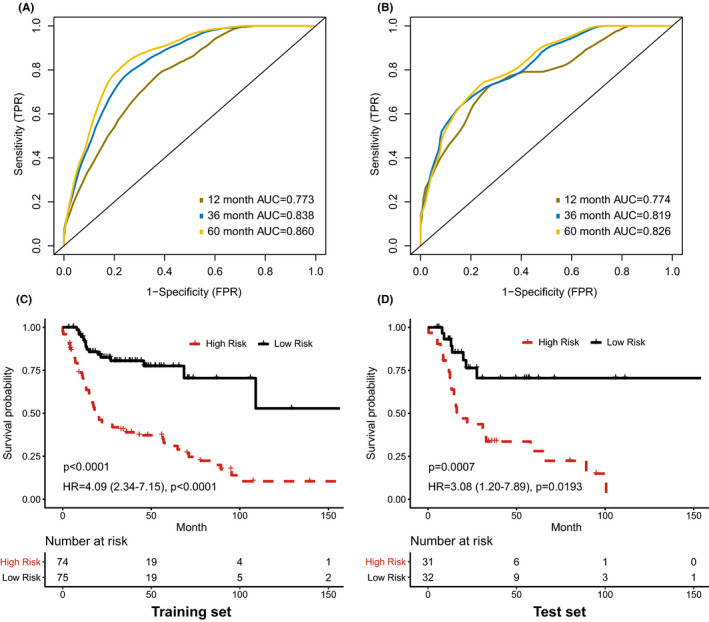
Histopathological image features combined with random forest may predict five somatic mutations, transcriptional subtypes, and methylation subtypes, with area under curve (AUC) ranging from 0.828 to 0.968. The prediction model based on image features could predict overall survival, with 5-year AUC of 0.831, 0.782, and 0.751 in training, test, and validation sets. We next established an integrative prognostic model of image features and gene expressions, which obtained better performance in training set (5-year AUC = 0.860) and test set (5-year AUC = 0.826). According to histopathological transcriptomics risk score (HTRS) generated by the model, high-risk and low-risk patients had different survival in training set (HR = 4.09, p < 0.001) and test set (HR=3.08, p = 0.019). Multivariate analysis suggested that HTRS was an independent predictor in training set (HR = 5.17, p < 0.001). The nomogram combining HTRS and clinical factors had higher net benefit than conventional clinical evaluation.

CONCLUSIONS

Histopathological image features provided a promising approach to predict mutations, molecular subtypes, and prognosis of HNSCC. The integration of image features and gene expression data had potential for improving prognosis prediction in HNSCC.

摘要

背景

组织病理学图像特征可提供细胞形态的定量测量,可能有助于对头颈鳞状细胞癌(HNSCC)的更好诊断和预后。

方法

我们首先使用组织病理学图像特征和机器学习算法,从癌症基因组图谱(TCGA)预测 212 名 HNSCC 患者的分子特征。接下来,我们将 TCGA-HNSCC 队列分为训练集(n=149)和测试集(n=63),并获得组织微阵列作为外部验证集(n=126)。我们通过生物信息学分析确定与图像特征相关的基因表达谱。

结果

组织病理学图像特征与随机森林相结合,可以预测五个体细胞突变、转录亚型和甲基化亚型,曲线下面积(AUC)范围为 0.828 至 0.968。基于图像特征的预测模型可以预测总生存期,在训练、测试和验证集中,5 年 AUC 分别为 0.831、0.782 和 0.751。我们随后建立了一个基于图像特征和基因表达的综合预后模型,在训练集(5 年 AUC=0.860)和测试集(5 年 AUC=0.826)中获得了更好的性能。根据模型生成的组织病理学转录组风险评分(HTRS),高风险和低风险患者在训练集(HR=4.09,p<0.001)和测试集(HR=3.08,p=0.019)中的生存情况不同。多变量分析表明,HTRS 是训练集中的独立预测因子(HR=5.17,p<0.001)。结合 HTRS 和临床因素的列线图比传统的临床评估具有更高的净效益。

结论

组织病理学图像特征为预测 HNSCC 的突变、分子亚型和预后提供了一种有前途的方法。图像特征与基因表达数据的整合有可能提高 HNSCC 的预后预测能力。
https://cdn.ncbi.nlm.nih.gov/pmc/blobs/ce4f/8267162/38885b1a2d31/CAM4-10-4615-g003.jpg
https://cdn.ncbi.nlm.nih.gov/pmc/blobs/ce4f/8267162/79e67c408e94/CAM4-10-4615-g006.jpg
https://cdn.ncbi.nlm.nih.gov/pmc/blobs/ce4f/8267162/2f3b6a99df00/CAM4-10-4615-g002.jpg
https://cdn.ncbi.nlm.nih.gov/pmc/blobs/ce4f/8267162/7596580ad49f/CAM4-10-4615-g007.jpg
https://cdn.ncbi.nlm.nih.gov/pmc/blobs/ce4f/8267162/1d8ccea35ce6/CAM4-10-4615-g001.jpg
https://cdn.ncbi.nlm.nih.gov/pmc/blobs/ce4f/8267162/2b6bdc2e36e0/CAM4-10-4615-g004.jpg
https://cdn.ncbi.nlm.nih.gov/pmc/blobs/ce4f/8267162/e3a937448300/CAM4-10-4615-g005.jpg
https://cdn.ncbi.nlm.nih.gov/pmc/blobs/ce4f/8267162/38885b1a2d31/CAM4-10-4615-g003.jpg
https://cdn.ncbi.nlm.nih.gov/pmc/blobs/ce4f/8267162/79e67c408e94/CAM4-10-4615-g006.jpg
https://cdn.ncbi.nlm.nih.gov/pmc/blobs/ce4f/8267162/2f3b6a99df00/CAM4-10-4615-g002.jpg
https://cdn.ncbi.nlm.nih.gov/pmc/blobs/ce4f/8267162/7596580ad49f/CAM4-10-4615-g007.jpg
https://cdn.ncbi.nlm.nih.gov/pmc/blobs/ce4f/8267162/1d8ccea35ce6/CAM4-10-4615-g001.jpg
https://cdn.ncbi.nlm.nih.gov/pmc/blobs/ce4f/8267162/2b6bdc2e36e0/CAM4-10-4615-g004.jpg
https://cdn.ncbi.nlm.nih.gov/pmc/blobs/ce4f/8267162/e3a937448300/CAM4-10-4615-g005.jpg
https://cdn.ncbi.nlm.nih.gov/pmc/blobs/ce4f/8267162/38885b1a2d31/CAM4-10-4615-g003.jpg

相似文献

1
Histopathological image and gene expression pattern analysis for predicting molecular features and prognosis of head and neck squamous cell carcinoma.头颈部鳞状细胞癌的组织病理学图像和基因表达模式分析预测分子特征和预后。
Cancer Med. 2021 Jul;10(13):4615-4628. doi: 10.1002/cam4.3965. Epub 2021 May 13.
2
Development and validation of a fourteen- innate immunity-related gene pairs signature for predicting prognosis head and neck squamous cell carcinoma.开发和验证十四对固有免疫相关基因对预测头颈部鳞状细胞癌预后的标志。
BMC Cancer. 2020 Oct 20;20(1):1015. doi: 10.1186/s12885-020-07489-7.
3
Retinol-binding protein type 1 expression predicts poor prognosis in head and neck squamous cell carcinoma.视黄醇结合蛋白 1 型表达预测头颈部鳞状细胞癌预后不良。
BMC Cancer. 2024 Oct 15;24(1):1277. doi: 10.1186/s12885-024-12565-3.
4
A Novel Ferroptosis-Related Gene Signature to Predict Prognosis in Patients with Head and Neck Squamous Cell Carcinoma.一种新的铁死亡相关基因签名,用于预测头颈部鳞状细胞癌患者的预后。
Dis Markers. 2021 Nov 22;2021:5759927. doi: 10.1155/2021/5759927. eCollection 2021.
5
Development and validation of a novel ferroptosis-related gene signature for predicting prognosis and immune microenvironment in head and neck squamous cell carcinoma.开发和验证一种新型的与铁死亡相关的基因特征,用于预测头颈部鳞状细胞癌的预后和免疫微环境。
Int Immunopharmacol. 2021 Sep;98:107789. doi: 10.1016/j.intimp.2021.107789. Epub 2021 Jun 12.
6
Integration of histopathological images and multi-dimensional omics analyses predicts molecular features and prognosis in high-grade serous ovarian cancer.整合组织病理学图像和多维组学分析可预测高级别浆液性卵巢癌的分子特征和预后。
Gynecol Oncol. 2021 Oct;163(1):171-180. doi: 10.1016/j.ygyno.2021.07.015. Epub 2021 Jul 16.
7
Radiomics Features on Enhanced Computed Tomography Predict FOXP3 Expression and Clinical Prognosis in Patients with Head and Neck Squamous Cell Carcinoma.增强 CT 影像学组学特征预测头颈部鳞状细胞癌患者 FOXP3 表达及临床预后
J Imaging Inform Med. 2024 Aug;37(4):1323-1335. doi: 10.1007/s10278-023-00910-0. Epub 2024 Feb 20.
8
Development and validation of radiomic signatures of head and neck squamous cell carcinoma molecular features and subtypes.头颈部鳞状细胞癌分子特征和亚型的放射组学特征的开发和验证。
EBioMedicine. 2019 Jul;45:70-80. doi: 10.1016/j.ebiom.2019.06.034. Epub 2019 Jun 27.
9
Autophagy-Related Signature for Head and Neck Squamous Cell Carcinoma.自噬相关标志物预测头颈部鳞状细胞癌。
Dis Markers. 2020 Oct 19;2020:8899337. doi: 10.1155/2020/8899337. eCollection 2020.
10
Six Glycolysis-Related Genes as Prognostic Risk Markers Can Predict the Prognosis of Patients with Head and Neck Squamous Cell Carcinoma.六个与糖酵解相关的基因作为预后风险标志物可预测头颈部鳞状细胞癌患者的预后。
Biomed Res Int. 2021 Feb 10;2021:8824195. doi: 10.1155/2021/8824195. eCollection 2021.

引用本文的文献

1
Predicting breast cancer prognosis based on a novel pathomics model through CHEK1 expression analysis using machine learning algorithms.通过使用机器学习算法进行CHEK1表达分析,基于一种新型病理组学模型预测乳腺癌预后。
PLoS One. 2025 May 9;20(5):e0321717. doi: 10.1371/journal.pone.0321717. eCollection 2025.
2
Machine Learning-Based Pathomics Model to Predict the Prognosis in Clear Cell Renal Cell Carcinoma.基于机器学习的病理组学模型预测透明细胞肾细胞癌的预后
Technol Cancer Res Treat. 2024 Jan-Dec;23:15330338241307686. doi: 10.1177/15330338241307686.
3
Predicting prognosis in lung adenocarcinoma by predicting TIGIT expression: a pathomics model.

本文引用的文献

1
Identification of a four-gene metabolic signature predicting overall survival for hepatocellular carcinoma.鉴定出一种四基因代谢特征,可预测肝细胞癌的总生存期。
J Cell Physiol. 2020 Feb;235(2):1624-1636. doi: 10.1002/jcp.29081. Epub 2019 Jul 16.
2
Correlation Analysis of Histopathology and Proteogenomics Data for Breast Cancer.乳腺癌组织病理学与蛋白质基因组学数据的相关性分析。
Mol Cell Proteomics. 2019 Aug 9;18(8 suppl 1):S37-S51. doi: 10.1074/mcp.RA118.001232. Epub 2019 Jul 8.
3
Development and validation of radiomic signatures of head and neck squamous cell carcinoma molecular features and subtypes.
通过预测TIGIT表达预测肺腺癌预后:一种病理组学模型
J Thorac Dis. 2024 Nov 30;16(11):7617-7629. doi: 10.21037/jtd-24-978. Epub 2024 Nov 29.
4
NETosis Genes and Pathomic Signature: A Novel Prognostic Marker for Ovarian Serous Cystadenocarcinoma.中性粒细胞胞外诱捕网形成相关基因与病理特征:卵巢浆液性囊腺癌的一种新型预后标志物
J Imaging Inform Med. 2024 Dec 11. doi: 10.1007/s10278-024-01366-6.
5
Relationship between EZH2 expression and prognosis of patients with hepatocellular carcinoma using a pathomics predictive model.基于病理组学预测模型探讨EZH2表达与肝细胞癌患者预后的关系
Heliyon. 2024 Sep 28;10(20):e38562. doi: 10.1016/j.heliyon.2024.e38562. eCollection 2024 Oct 30.
6
Pathomic and bioinformatics analysis of clinical-pathological and genomic factors for pancreatic cancer prognosis.胰腺癌临床病理和基因组因素的病理组学和生物信息学分析用于预后评估。
Sci Rep. 2024 Nov 13;14(1):27769. doi: 10.1038/s41598-024-79619-1.
7
Construction of a pathomics model for predicting mRNAsi in lung adenocarcinoma and exploration of biological mechanism.构建预测肺腺癌中mRNA稳定性指数(mRNAsi)的病理组学模型并探索其生物学机制。
Heliyon. 2024 Aug 29;10(17):e37100. doi: 10.1016/j.heliyon.2024.e37100. eCollection 2024 Sep 15.
8
Predicting CTLA4 expression and prognosis in clear cell renal cell carcinoma using a pathomics signature of histopathological images and machine learning.利用组织病理学图像的病理组学特征和机器学习预测透明细胞肾细胞癌中的CTLA4表达及预后
Heliyon. 2024 Jul 18;10(15):e34877. doi: 10.1016/j.heliyon.2024.e34877. eCollection 2024 Aug 15.
9
Assessment of AURKA expression and prognosis prediction in lung adenocarcinoma using machine learning-based pathomics signature.基于机器学习的病理组学特征评估肺腺癌中AURKA的表达及预后预测
Heliyon. 2024 Jun 14;10(12):e33107. doi: 10.1016/j.heliyon.2024.e33107. eCollection 2024 Jun 30.
10
Matrix metalloproteinase 9 expression and glioblastoma survival prediction using machine learning on digital pathological images.基于数字病理图像的机器学习对基质金属蛋白酶 9 表达和胶质母细胞瘤生存预测的研究。
Sci Rep. 2024 Jul 2;14(1):15065. doi: 10.1038/s41598-024-66105-x.
头颈部鳞状细胞癌分子特征和亚型的放射组学特征的开发和验证。
EBioMedicine. 2019 Jul;45:70-80. doi: 10.1016/j.ebiom.2019.06.034. Epub 2019 Jun 27.
4
Examination of Independent Prognostic Power of Gene Expressions and Histopathological Imaging Features in Cancer.癌症中基因表达与组织病理学影像特征的独立预后能力研究
Cancers (Basel). 2019 Mar 13;11(3):361. doi: 10.3390/cancers11030361.
5
VEGF in Signaling and Disease: Beyond Discovery and Development.血管内皮生长因子在信号转导和疾病中的作用:超越发现和开发。
Cell. 2019 Mar 7;176(6):1248-1264. doi: 10.1016/j.cell.2019.01.021.
6
Precision medicine in head and neck cancer.头颈部肿瘤的精准医学。
Drug Resist Updat. 2018 Sep;40:13-16. doi: 10.1016/j.drup.2018.09.001. Epub 2018 Sep 25.
7
Gene Expression Subtype Predicts Nodal Metastasis and Survival in Human Papillomavirus-Negative Head and Neck Cancer.基因表达亚型可预测人乳头瘤病毒阴性头颈癌的淋巴结转移及生存情况。
Laryngoscope. 2019 Jan;129(1):154-161. doi: 10.1002/lary.27340. Epub 2018 Sep 24.
8
Classification and mutation prediction from non-small cell lung cancer histopathology images using deep learning.基于深度学习的非小细胞肺癌组织病理学图像分类和突变预测。
Nat Med. 2018 Oct;24(10):1559-1567. doi: 10.1038/s41591-018-0177-5. Epub 2018 Sep 17.
9
Integrating genomic data and pathological images to effectively predict breast cancer clinical outcome.整合基因组数据和病理图像,有效预测乳腺癌临床预后。
Comput Methods Programs Biomed. 2018 Jul;161:45-53. doi: 10.1016/j.cmpb.2018.04.008. Epub 2018 Apr 19.
10
Targeting B cell receptor signalling in cancer: preclinical and clinical advances.靶向癌症中的 B 细胞受体信号:临床前和临床进展。
Nat Rev Cancer. 2018 Mar;18(3):148-167. doi: 10.1038/nrc.2017.121. Epub 2018 Jan 19.