Zhao Guang Wei, Huang Tingting, Wu Di, Zhang Liwu, Luo Zeli, Liu Jia, Yang Xiaowei
Animal Diseases Rapid Diagnosis Center, Southwest University, Chongqing, China.
Chongqing Sanjiezhongxin Bioengineering Co. Ltd., Chongqing, China.
Vet Res Forum. 2019 Spring;10(2):169-172. doi: 10.30466/vrf.2019.98874.2359. Epub 2019 Jun 15.
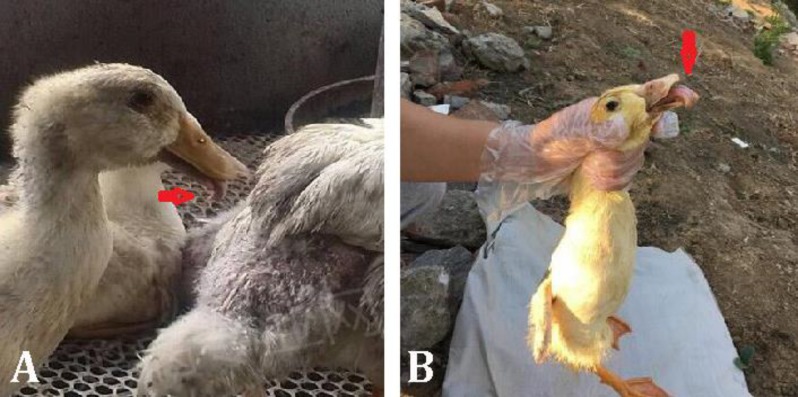
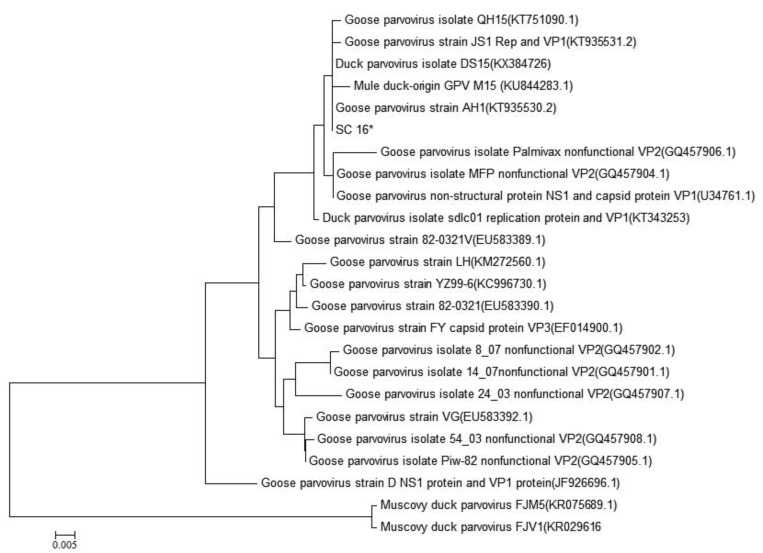
Duck beak atrophy and dwarfism syndrome (BADS) is a newly emerged disease in China since 2015. In October 2017, an unidentified disease occurred in Cherry Valley ducks, Chongqing municipality, the southwest of China. The affected birds showed short beak and growth retardation clinical signs. The disease caused approximately 20.00% morbidity and serious weight loss due to retarded growth. In order to identify the causative agent of BADS, liver, spleen, lung and heart samples were collected for virus isolation, hemagglutination test, PCR identification, and partial gene sequencing. The isolated virus was tentatively named SC16. Hemagglutination test indicated that the virus was negative to chicken red blood cells. Based on the PCR and sequencing results, the causative agent of BADS was a novel duck-origin goose parvovirus (DGPV) while no another co-infection pathogen was found in this case. Further analysis could provide insights into the control strategies of DGPV in ducks.
鸭喙萎缩与侏儒综合征(BADS)是自2015年以来在中国新出现的一种疾病。2017年10月,在中国西南部的重庆市,樱桃谷鸭发生了一种不明疾病。患病鸭表现出喙短和生长发育迟缓的临床症状。该疾病导致约20.00%的发病率,并且由于生长发育迟缓造成严重体重减轻。为了确定BADS的病原体,采集了肝脏、脾脏、肺和心脏样本进行病毒分离、血凝试验、PCR鉴定和部分基因测序。分离出的病毒暂命名为SC16。血凝试验表明该病毒对鸡红细胞呈阴性。基于PCR和测序结果,BADS的病原体是一种新型鸭源鹅细小病毒(DGPV),在该病例中未发现其他合并感染病原体。进一步分析可为鸭DGPV的防控策略提供见解。