Yazdi Hassan Bgheri, Hojati Vida, Shiravi Abdolhossein, Hosseinian Sara, Vaezi Gholamhassan, Hadjzadeh Mousa-Al-Reza
Department of Biology, Damghan Branch, Islamic Azad University, Damghan, Iran.
Department of Physiology, School of Medicine, Mashhad University of Medical Sciences, Mashhad, Iran.
J Pharmacopuncture. 2019 Jun;22(2):109-114. doi: 10.3831/KPI.2019.22.014. Epub 2019 Jun 30.
Oxidative stress plays a central role in diabetes-induced complications. In the present study, the protevtive effect of was evaluated against diabetes-induced liver oxidative stress and dysfunction.
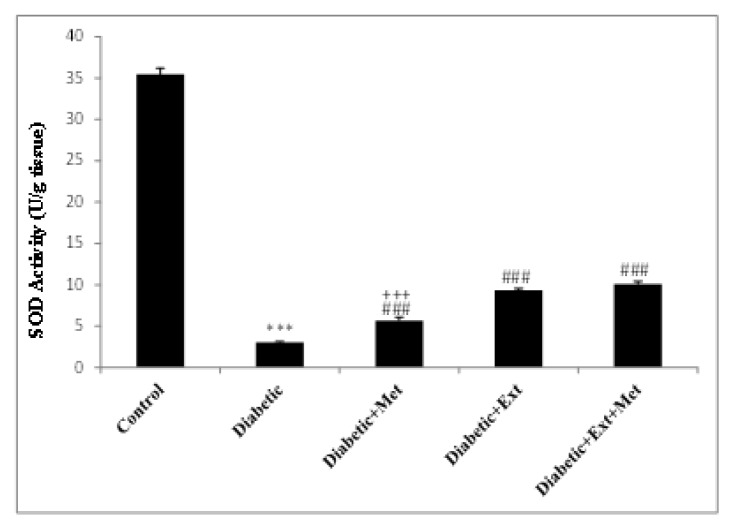
Fifty male Wistar rats were randomly divided into five groups: control, diabetic, diabetic + metformin, diabetic + extract, and diabetic + extract + metformin. Experimental diabetes was induced by a single-dose (55 mg/kg, intraperitoneally (ip)) injection of streptozotocin (STZ). Metformin (300 mg/kg) and extract (70 mg/kg) were orally administrated three days after STZ injection for four weeks. The levels of malondialdehyde (MDA), total thiol content and superoxide dismutase (SOD) and catalase activities were measured in the liver tissue. Serum glucose concentration, aspartate aminotransferase (AST) and alanine aminotransferase (ALT) activities were also determined.
In the diabetic group, serum glucose concentration, serum AST and ALT activities and liver MDA level were significantly higher while tissue total thiol content as well as catalase and SOD activities were lower, compared to the control group. Serum glucose in diabetic rats treated with metformin + extract showed a significant decrease compared with the diabetic group. In all the extract and metformin treated groups, serum ALT, tissue MDA level, total thiol content and SOD activity significantly improved compared with the diabetic rats. However, treatment of the diabetic rats only with metformin could not significantly change the activities of catalase and AST compared with the diabetic group.
These findings suggested that extract had a therapeutic effect on liver dysfuncyion and oxidative stress induced by diabetes, that may be probably due to its antioxidant and antiinflammatory effects.
氧化应激在糖尿病诱发的并发症中起核心作用。在本研究中,评估了[具体提取物名称未给出]对糖尿病诱发的肝脏氧化应激和功能障碍的保护作用。
将50只雄性Wistar大鼠随机分为五组:对照组、糖尿病组、糖尿病+二甲双胍组、糖尿病+[提取物名称未给出]提取物组和糖尿病+[提取物名称未给出]提取物+二甲双胍组。通过单次腹腔注射链脲佐菌素(STZ,55mg/kg)诱导实验性糖尿病。在注射STZ三天后,口服给予二甲双胍(300mg/kg)和[提取物名称未给出]提取物(70mg/kg),持续四周。测定肝组织中丙二醛(MDA)水平、总巯基含量、超氧化物歧化酶(SOD)和过氧化氢酶活性。还测定了血清葡萄糖浓度、天冬氨酸转氨酶(AST)和丙氨酸转氨酶(ALT)活性。
与对照组相比,糖尿病组血清葡萄糖浓度、血清AST和ALT活性以及肝脏MDA水平显著升高,而组织总巯基含量以及过氧化氢酶和SOD活性降低。与糖尿病组相比,二甲双胍+[提取物名称未给出]提取物治疗的糖尿病大鼠血清葡萄糖显著降低。在所有[提取物名称未给出]提取物和二甲双胍治疗组中,与糖尿病大鼠相比,血清ALT、组织MDA水平、总巯基含量和SOD活性均显著改善。然而,与糖尿病组相比,仅用二甲双胍治疗糖尿病大鼠不能显著改变过氧化氢酶和AST的活性。
这些发现表明,[提取物名称未给出]提取物对糖尿病诱发的肝脏功能障碍和氧化应激具有治疗作用,这可能归因于其抗氧化和抗炎作用。