Yilmaz Siobhan K, Bohara Alok K, Chowdhury Soumi Roy
Department of Economics, University of New Mexico, Albuquerque, NM, USA.
National Council of Applied Economic Research (NCAER), New Delhi, India.
Pharmacoecon Open. 2020 Jun;4(2):263-276. doi: 10.1007/s41669-019-0168-6.
To combat the lack of proper facilities and menstrual health knowledge in developing countries, many WASH (Water, Hygiene, and Sanitation) initiatives are including menstrual hygiene management (MHM) components. However, evidence shows that prior efforts have not been ultimately successful in inducing relevant behavior changes, due in part to cultural constraints and unidimensional interventions. As such, MHM research may need to include consideration of new theories/approaches. Evidence is growing of the role that physical presence/proximity and ability to touch objects has on incentives for consumers to purchase goods, captured through willingness to pay (WTP) figures. Such findings can be partially explained by Pavlovian processes.
This study sought to provide field-work validation of such findings of the role of Pavlovian processes and endowment effect on WTP figures for a female hygiene kit, reflecting motivation to adopt better hygiene behaviors.
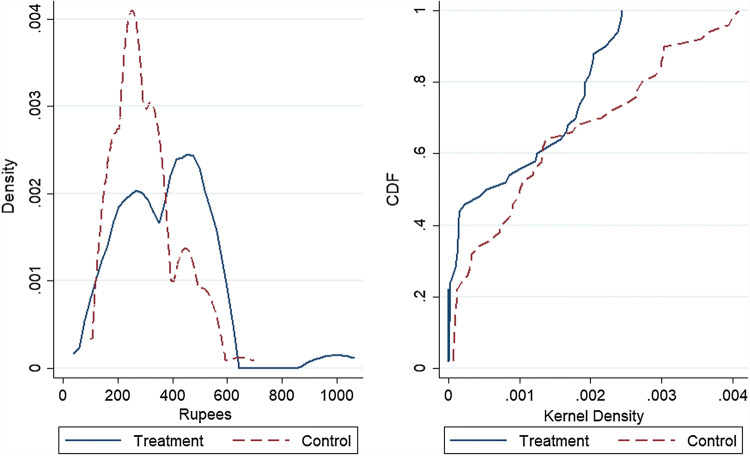
This study used primary survey data collected from females in two upper-level schools in southwestern Nepal (n = 169). When presented in conjunction with a hygiene education session, one group of females was allowed physical interaction with a female hygiene kit, while another was not, before being surveyed on their WTP for the kit. Both non-parametric and parametric statistical analyses were performed to assess the impact of this ability to touch the kits on WTP figures.
Results show a statistically significant difference between the WTP figures of those females allowed interaction with the kits prior to being surveyed and those who did not. This confirms the positive impact of physical presence/touch on motivations to use/acquire hygiene-related tools.
Such findings reveal how, through application of the theory of Pavlovian processes, future (menstrual) health education efforts could harness the human instinct to consume, remember, and use those objects presented in physical form, and include personal contact and demonstrations of better health practices in future MHM and WASH education initiatives. Such an approach may allow protocols and interventions to have more success, and dissemination of healthier behaviors and knowledge to be more prominent.
为应对发展中国家缺乏适当设施和月经健康知识的问题,许多水、卫生与环境卫生(WASH)倡议都纳入了月经卫生管理(MHM)内容。然而,有证据表明,先前的努力并未最终成功地促使相关行为发生改变,部分原因是文化限制和一维干预措施。因此,MHM研究可能需要考虑新的理论/方法。越来越多的证据表明,身体在场/接近以及触摸物体的能力对消费者购买商品的动机有影响,这通过支付意愿(WTP)数据得以体现。此类发现可部分由巴甫洛夫过程来解释。
本研究旨在对巴甫洛夫过程和禀赋效应在女性卫生用品套装的WTP数据方面所起作用的此类发现进行实地验证,以反映采用更好卫生行为的动机。
本研究使用了从尼泊尔西南部两所高中的女性中收集的原始调查数据(n = 169)。在结合卫生教育课程进行展示时,一组女性在被调查对该套装的WTP之前,被允许与女性卫生用品套装进行身体互动,而另一组则不允许。进行了非参数和参数统计分析,以评估触摸套装的这种能力对WTP数据的影响。
结果显示,在被调查之前被允许与套装互动的女性和未被允许的女性的WTP数据之间存在统计学上的显著差异。这证实了身体在场/触摸对使用/获取卫生相关工具的动机有积极影响。
此类发现揭示了如何通过应用巴甫洛夫过程理论,未来的(月经)健康教育努力可以利用人类消费、记忆和使用以实物形式呈现的物品的本能,并在未来的MHM和WASH教育倡议中纳入个人接触以及更好健康做法的示范。这种方法可能会使方案和干预措施更成功,并使更健康行为和知识的传播更显著。