Xiao Xuemei, Cheng Zhihui, Lv Jian, Xie Jianming, Ma Ning, Yu Jihua
College of Horticulture, Gansu Agricultural University, Lanzhou, Gansu Province, China.
College of Horticulture, Northwest A&F University, Yangling, Shaanxi Province, China.
PeerJ. 2019 Jul 15;7:e7267. doi: 10.7717/peerj.7267. eCollection 2019.
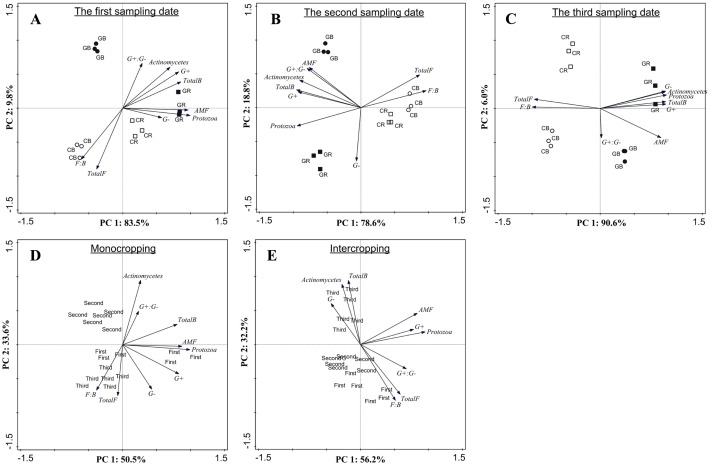
The continuous cropping obstacle of cucumber ( L.) under facility cultivation is more prevalent in China. This is associated with an imbalance in soil microbial and ecological environment in long-term monocultures. It was postulated that intercropping with green garlic would relieve the continuous cropping obstacle of cucumber by altering the soil micro-ecology status. A pot-based experiment was conducted to investigate the green garlic-cucumber intercropping and cucumber monocropping systems. The results showed that the cucumber shoot biomass was improved by intercropping with green garlic. However, the population of soil bacteria and actinomycetes increased, while the fungal population decreased. The fatty acid methyl ester (FAME) profiles indicated that soil contained more fungal FAME biomarkers (18:1ω9c, 18:2ω6, 9) and higher fungal:bacterial ratio in the monoculture system, whereas clustering of more bacterial FAME biomarkers (cy17:0, cy19:0, 16:1ω7c10, Me16:0, 10Me17:0, 10Me18:0) was observed under intercropping conditions. Moreover, significantly ( < 0.05) higher soil invertase and alkaline phosphatase activities, organic matter, and available N, P and K contents were observed under intercropping systems. These were high in both bulk and rhizosphere soils in the intercropping system when compared to monocropping system. These findings suggest that intercropping with green garlic can alleviate continuous cropping obstacle of cucumber by improving the diverse composition of soil microbial community, enzyme activities, and nutrient availability.
设施栽培条件下黄瓜(L.)的连作障碍在中国更为普遍。这与长期单作导致的土壤微生物和生态环境失衡有关。据推测,与青蒜间作可通过改变土壤微生态状况来缓解黄瓜的连作障碍。进行了一项基于盆栽的试验,以研究青蒜 - 黄瓜间作和黄瓜单作系统。结果表明,与青蒜间作可提高黄瓜地上部生物量。然而,土壤细菌和放线菌数量增加,而真菌数量减少。脂肪酸甲酯(FAME)谱表明,单作系统中土壤含有更多的真菌FAME生物标志物(18:1ω9c、18:2ω6,9)且真菌与细菌的比例更高,而在间作条件下观察到更多细菌FAME生物标志物(cy17:0、cy19:0、16:1ω7c10、Me16:0、10Me17:0、10Me18:0)聚集。此外,间作系统下土壤蔗糖酶和碱性磷酸酶活性、有机质以及有效氮、磷和钾含量均显著(<0.05)更高。与单作系统相比,间作系统中的表土和根际土壤均如此。这些结果表明,与青蒜间作可通过改善土壤微生物群落的多样组成、酶活性和养分有效性来缓解黄瓜的连作障碍。