Center for Health Services Research in Medicine, Department of Psychiatry and Psychotherapy, University Clinic Erlangen, Friedrich-Alexander-University Erlangen-Nürnberg (FAU), Schwabachanlage 6, 91054, Erlangen, Germany.
BMC Geriatr. 2019 Jul 25;19(1):196. doi: 10.1186/s12877-019-1207-y.
Day-care and telephone counseling have been discussed as effective support measures for caregivers of people with cognitive impairment.
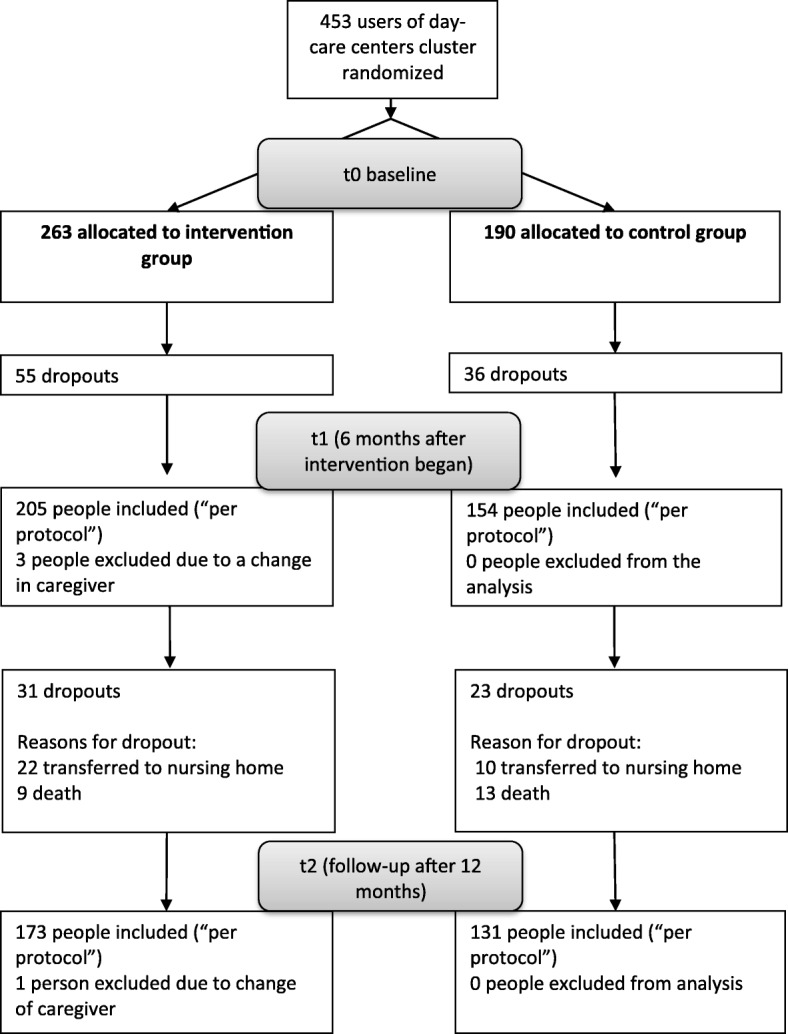
In a two-arm cluster-randomized trial involving multicomponent therapy for cognitively impaired persons in day-care centers and telephone counseling for their caregivers versus treatment as usual (TAU), we investigated long-term effects on caregivers' burden and depressiveness. Person-caregiver dyads involving home-dwelling persons with MCI, mild dementia, or moderate dementia were eligible. Day-care centers were randomized into an intervention group (IG) or a control group (CG). Outcome assessors were blinded. Out of 359 caregivers who had completed a 6-month intervention phase (n = 205, n = 154), a total of 304 of them were available at the 12-month follow-up (n = 173, n = 131). Instruments for assessing were the Burden Scale for Family Caregivers - short version (BSFC-s) (caregiver burden) and the Well-Being Index Score (WHO-5) (depressiveness). Mixed ANOVAs were used for the main analyses; descriptive statistics and subgroup analyses were additionally performed; secondary analyses involved multiple linear regressions for the main outcomes that were significant in the unadjusted main analysis.
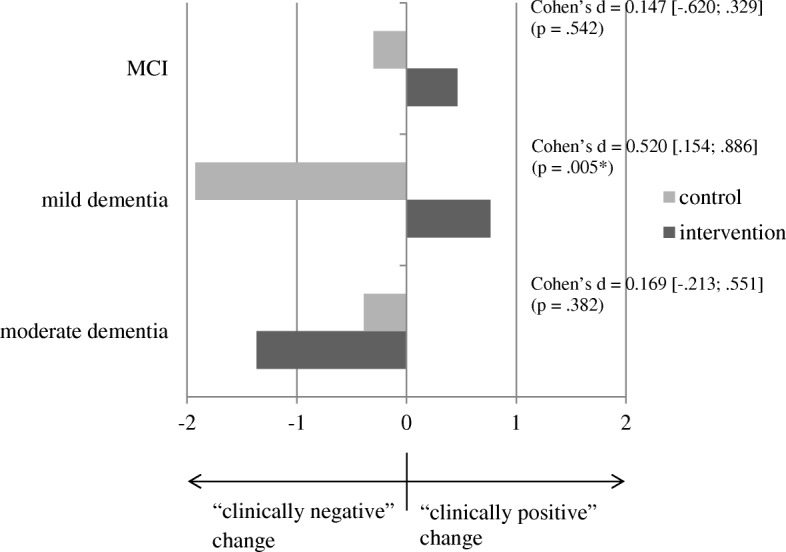
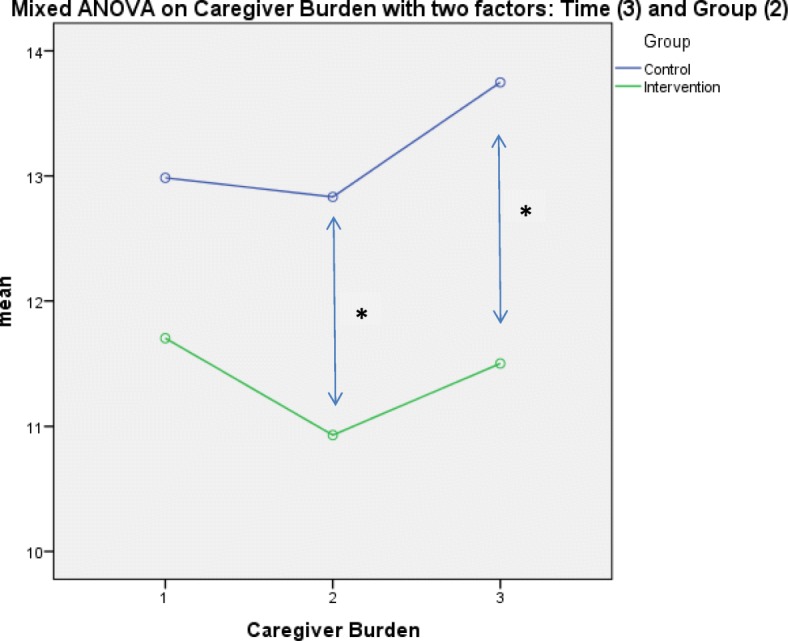
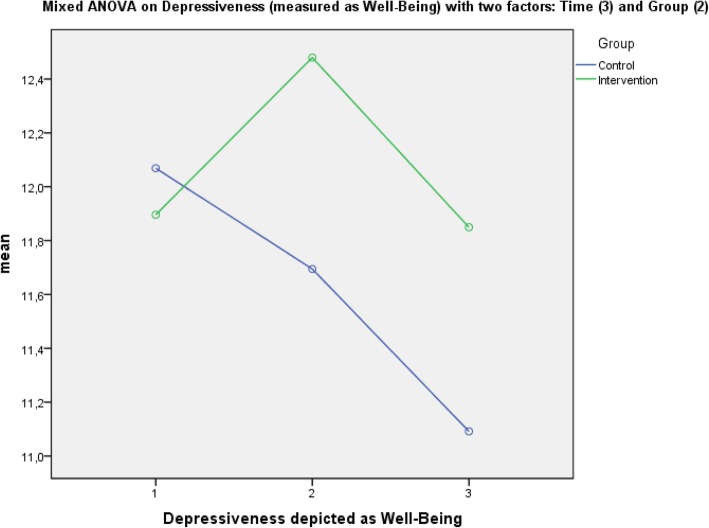
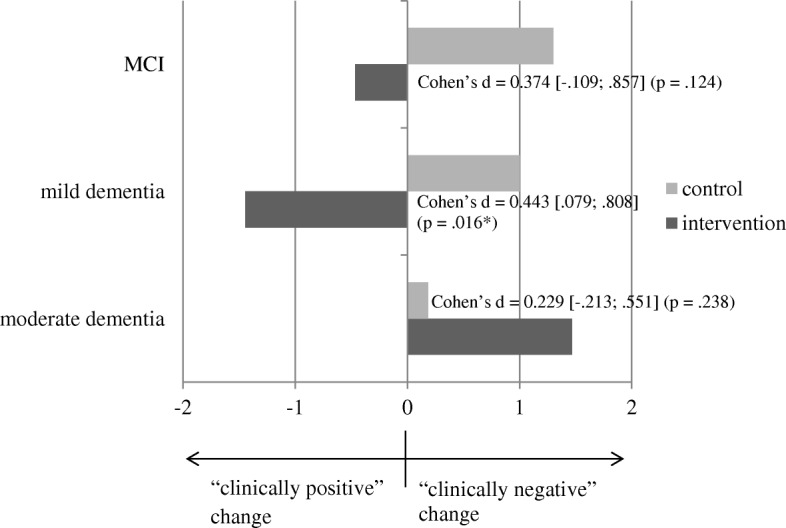
At follow-up, crude mean differences showed a nonsignificant advantage for the IG in caregiver burden [IG: -.20 (SD = 5.39) vs. CG: .76 (SD = 5.49), p = .126, d = .177] and depressiveness (reverse scored) [IG: -.05 (SD = 5.17) vs. CG: -.98 (SD = 5.65), p = .136, d = .173]. For caregiver burden, a mixed ANOVA resulted in significant main effects of group (F (1, 302) = 4.40; p = .037) and time (F (1.88, 568.96) = 3.56; p = .032) but not a significant interaction. The largest effects were found for the "mild dementia" subgroup (d = .443 for caregiver burden and d = .520 for depressiveness).
Positive long-term effects of a combined intervention involving telephone counseling for caregivers and multicomponent activation for patients were observed especially for mild dementia. However, the treatment effects washed out after the intervention ended.
ISRCTN16412551 (date: 30 July 2014, retrospectively).
日间护理和电话咨询已被讨论为认知障碍患者照顾者的有效支持措施。
在一项涉及日间护理中心对认知障碍患者进行多组分治疗和对其照顾者进行电话咨询与常规治疗(TAU)的两臂群组随机试验中,我们研究了对照顾者负担和抑郁的长期影响。符合条件的是居家的 MCI、轻度痴呆或中度痴呆患者及其照顾者。日间护理中心被随机分为干预组(IG)或对照组(CG)。结局评估者设盲。在完成 6 个月干预阶段的 359 名照顾者中(n=205,n=154),共有 304 名在 12 个月随访时可用(n=173,n=131)。评估工具包括家庭照顾者负担量表-简短版(BSFC-s)(照顾者负担)和世界卫生组织幸福感指数评分(WHO-5)(抑郁)。主要分析采用混合方差分析;另外还进行了描述性统计和亚组分析;次要分析涉及对主要结局的多重线性回归,这些主要结局在未调整的主要分析中具有统计学意义。
随访时,IG 在照顾者负担方面的粗均数差异无统计学意义[IG:-.20(SD=5.39)vs. CG:.76(SD=5.49),p=.126,d=.177]和抑郁(反向评分)[IG:-.05(SD=5.17)vs. CG:-.98(SD=5.65),p=.136,d=.173]。对于照顾者负担,混合方差分析得出组间有显著的主要效应(F(1,302)=4.40;p=.037)和时间(F(1.88,568.96)=3.56;p=.032),但无显著交互作用。最大的影响见于“轻度痴呆”亚组(照顾者负担的 d 值为.443,抑郁的 d 值为.520)。
对包括照顾者电话咨询和患者多组分激活的联合干预的积极长期影响尤其见于轻度痴呆。然而,治疗效果在干预结束后消失。
ISRCTN80315527(日期:2014 年 7 月 30 日,回顾性)。