Columbia University Mailman School of Public Health, New York, United States.
Columbia University Vagelos College of Physicians & Surgeons, New York, United States.
Environ Res. 2019 Oct;177:108595. doi: 10.1016/j.envres.2019.108595. Epub 2019 Jul 19.
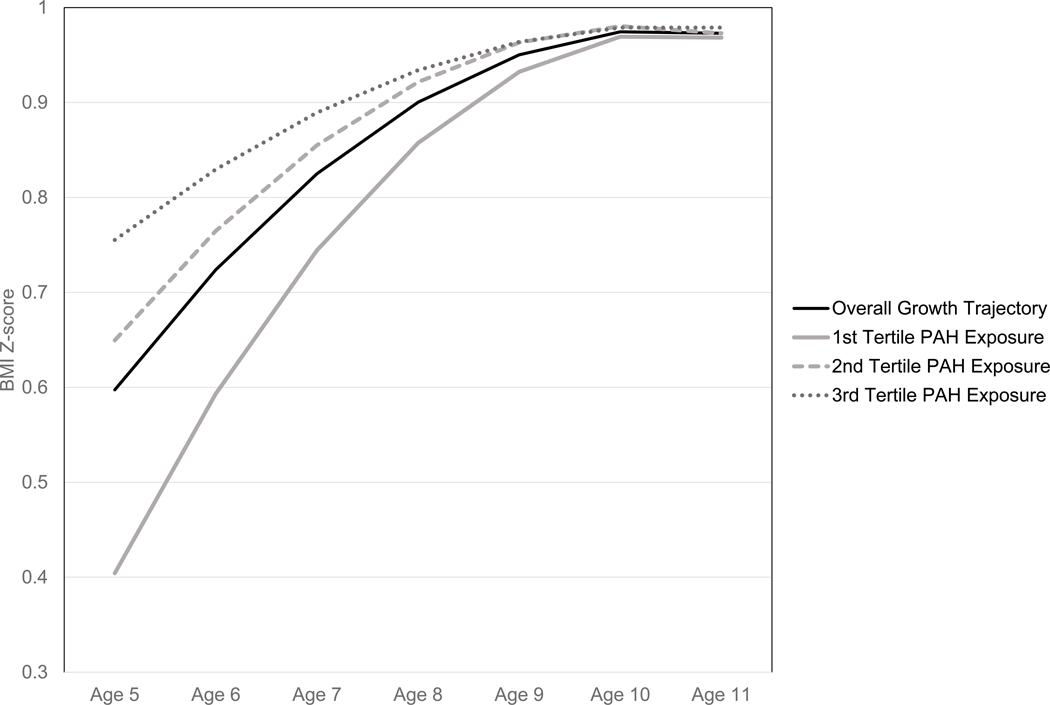
There is evidence that exposures to polycyclic aromatic hydrocarbons (PAH) and fine particles in air pollution are associated with higher childhood body mass index (BMI). Birth cohort analyses of prenatal exposures to PAH and child BMI Z-scores from age 5-14 years were conducted. African-American and Hispanic children born in the Bronx or Northern Manhattan, New York (1998-2006), whose mothers underwent personal air monitoring for airborne PAH exposure during pregnancy, were followed up with measurements of height and weight at approximate ages 5, 7, 9, 10, 11, 12.5 and 13.5 years. Multivariable generalized estimating equation analyses were used to relate prenatal airborne PAH exposures to child BMI Z-scores through time. The analyses adjusted for many known risk factors for childhood obesity and included interactions terms between age and exposure tertiles and age squared and exposure tertiles. In total, 535 children had at least one height and weight measure during follow-up. The prevalence of obesity was 20.6% at age 5 and increased across follow-ups until age 11 when it was 33.0%. At age 5, BMI Z-scores were significantly greater for children in the third tertile of exposure relative to the first tertile (0.35 Z-score units, 95% CI 0.09, 0.61, p = 0.007) and were non-significantly higher for the second tertile of exposure compared to the first tertile (0.25 Z-score units, 95% CI -0.02, 0.52, P = 0.075). The trajectories of BMI Z-scores by tertiles of exposure converged as the children aged, such that by age 11 years the estimated mean BMI Z-scores associated with each tertile of exposure were not different. Prenatal exposures to airborne PAH were associated with higher childhood BMI Z-scores at a young age, but growth trajectories converged by age 11 years. Accordingly, highly exposed children spend a greater proportion of their childhood with higher BMI Z-scores.
有证据表明,暴露于多环芳烃(PAH)和空气污染中的细颗粒物与儿童体重指数(BMI)较高有关。进行了产前暴露于 PAH 和儿童 BMI Z 分数的出生队列分析,这些儿童年龄在 5-14 岁之间。1998-2006 年,在纽约布朗克斯或北部曼哈顿出生的非裔美国人和西班牙裔儿童,其母亲在怀孕期间接受了个人空气监测以测量空气中的 PAH 暴露情况,随后在大约 5、7、9、10、11、12.5 和 13.5 岁时测量身高和体重。使用多变量广义估计方程分析来研究产前空气中 PAH 暴露与儿童 BMI Z 分数的关系。该分析调整了许多与儿童肥胖有关的已知危险因素,包括年龄与暴露三分位数之间的交互项以及年龄平方与暴露三分位数之间的交互项。共有 535 名儿童在随访期间至少有一次身高和体重测量值。5 岁时肥胖的患病率为 20.6%,并随着随访的进行而增加,直到 11 岁时达到 33.0%。在 5 岁时,与第一三分位数相比,暴露于第三三分位数的儿童 BMI Z 评分显着更高(0.35 Z 评分单位,95%CI 0.09,0.61,p=0.007),与第一三分位数相比,第二三分位数的暴露量略高(0.25 Z 评分单位,95%CI -0.02,0.52,P=0.075)。随着儿童年龄的增长,暴露三分位数的 BMI Z 评分轨迹趋于一致,以至于在 11 岁时,与每个暴露三分位数相关的估计平均 BMI Z 评分没有差异。产前暴露于空气中的 PAH 与儿童早期较高的 BMI Z 评分有关,但到 11 岁时,生长轨迹趋于一致。因此,高度暴露的儿童在其童年时期有更高 BMI Z 评分的比例更大。