Palou Pere, Muntaner-Mas Adrià, Cantallops Jaume, Borràs Pere Antoni, Labayen Idoia, Jiménez-Pavón David, Dorado García Cecilia, Moliner-Urdiales Diego, Rodríguez Pérez Manuel A, Rojo-Tirado Miguel A, Cadenas-Sanchez Cristina, Ortega Francisco B, Vidal-Conti Josep
GICAFE "Physical Activity and Exercise Sciences Research Group", University of the Balearic Islands, Palma, Spain.
PROFITH "PROmoting FITness and Health Through Physical Activity" Research Group, Faculty of Sport Sciences, Department of Physical Education and Sports, University of Granada, Granada, Spain.
Front Psychol. 2019 Jul 10;10:1585. doi: 10.3389/fpsyg.2019.01585. eCollection 2019.
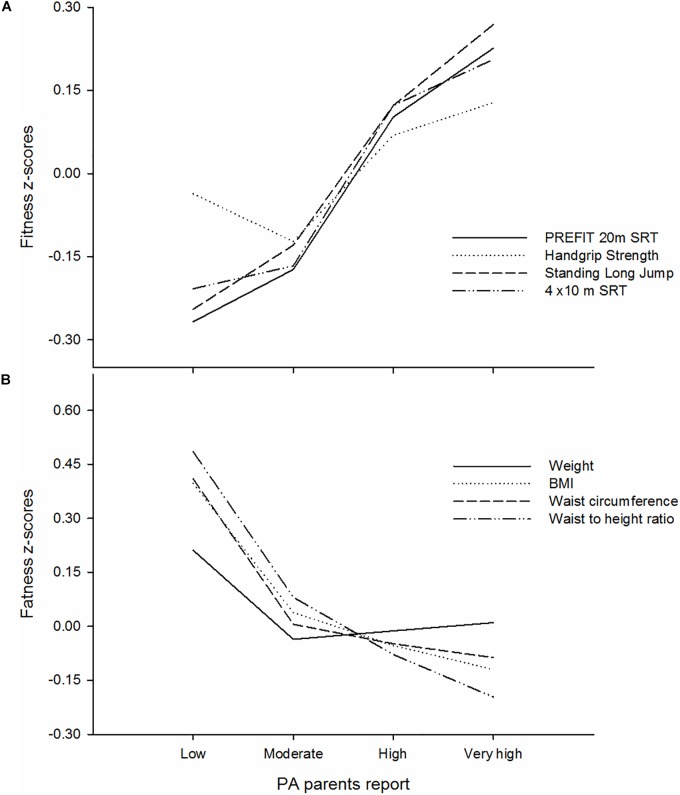
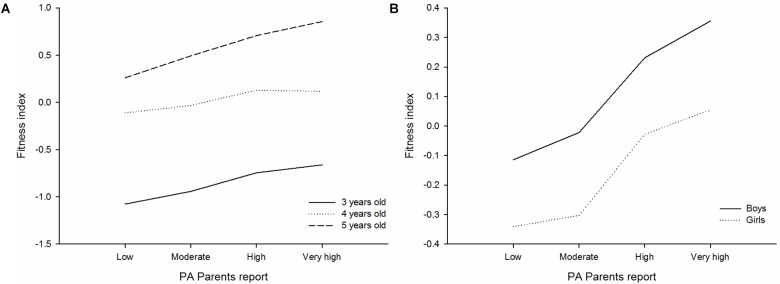
Physical inactivity is recognized as a determinant of low physical fitness and body composition in preschool children, which in turn, are important markers of health through the lifespan. Objective methods to assess physical activity, physical fitness and body composition in preschool children are preferable; however, they have some practical limitations in the school context. Therefore, the aim of this study was to test whether a single question regarding physical activity level of preschool children, reported by their parents, could be used as an alternative screening tool of physical fitness and body composition. The information was obtained from 10 different cities throughout Spain, gathering a total of 3179 healthy preschool children (52.8% boys and 47.2% girls) aged 3-5 years. Physical activity levels of preschool children were reported by parents using a single question with five response options (very low, low, average, high, or very high). Physical fitness and body composition were assessed with the PREFIT fitness battery. The results showed that parents' perception of their children's physical activity was positively associated with all objectively measured physical fitness components (β = -0.094 to 0.113; all < 0.020); and negatively with body composition indicators as measured (β = -0.113 to -0.058; all < 0.001). The results showed significant differences in all physical fitness and body composition -scores across the parent-reported physical activity levels (all < 0.017 and all < 0.001, respectively), as well as, for the fitness index ( < 0.001). Our study suggests that in school settings with insufficient resources to objectively assess fitness and body composition, parents-reported physical activity level by means of a single question might provide useful information about these important health markers in preschool children.
缺乏身体活动被认为是导致学龄前儿童身体素质低下和身体成分不健康的一个因素,而身体素质和身体成分又是贯穿一生的重要健康指标。评估学龄前儿童身体活动、身体素质和身体成分的客观方法更为可取;然而,在学校环境中,这些方法存在一些实际限制。因此,本研究的目的是测试由家长报告的关于学龄前儿童身体活动水平的单一问题,是否可以用作身体素质和身体成分的替代筛查工具。信息来自西班牙全国10个不同城市,共收集了3179名3至5岁的健康学龄前儿童(男孩占52.8%,女孩占47.2%)。家长通过一个有五个回答选项(极低、低、中等、高或非常高)的单一问题报告学龄前儿童的身体活动水平。使用PREFIT体能测试组合评估身体素质和身体成分。结果表明,家长对孩子身体活动的认知与所有客观测量的身体素质成分呈正相关(β = -0.094至0.113;均P < 0.020);与测量的身体成分指标呈负相关(β = -0.113至 -0.058;均P < 0.001)。结果显示,在家长报告的身体活动水平上,所有身体素质和身体成分得分均存在显著差异(分别为均P < 0.017和均P < 0.001),体能指数也有显著差异(P < 0.001)。我们的研究表明,在资源不足无法客观评估体能和身体成分的学校环境中,通过单一问题由家长报告的身体活动水平可能会提供有关学龄前儿童这些重要健康指标的有用信息。