Moore Kelsey R, Magnabosco Cara, Momper Lily, Gold David A, Bosak Tanja, Fournier Gregory P
Department of Earth, Atmospheric and Planetary Sciences, Massachusetts Institute of Technology, Cambridge, MA, United States.
Center for Computational Biology, Flatiron Institute, Simons Foundation, New York, NY, United States.
Front Microbiol. 2019 Jul 12;10:1612. doi: 10.3389/fmicb.2019.01612. eCollection 2019.
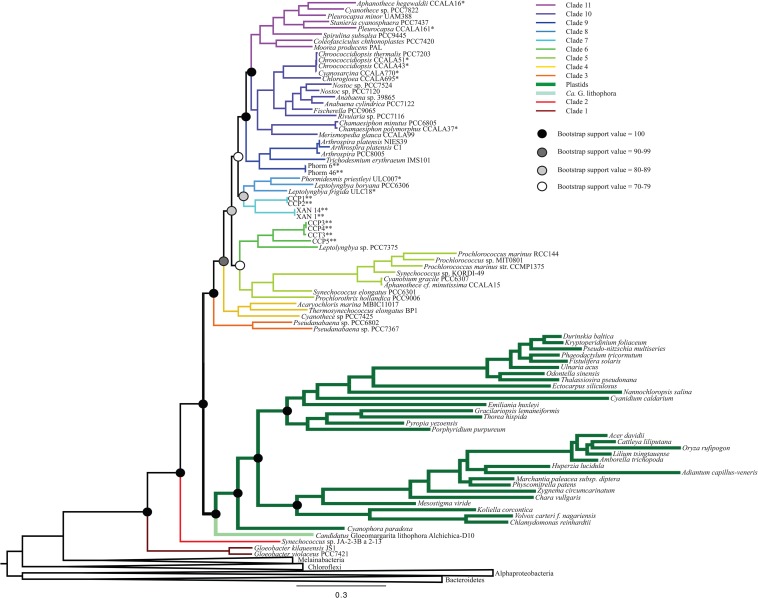
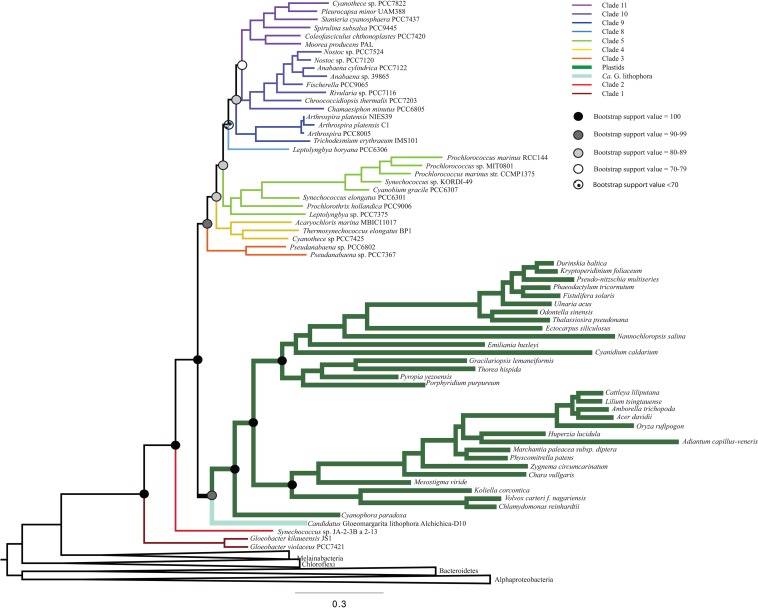
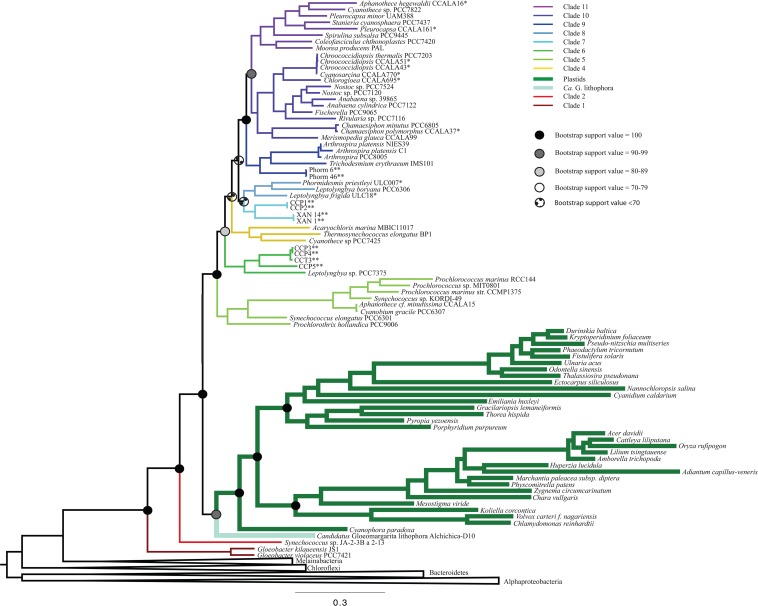
The phylum Cyanobacteria includes free-living bacteria and plastids, the descendants of cyanobacteria that were engulfed by the ancestral lineage of the major photosynthetic eukaryotic group Archaeplastida. Endosymbiotic events that followed this primary endosymbiosis spread plastids across diverse eukaryotic groups. The remnants of the ancestral cyanobacterial genome present in all modern plastids, enable the placement of plastids within Cyanobacteria using sequence-based phylogenetic analyses. To date, such phylogenetic studies have produced conflicting results and two competing hypotheses: (1) plastids diverge relatively recently in cyanobacterial evolution and are most closely related to nitrogen-fixing cyanobacteria, or (2) plastids diverge early in the evolutionary history of cyanobacteria, before the divergence of most cyanobacterial lineages. Here, we use phylogenetic analysis of ribosomal proteins from an expanded data set of cyanobacterial and representative plastid genomes to infer a deep placement for the divergence of the plastid ancestor lineage. We recover plastids as sister to and show that the group diverges from other cyanobacterial groups before , a previously unreported placement. The tree topologies and phylogenetic distances in our study have implications for future molecular clock studies that aim to model accurate divergence times, especially with respect to groups containing fossil calibrations. The newly sequenced cyanobacterial groups included here will also enable the use of novel cyanobacterial microfossil calibrations.
蓝藻门包括自由生活的细菌和质体,质体是蓝藻的后代,被主要光合真核生物类群古质体植物的祖先谱系所吞噬。在这种原始内共生之后发生的内共生事件,使质体在不同的真核生物类群中传播。所有现代质体中都存在的祖先蓝藻基因组的残余部分,使得通过基于序列的系统发育分析能够将质体置于蓝藻门内。迄今为止,这类系统发育研究产生了相互矛盾的结果和两种相互竞争的假说:(1)质体在蓝藻进化中相对较晚分化,与固氮蓝藻关系最为密切;或者(2)质体在蓝藻进化历史早期分化,早于大多数蓝藻谱系的分化。在这里,我们对来自扩大的蓝藻和代表性质体基因组数据集的核糖体蛋白进行系统发育分析,以推断质体祖先谱系分化的深度位置。我们发现质体是[某一蓝藻类群]的姐妹群,并表明该类群在[另一蓝藻类群]之前就与其他蓝藻类群分化,这是一个以前未报道过的位置。我们研究中的树形拓扑结构和系统发育距离,对未来旨在模拟准确分化时间的分子钟研究有影响,特别是对于包含化石校准的类群。这里新测序的蓝藻类群也将使得能够使用新的蓝藻微化石校准。