Infection Biology Unit, Deutsches Primatenzentrum - Leibniz Institute for Primate Research, Kellnerweg 4, 37077 Göttingen, Germany; Faculty of Biology and Psychology, University Göttingen, Wilhelm-Weber-Str. 2, 37073 Göttingen, Germany.
Infection Biology Unit, Deutsches Primatenzentrum - Leibniz Institute for Primate Research, Kellnerweg 4, 37077 Göttingen, Germany; Faculty of Biology and Psychology, University Göttingen, Wilhelm-Weber-Str. 2, 37073 Göttingen, Germany.
Virology. 2019 Sep;535:261-265. doi: 10.1016/j.virol.2019.07.016. Epub 2019 Jul 19.
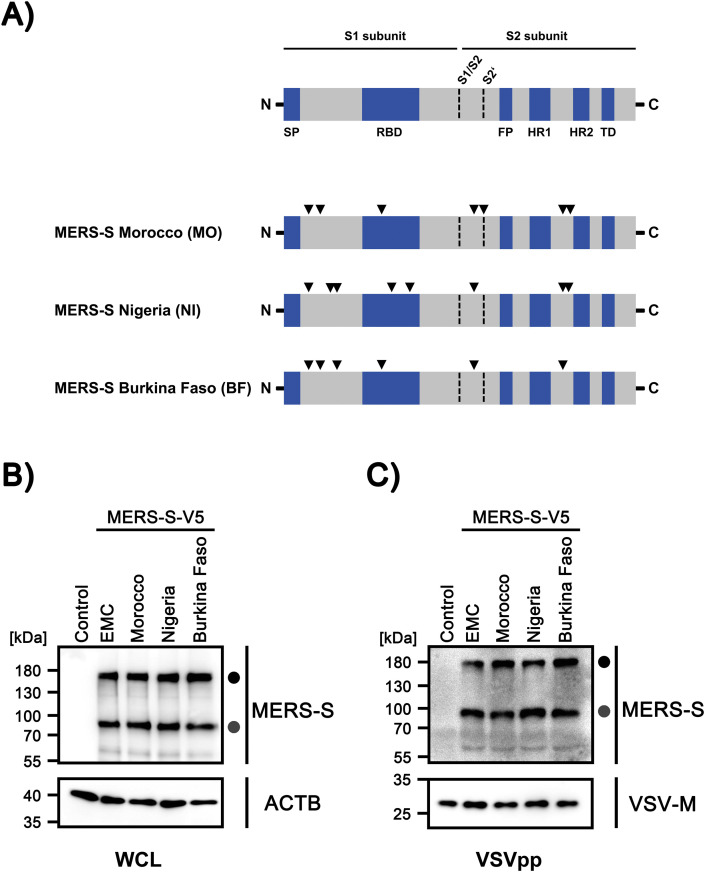
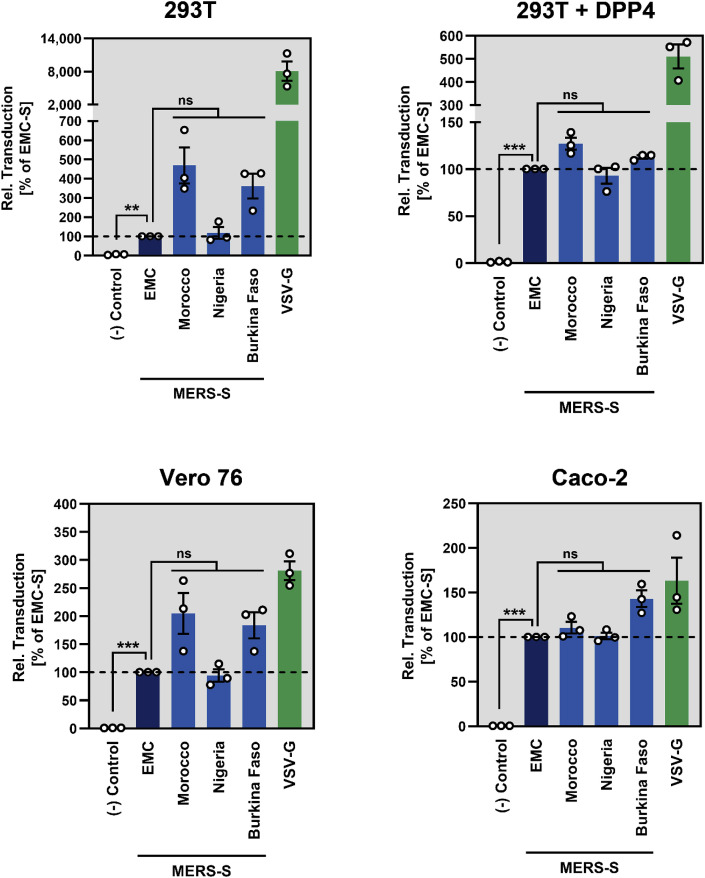
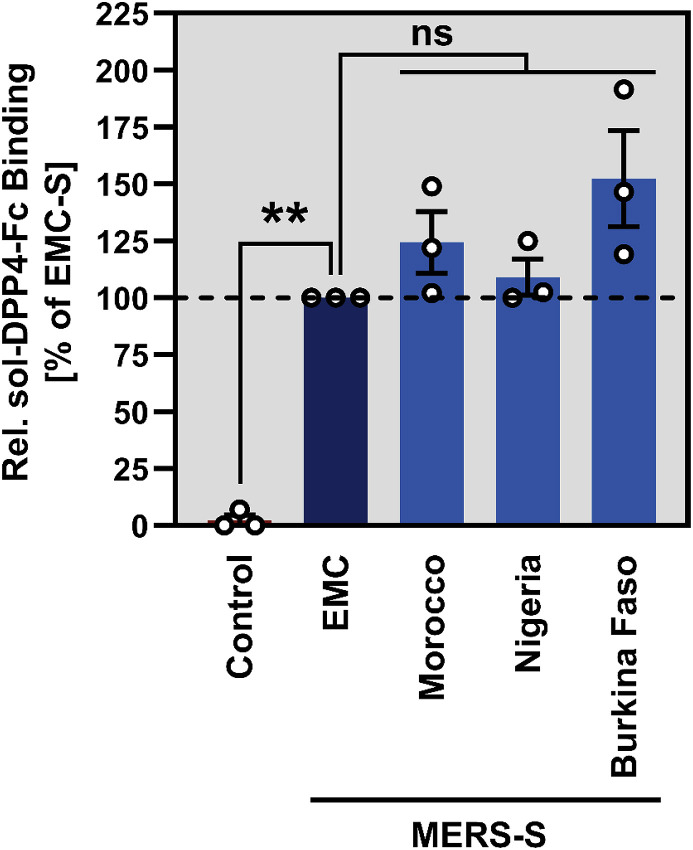
The highly pathogenic Middle East respiratory syndrome (MERS)-related coronavirus (CoV) is transmitted from dromedary camels, the natural reservoir, to humans. For at present unclear reasons, MERS cases have so far only been observed in the Arabian Peninsula, although MERS-CoV also circulates in African dromedary camels. A recent study showed that MERS-CoV found in North/West- (Morocco) and West-African (Burkina Faso and Nigeria) dromedary camels are genetically distinct from Arabian viruses and have reduced replicative capacity in human cells, potentially due to amino acid changes in one or more viral proteins. Here, we show that the spike (S) proteins of the prototypic Arabian MERS-CoV strain, human betacoronavirus 2c EMC/2012, and the above stated African MERS-CoV variants do not appreciably differ in expression, DPP4 binding and ability to drive entry into target cells. Thus, virus-host-interactions at the entry stage may not limit spread of North- and West-African MERS-CoV in human cells.
高致病性中东呼吸综合征(MERS)相关冠状病毒(CoV)从骆驼,即其自然宿主,传播给人类。由于目前尚不清楚的原因,尽管 MERS-CoV 也在非洲单峰驼中传播,但迄今为止,MERS 病例仅在阿拉伯半岛观察到。最近的一项研究表明,在北非/西北(摩洛哥)和西非(布基纳法索和尼日利亚)的单峰驼中发现的 MERS-CoV 与阿拉伯病毒在基因上不同,并且在人细胞中的复制能力降低,这可能是由于一种或多种病毒蛋白中的氨基酸变化。在这里,我们表明,原型阿拉伯 MERS-CoV 株、人类β冠状病毒 2c EMC/2012 和上述非洲 MERS-CoV 变体的刺突(S)蛋白在表达、DPP4 结合和驱动进入靶细胞的能力方面没有明显差异。因此,在进入阶段的病毒-宿主相互作用可能不会限制北非和西非 MERS-CoV 在人细胞中的传播。