Smith Parker, Cozart Jamison, Lynn Bryan K, Alberts Erin, Frangipani Emanuela, Schuster Martin
Department of Microbiology, Oregon State University, Corvallis, OR 97331, USA.
Department of Integrative Biology, Oregon State University, Corvallis, OR 97331, USA.
iScience. 2019 Sep 27;19:101-109. doi: 10.1016/j.isci.2019.07.015. Epub 2019 Jul 16.
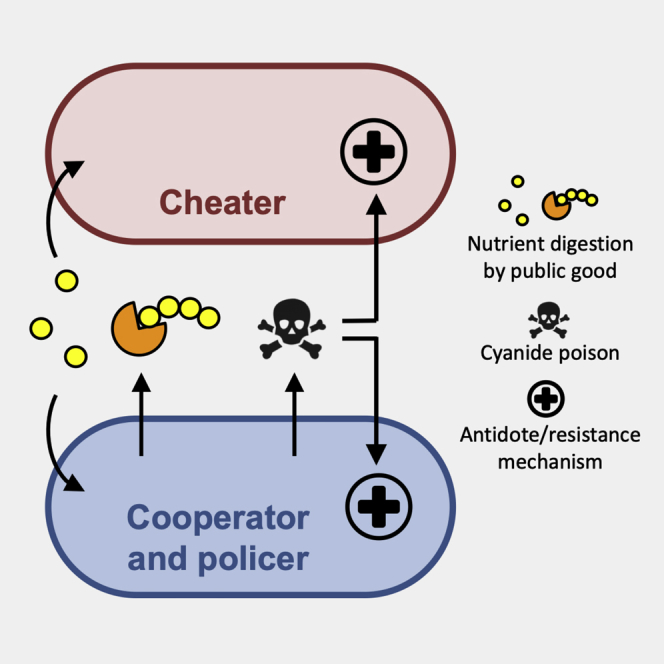
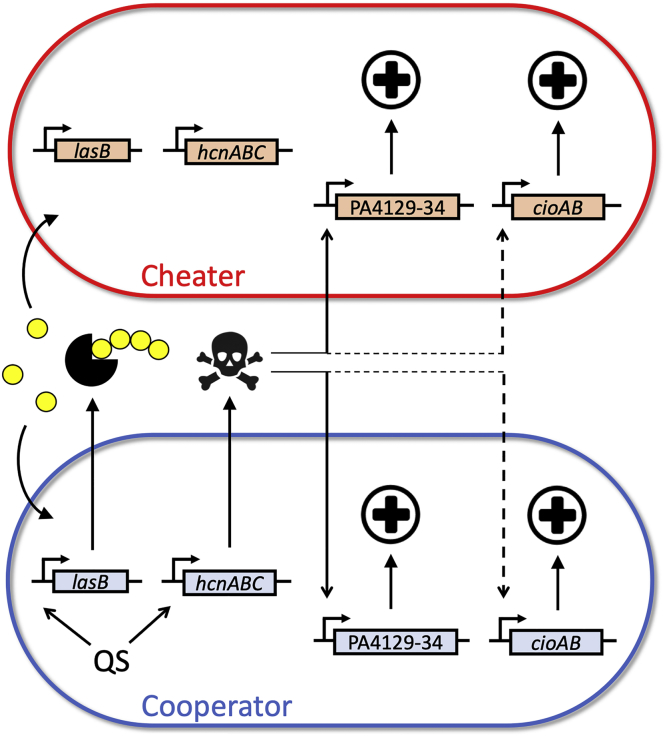
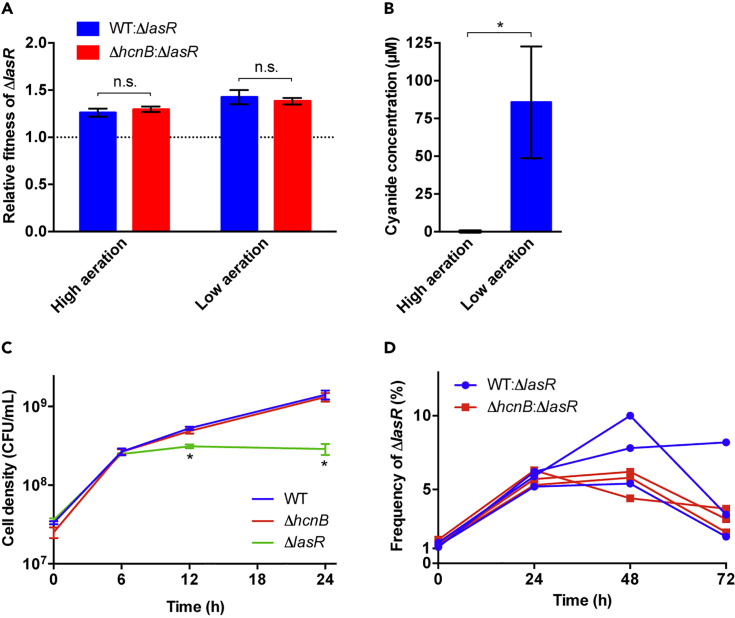
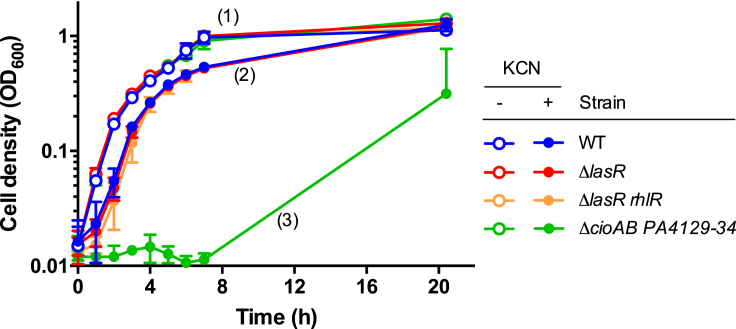
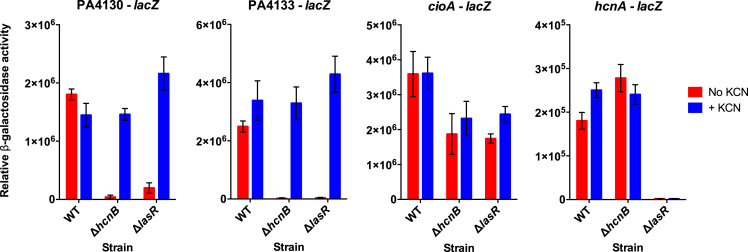
In all domains of life, mechanisms exist that protect cooperating groups from exploitation by cheaters. Recent observations with the bacterium Pseudomonas aeruginosa have suggested a paradigmatic cheater control mechanism in which cooperator cells punish or "police" cheater cells by cyanide poisoning. These cheater cells are deficient in a pleiotropic quorum-sensing regulator that controls the production of cooperative secretions including cyanide, and presumably also cyanide resistance. In this study, we directly tested and refuted the cyanide policing model. Contrary to the hypothesis, cheater fitness was unaffected by the presence of cyanide. Cheater mutants grew equally well in co-cultures with either cyanide-proficient or cyanide-deficient cooperators, and they were as resistant to exogenous cyanide as wild-type cells. We show that these behaviors are the result of quorum-sensing-independent and cyanide-responsive resistance gene regulation. Our results highlight the role of genetic architecture in the evolution of cooperative behavior.
在生命的所有领域中,都存在着保护合作群体不被作弊者利用的机制。最近对铜绿假单胞菌的观察表明了一种典型的作弊者控制机制,即合作者细胞通过氰化物中毒来惩罚或“监管”作弊者细胞。这些作弊者细胞缺乏一种多效性群体感应调节因子,该调节因子控制包括氰化物在内的合作分泌物的产生,并且可能还控制氰化物抗性。在这项研究中,我们直接测试并驳斥了氰化物监管模型。与假设相反,氰化物的存在并未影响作弊者的适应性。作弊者突变体在与氰化物产生能力正常或缺乏氰化物的合作者共培养时生长情况相同,并且它们对外源氰化物的抗性与野生型细胞相同。我们表明,这些行为是群体感应非依赖性和氰化物响应性抗性基因调控的结果。我们的结果突出了遗传结构在合作行为进化中的作用。