Department of Botany, School of Chemical and Life Sciences, Hamdard University, New Delhi, 110 062, India.
Biol Res. 2019 Jul 29;52(1):39. doi: 10.1186/s40659-019-0246-3.
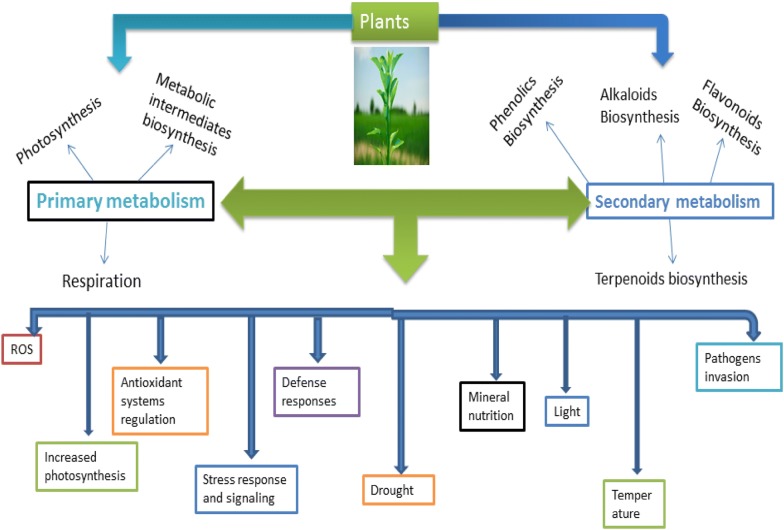
In the growth condition(s) of plants, numerous secondary metabolites (SMs) are produced by them to serve variety of cellular functions essential for physiological processes, and recent increasing evidences have implicated stress and defense response signaling in their production. The type and concentration(s) of secondary molecule(s) produced by a plant are determined by the species, genotype, physiology, developmental stage and environmental factors during growth. This suggests the physiological adaptive responses employed by various plant taxonomic groups in coping with the stress and defensive stimuli. The past recent decades had witnessed renewed interest to study abiotic factors that influence secondary metabolism during in vitro and in vivo growth of plants. Application of molecular biology tools and techniques are facilitating understanding the signaling processes and pathways involved in the SMs production at subcellular, cellular, organ and whole plant systems during in vivo and in vitro growth, with application in metabolic engineering of biosynthetic pathways intermediates.
在植物的生长条件下,它们会产生大量的次生代谢物 (SMs),以满足生理过程所必需的各种细胞功能,最近越来越多的证据表明,次生代谢物的产生与应激和防御反应信号有关。植物产生的次生分子的类型和浓度取决于物种、基因型、生理、发育阶段和生长过程中的环境因素。这表明,不同植物分类群在应对应激和防御刺激时所采用的生理适应反应。在过去的几十年里,人们重新产生了兴趣,研究影响植物体内和体外生长过程中次生代谢的非生物因素。分子生物学工具和技术的应用,促进了对 SMs 产生的信号过程和途径的理解,这些信号过程和途径涉及到亚细胞、细胞、器官和整个植物系统,应用于生物合成途径中间产物的代谢工程。