Cardiff School of Sport and Health Sciences, Cardiff Metropolitan University, Cardiff CF236XD, United Kingdom;
Centre for Heart, Lung and Vascular Health, University of British Columbia Okanagan, Kelowna, BC V1V 1V7, Canada.
Proc Natl Acad Sci U S A. 2019 Aug 13;116(33):16177-16179. doi: 10.1073/pnas.1909002116. Epub 2019 Jul 29.
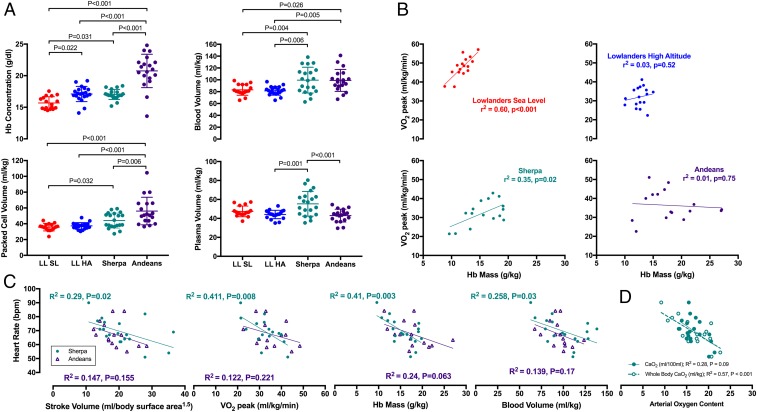
In contrast to Andean natives, high-altitude Tibetans present with a lower hemoglobin concentration that correlates with reproductive success and exercise capacity. Decades of physiological and genomic research have assumed that the lower hemoglobin concentration in Himalayan natives results from a blunted erythropoietic response to hypoxia (i.e., no increase in total hemoglobin mass). In contrast, herein we test the hypothesis that the lower hemoglobin concentration is the result of greater plasma volume, rather than an absence of increased hemoglobin production. We assessed hemoglobin mass, plasma volume and blood volume in lowlanders at sea level, lowlanders acclimatized to high altitude, Himalayan Sherpa, and Andean Quechua, and explored the functional relevance of volumetric hematological measures to exercise capacity. Hemoglobin mass was highest in Andeans, but also was elevated in Sherpa compared with lowlanders. Sherpa demonstrated a larger plasma volume than Andeans, resulting in a comparable total blood volume at a lower hemoglobin concentration. Hemoglobin mass was positively related to exercise capacity in lowlanders at sea level and in Sherpa at high altitude, but not in Andean natives. Collectively, our findings demonstrate a unique adaptation in Sherpa that reorientates attention away from hemoglobin concentration and toward a paradigm where hemoglobin mass and plasma volume may represent phenotypes with adaptive significance at high altitude.
与安第斯原住民不同,高海拔的藏民血红蛋白浓度较低,但这与生殖成功和运动能力相关。几十年来,生理和基因组研究一直假设喜马拉雅原住民的血红蛋白浓度较低是由于对低氧的促红细胞生成反应迟钝(即总血红蛋白质量没有增加)。相比之下,我们在此检验了一个假设,即较低的血红蛋白浓度是由于血浆量增加,而不是由于血红蛋白生成增加。我们评估了低地居民在海平面、低地居民适应高海拔、喜马拉雅夏尔巴人和安第斯克丘亚人血红蛋白质量、血浆体积和血容量,并探讨了容积血液学测量与运动能力的功能相关性。血红蛋白质量在安第斯人最高,但与低地居民相比,夏尔巴人也有所升高。与安第斯人相比,夏尔巴人表现出更大的血浆量,从而在较低的血红蛋白浓度下产生相当的总血容量。血红蛋白质量与低地居民在海平面和夏尔巴人在高海拔时的运动能力呈正相关,但与安第斯原住民无关。总的来说,我们的研究结果表明,夏尔巴人有一种独特的适应,这种适应将注意力从血红蛋白浓度转移到一个新的范式,即血红蛋白质量和血浆量在高海拔地区可能代表具有适应意义的表型。