Barry Robert J, Sii Freda, Bruynseels Alice, Abbott Joseph, Blanch Richard J, MacEwen Caroline J, Shah Peter
Department of Ophthalmology, Queen Elizabeth Hospital Birmingham, University Hospitals Birmingham NHS Foundation Trust, Birmingham, UK.
Neuroscience and Ophthalmology, Institute of Inflammation and Ageing, University of Birmingham, Birmingham, UK.
Clin Ophthalmol. 2019 Jul 8;13:1165-1172. doi: 10.2147/OPTH.S201900. eCollection 2019.
Worldwide, as many as 6 million children annually sustain ocular trauma, with up to a quarter of a million children requiring hospitalization. Management of pediatric ocular trauma differs from that in adults, both in terms of initial assessment and acute intervention, with significant variation in practice between different centers. Patterns of healing and long-term outcomes are also very different for children compared to adults. In order to develop effective protocols for management, it is first necessary to understand current trends in presentation and treatment.
We conducted a prospective, observational study of pediatric ocular trauma presenting to UK-based ophthalmologists over a one-year period; reporting cards were distributed by the British Ophthalmic Surveillance Unit, and clinicians were asked to report cases of acute orbital and ocular trauma in children aged 16 years or less requiring inpatient or day-case admission. A validated, standardized questionnaire was sent to reporting ophthalmologists to collect data on clinical features and initial management of injury.
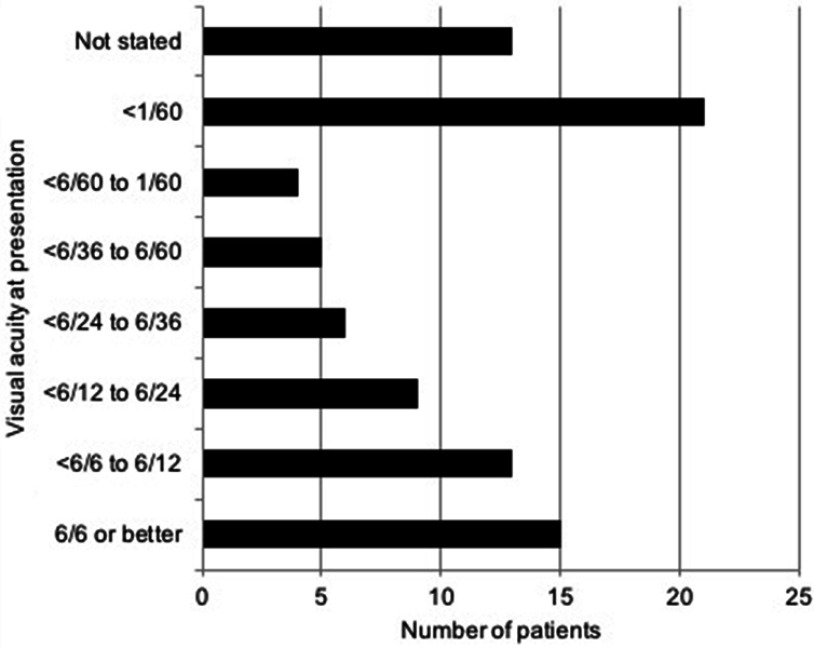
Eighty-six episodes of pediatric ocular trauma were reported. Trauma involving the globe was reported in 66/86 patients (76.7%), of which 40/66 (60.1%) were open-globe. Trauma to the anterior segment was reported in 57/86 (66.3%), and posterior segment in 23/86 patients (26.7%). Twenty-five of 86 (29.1%) patients sustained severe trauma defined as having best-corrected visual acuity worse than 6/60 Snellen (incidence 0.19 per 100,000 population).
There has been no improvement in the incidence or severity of pediatric ocular injury rates over the past 25 years. Eye-care providers must be able to provide the necessary services for assessment and management of severe pediatric ocular trauma in the emergency setting.
在全球范围内,每年多达600万儿童遭受眼外伤,其中多达25万儿童需要住院治疗。儿童眼外伤的处理在初始评估和急性干预方面均与成人不同,不同中心的实践差异很大。与成人相比,儿童的愈合模式和长期预后也有很大差异。为了制定有效的处理方案,首先有必要了解目前的就诊和治疗趋势。
我们对在英国眼科医生处就诊的儿童眼外伤进行了为期一年的前瞻性观察研究;由英国眼科监测单位分发报告卡,要求临床医生报告16岁及以下需要住院或日间手术的儿童急性眼眶和眼外伤病例。向报告的眼科医生发送一份经过验证的标准化问卷,以收集有关损伤临床特征和初始处理的数据。
共报告了86例儿童眼外伤事件。86例患者中有66例(76.7%)报告有眼球损伤,其中66例中的40例(60.1%)为开放性眼球损伤。86例中有57例(66.3%)报告有前段损伤,23例(26.7%)有后段损伤。86例患者中有25例(29.1%)遭受严重创伤,定义为最佳矫正视力低于6/60 Snellen(发病率为每10万人0.19例)。
在过去25年中,儿童眼外伤的发病率和严重程度没有改善。眼保健提供者必须能够在紧急情况下为严重儿童眼外伤的评估和处理提供必要的服务。