Su Yun, Feng Zemeng, He Yumin, Hong Lingling, Liu Gang, Li Tiejun, Yin Yulong
Hunan international joint laboratory of Animal Intestinal Ecology and Health, Laboratory of Animal Nutrition and Human Health, College of Life Sciences, Hunan Normal University, Changsha, China.
Key Laboratory of Agro-ecological Processes in Subtropical Region, Institute of Subtropical Agriculture, Chinese Academy of Sciences; National Engineering Laboratory for Pollution Control and Waste Utilization in Livestock and Poultry Production; Hunan Provincial Engineering Research Center for Healthy Livestock and Poultry Production; Scientific Observing and Experimental Station of Animal Nutrition and Feed Science in South-Central, Ministry of Agriculture, Changsha, China.
Food Nutr Res. 2019 Jul 17;63. doi: 10.29219/fnr.v63.1444. eCollection 2019.
Obesity and its related metabolic syndrome continue to be major public health problems. Monosodium L-glutamate (MSG) may cause metabolic diseases such as obesity. Meanwhile, the Chinese population has undergone rapid transition to a high-fat diet. There is little information available on the effect of MSG and fat alone, or in combination, on free fatty acids (FFAs), lipid metabolism and FFA receptors.
The aim of this study was to evaluate the effects of MSG and fat alone, or in combination, on intestinal luminal FFAs and expression of gastrointestinal FFA receptors. The aim was also to test whether dietary fat and/or MSG could affect expression of genes related to fatty acid metabolism.
A total of 32 growing pigs were used and fed with four iso-nitrogenous and iso-caloric diets. Pigs in the four treatments received diets with one of two fat concentrations levels (4.4 and 9.4%) and one of two MSG dose levels (0 and 3%), in which most of the fat were brought by soybean oil. The concentration of short chain fatty acids (SCFAs) in cecum and colon, long chain fatty acids (LCFAs) in ileum, cecum and colon, and FFAs receptors expression in hypothalamus and gastrointestinal tract were determined.
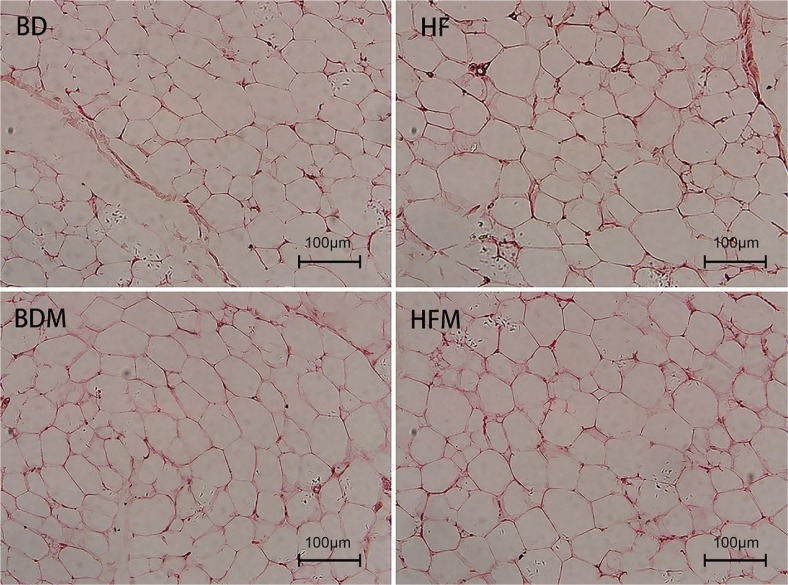
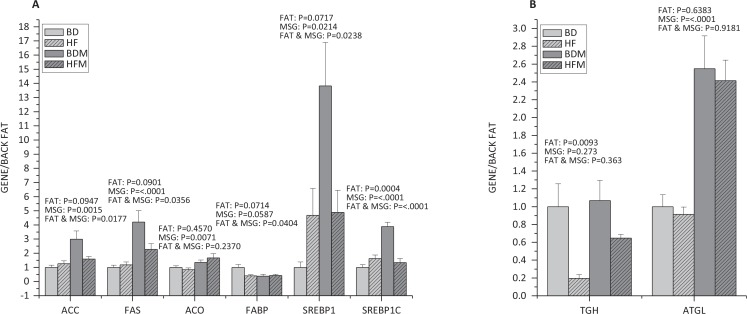
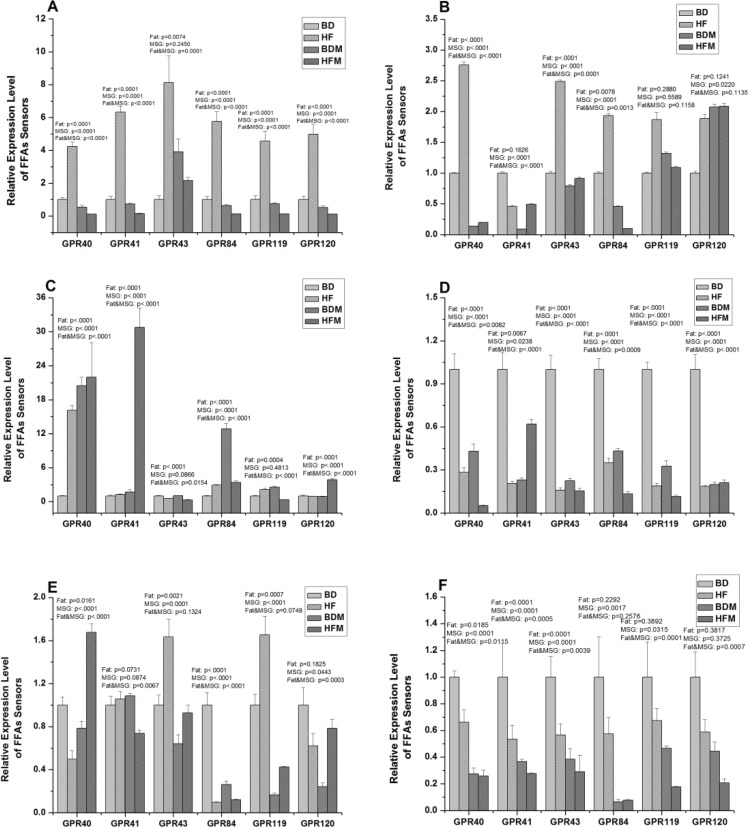
MSG and/or fat changed intestinal luminal SCFAs, levels of LCFAs, and showed an antagonistic effect on most of LCFAs. Simultaneously, MSG and/or fat decreased the expression of FFA receptors in hypothalamus and gastrointestinal tract. MSG and/or fat promoted fat deposition through different ways in back fat.
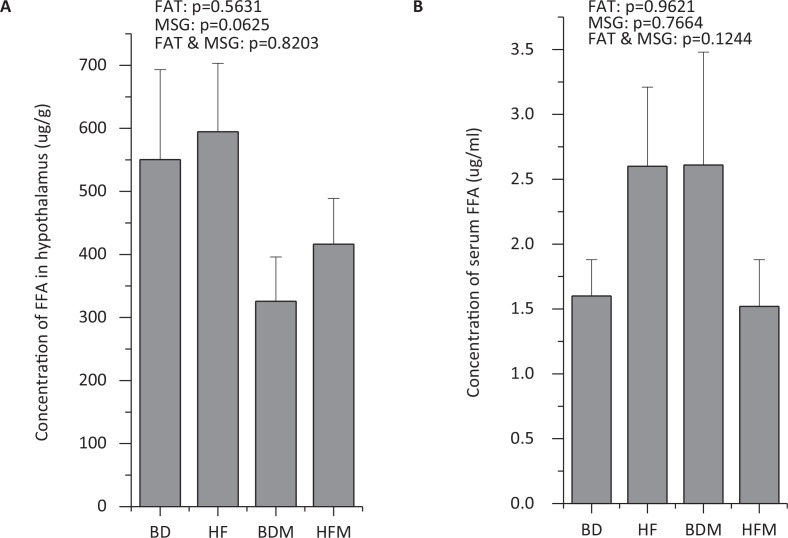
Our results support that MSG and/or fat can alter intestinal luminal FFAs composition and concentration, especially LCFAs, in addition, the expression of FFA receptors in ileum and hypothalamus could be decreased. Moreover, MSG and/or fat can promote protein deposition in back fat, and affect the distribution and metabolism of fatty acids in the body tissues and the body's ability to perceive fatty acids; these results provide a reference for the occurrence of fat deposition and obesity caused by high-fat and monosodium glutamate diet.
肥胖及其相关的代谢综合征仍然是主要的公共卫生问题。L-谷氨酸钠(MSG)可能会引发肥胖等代谢性疾病。与此同时,中国人群已迅速过渡到高脂肪饮食。关于MSG和脂肪单独或联合作用对游离脂肪酸(FFA)、脂质代谢及FFA受体的影响,目前可用信息较少。
本研究旨在评估MSG和脂肪单独或联合作用对肠腔FFA及胃肠道FFA受体表达的影响。同时,检测膳食脂肪和/或MSG是否会影响脂肪酸代谢相关基因的表达。
选用32头生长猪,饲喂四种等氮等热量日粮。四种处理中的猪分别接受两种脂肪浓度水平(4.4%和9.4%)和两种MSG剂量水平(0和3%)之一的日粮,其中大部分脂肪由大豆油提供。测定盲肠和结肠中短链脂肪酸(SCFA)的浓度、回肠、盲肠和结肠中长链脂肪酸(LCFA)的水平,以及下丘脑和胃肠道中FFA受体的表达。
MSG和/或脂肪改变了肠腔SCFA、LCFA水平,并对大多数LCFA表现出拮抗作用。同时,MSG和/或脂肪降低了下丘脑和胃肠道中FFA受体的表达。MSG和/或脂肪通过不同方式促进背部脂肪的脂肪沉积。
我们的研究结果表明,MSG和/或脂肪可改变肠腔FFA组成和浓度,尤其是LCFA,此外,还可降低回肠和下丘脑中FFA受体的表达。而且,MSG和/或脂肪可促进背部脂肪的蛋白质沉积,并影响体内组织中脂肪酸的分布和代谢以及机体感知脂肪酸的能力;这些结果为高脂和味精饮食导致脂肪沉积和肥胖的发生提供了参考。