Feng Ze-Meng, Li Tie-Jun, Wu Li, Xiao Ding-Fu, Blachier Francois, Yin Yu-Long
Institute of Subtropical Agriculture, The Chinese Academy of Sciences, Research Center of Healthy Breeding Livestock & Poultry, Hunan Engineering & Research Center of Animal & Poultry Science, Key Lab Agro-Ecology Processing Subtropical Region, Scientific Observational and Experimental Station of Animal Nutrition and Feed Science in South-Central, Ministry of Agriculture, Changsha, Hunan, China.
Obes Facts. 2015;8(2):87-100. doi: 10.1159/000380889. Epub 2015 Mar 10.
The Chinese have been undergone rapid transition to a high-fat diet-consuming lifestyle, while monosodium L-glutamate (MSG) is widely used as a daily food additive. It has been reported that fat alters the composition of intestinal microbiota. However, little information is available on the effects of oral MSG on intestinal microbiota, and no study was done focusing on the interaction effect of fat and MSG with respect to intestinal microbiota. The present study thus aimed to determine the effects of MSG and/or fat on intestinal microbiota, and also to identify possible interactions between these two nutrients.
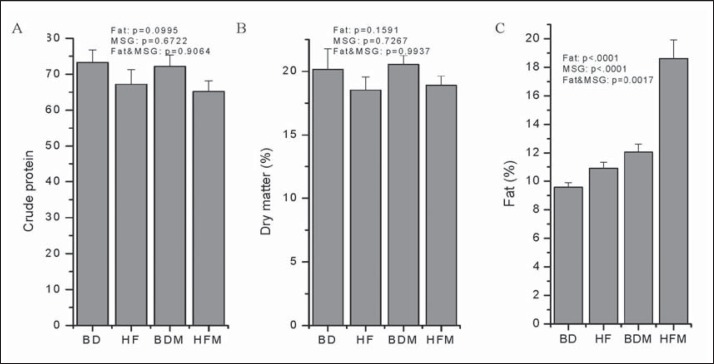
Four iso-nitrogenous and iso-caloric diets were provided to growing pigs. The microbiota from jejunum, ileum, cecum, and colon were analyzed.
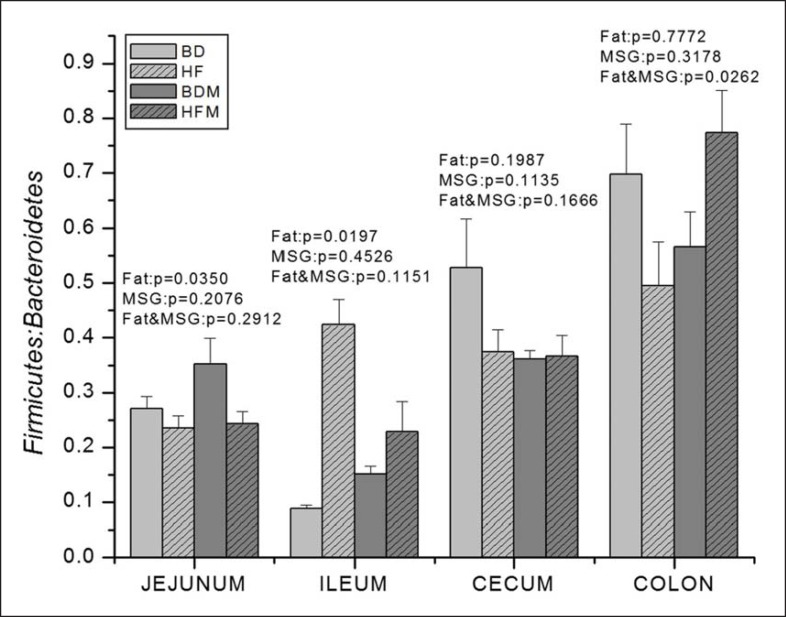
Our results show that both MSG and fat clearly increased the intestinal microbiota diversity. MSG and fat modified the composition of intestinal microbiota, particularly in the colon. Both MSG and fat promoted the colonization of microbes related to energy extraction in gastrointestinal tract via different ways. MSG promoted the colonization of Faecalibacterium prausnitzii and Roseburia, while fat increased the percentage of Prevotella in colon and other intestinal segments.
Our results will help to understand how individual or combined dietary changes modify the microbiota composition to prevent obesity.
中国人已迅速过渡到高脂肪饮食的生活方式,同时谷氨酸钠(MSG)作为日常食品添加剂被广泛使用。据报道,脂肪会改变肠道微生物群的组成。然而,关于口服味精对肠道微生物群的影响,目前知之甚少,也没有研究关注脂肪和味精在肠道微生物群方面的相互作用。因此,本研究旨在确定味精和/或脂肪对肠道微生物群的影响,并确定这两种营养素之间可能的相互作用。
为生长猪提供四种等氮等热量的日粮。分析空肠、回肠、盲肠和结肠的微生物群。
我们的结果表明,味精和脂肪均显著增加了肠道微生物群的多样性。味精和脂肪改变了肠道微生物群的组成,尤其是在结肠。味精和脂肪通过不同方式促进了与胃肠道能量提取相关的微生物的定殖。味精促进了普拉梭菌和罗氏菌的定殖,而脂肪增加了结肠和其他肠道段中普雷沃氏菌的百分比。
我们的结果将有助于理解饮食变化如何单独或共同改变微生物群组成以预防肥胖。