Schiermeyer Andreas, Schneider Katja, Kirchhoff Janina, Schmelter Thomas, Koch Natalie, Jiang Ke, Herwartz Denise, Blue Ryan, Marri Pradeep, Samuel Pon, Corbin David R, Webb Steven R, Gonzalez Delkin O, Folkerts Otto, Fischer Rainer, Schinkel Helga, Ainley W Michael, Schillberg Stefan
Fraunhofer Institute for Molecular Biology and Applied Ecology IME Aachen Germany.
Corteva Agriscience Indianapolis IN USA.
Plant Direct. 2019 Jul 19;3(7):e00153. doi: 10.1002/pld3.153. eCollection 2019 Jul.
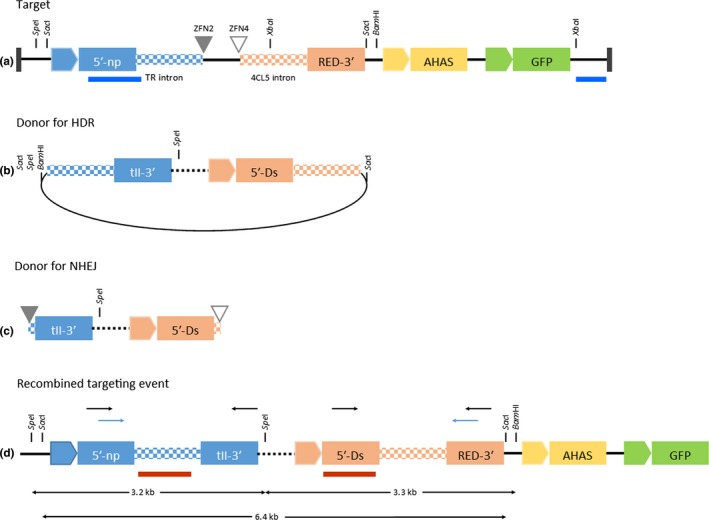
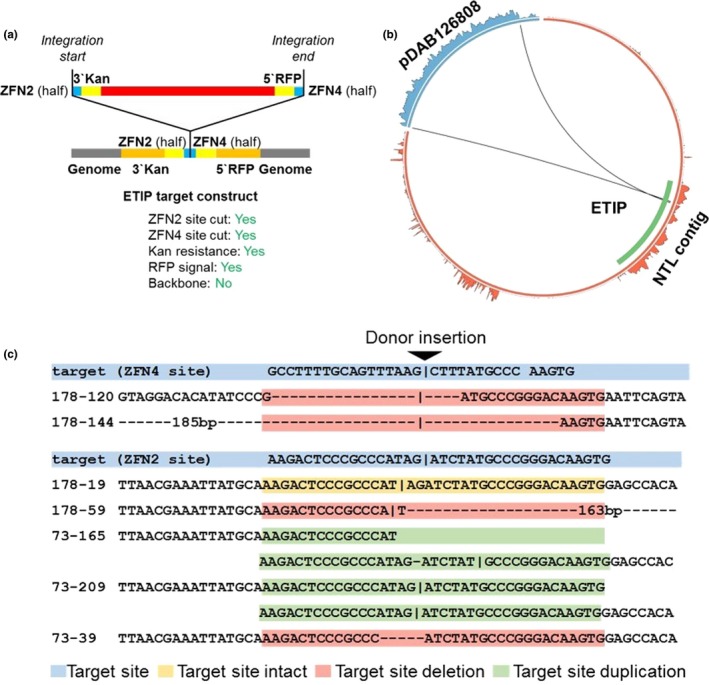
Targeted integration of recombinant DNA fragments into plant genomes by DNA double-strand break (DSB) repair mechanisms has become a powerful tool for precision engineering of crops. However, many targeting platforms require the screening of many transgenic events to identify a low number of targeted events among many more random insertion events. We developed an engineered transgene integration platform (ETIP) that uses incomplete marker genes at the insertion site to enable rapid phenotypic screening and recovery of targeted events upon functional reconstitution of the marker genes. The two marker genes, encoding neomycin phosphotransferase II () and . red fluorescent protein () enable event selection on kanamycin-containing selective medium and subsequent screening for red fluorescent clones. The ETIP design allows targeted integration of donor DNA molecules either by homology-directed repair (HDR) or non-homologous end joining (NHEJ)-mediated mechanisms. Targeted donor DNA integration is facilitated by zinc finger nucleases (ZFN). The ETIP cassette was introduced into BY-2 suspension cells to generate target cell lines containing a single copy locus of the transgene construct. The utility of the ETIP platform has been demonstrated by targeting DNA constructs containing up to 25-kb payload. The success rate for clean targeted DNA integration was up to 21% for HDR and up to 41% for NHEJ based on the total number of calli analyzed by next-generation sequencing (NGS). The rapid generation of targeted events with large DNA constructs expands the utility of the nuclease-mediated gene addition platform both for academia and the commercial sector.
通过DNA双链断裂(DSB)修复机制将重组DNA片段靶向整合到植物基因组中,已成为作物精准工程的有力工具。然而,许多靶向平台需要筛选大量转基因事件,以便在更多随机插入事件中识别少量靶向事件。我们开发了一种工程化转基因整合平台(ETIP),该平台在插入位点使用不完整的标记基因,以便在标记基因功能重组后能够快速进行表型筛选并回收靶向事件。这两个标记基因,分别编码新霉素磷酸转移酶II()和红色荧光蛋白(),能够在含卡那霉素的选择培养基上进行事件筛选,并随后筛选红色荧光克隆。ETIP设计允许通过同源定向修复(HDR)或非同源末端连接(NHEJ)介导的机制靶向整合供体DNA分子。锌指核酸酶(ZFN)促进了靶向供体DNA的整合。将ETIP盒导入BY-2悬浮细胞中,以产生含有转基因构建体单拷贝位点的靶细胞系。ETIP平台的实用性已通过靶向包含高达25 kb有效载荷的DNA构建体得到证明。基于下一代测序(NGS)分析的愈伤组织总数,HDR的纯净靶向DNA整合成功率高达21%,NHEJ的成功率高达41%。使用大型DNA构建体快速产生靶向事件,扩大了核酸酶介导的基因添加平台在学术界和商业领域的实用性。