Center for Development Research (ZEF), University of Bonn, Bonn, Germany.
Faculty of Medicine, University of Bonn, Bonn, Germany.
PLoS One. 2019 Jul 30;14(7):e0220152. doi: 10.1371/journal.pone.0220152. eCollection 2019.
Prioritizing zoonotic diseases is one of the emerging tasks for developing multi-sectoral collaboration within One Health. Globally, many efforts have been made to prioritize zoonotic diseases at national levels, especially in low resource settings. Prioritization of zoonoses has been conducted in different countries at different levels (i.e. national, regional and local) for different purposes. India has also initiated prioritization of zoonotic diseases at the national level. However, in a country like India with wide climatic variations, different animal-human and vector densities, it is important to look at these zoonotic conditions in local settings too. The present study aims to determine which zoonoses should be prioritized for collaboration between stakeholders in the Indian city of Ahmedabad.
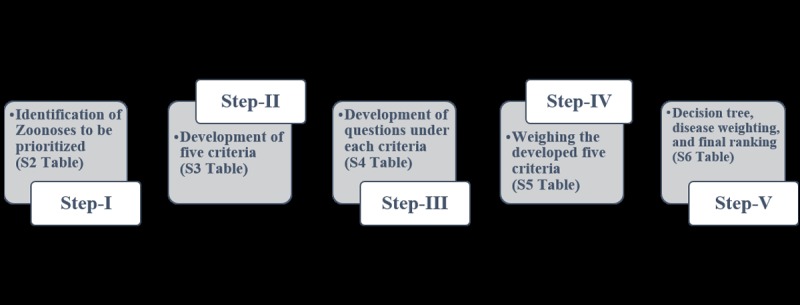
The present study followed a participatory research method, entailing a stakeholder workshop for prioritizing zoonotic diseases in Ahmedabad. It was carried out through a facilitated consultative process involving 19 experts in zoonoses from the human and animal health systems during a one-day workshop in September 2018. To prioritize the zoonotic diseases, the One Health Zoonotic Disease Prioritization (OHZDP) tool of the U.S. Centers for Disease Control and Prevention was adopted. The Analytical Hierarchical Process (AHP) and decision-tree analysis were used to rank the diseases.
Out of 38 listed zoonotic diseases, 14 were selected for prioritization. These were scored and weighed against five criteria: severity of disease in humans, potential for epidemic and/or pandemic, availability of prevention and/or control strategies, burden of animal disease existing inter-sectoral collaboration. The top five diseases that have been prioritized for Ahmedabad are Rabies, Brucellosis, Avian Influenza (H5N1), Influenza A (H1N1) and Crimean-Congo Hemorrhagic Fever. Sensitivity analysis did not indicate significant changes in zoonotic disease prioritization based on criteria weights.
Prioritization of zoonotic diseases at the local level is essential for development of effective One Health strategies. This type of participatory disease prioritization workshop is highly recommended and can be replicated in other Indian cities, as well as in other low and middle-income countries.
在“同一健康”框架内,优先考虑人畜共患病是多部门合作的新兴任务之一。在全球范围内,许多国家,特别是资源有限的国家,都在努力在国家层面上确定人畜共患病的优先顺序。在不同国家和地区,为不同目的,已经在不同层面(即国家、区域和地方)对人畜共患病进行了优先排序。印度也在国家层面上启动了人畜共患病的优先排序工作。然而,在印度这样一个气候差异大、动物-人类和媒介密度不同的国家,在地方层面上考虑这些人畜共患条件也很重要。本研究旨在确定印度艾哈迈达巴德市的利益相关者应该优先合作的人畜共患病。
本研究采用参与式研究方法,在艾哈迈达巴德市举办了一次利益攸关方人畜共患病优先排序研讨会。该研究通过在 2018 年 9 月为期一天的研讨会上,由来自人类和动物卫生系统的 19 名人畜共患病专家参与协商进程来进行。为了对人畜共患病进行优先排序,采用了美国疾病控制与预防中心的“同一健康人畜共患病优先排序(OHZDP)”工具。使用层次分析法(AHP)和决策树分析对疾病进行排名。
在列出的 38 种人畜共患病中,有 14 种被选为优先排序。对这些疾病进行了评分,并根据五个标准进行了权衡:人类疾病的严重程度、流行和/或大流行的潜力、预防和/或控制策略的可获得性、动物疾病的负担、跨部门现有合作。在艾哈迈达巴德被优先排序的前五种疾病是狂犬病、布鲁氏菌病、禽流感(H5N1)、甲型流感(H1N1)和克里米亚-刚果出血热。敏感性分析表明,根据标准权重,人畜共患病的优先排序没有显著变化。
在地方层面上对人畜共患病进行优先排序对于制定有效的同一健康战略至关重要。这种参与式疾病优先排序研讨会非常值得推荐,并可在印度其他城市以及其他低收入和中等收入国家复制。