Steffi Chris, Shi Zhilong, Kong Chee Hoe, Chong Sue Wee, Wang Dong, Wang Wilson
Department of Orthopaedic Surgery, National University of Singapore, NUHS Tower Block Level 11, 1E Kent Ridge Road, Singapore 119228, Singapore.
Polymers (Basel). 2019 Jul 29;11(8):1256. doi: 10.3390/polym11081256.
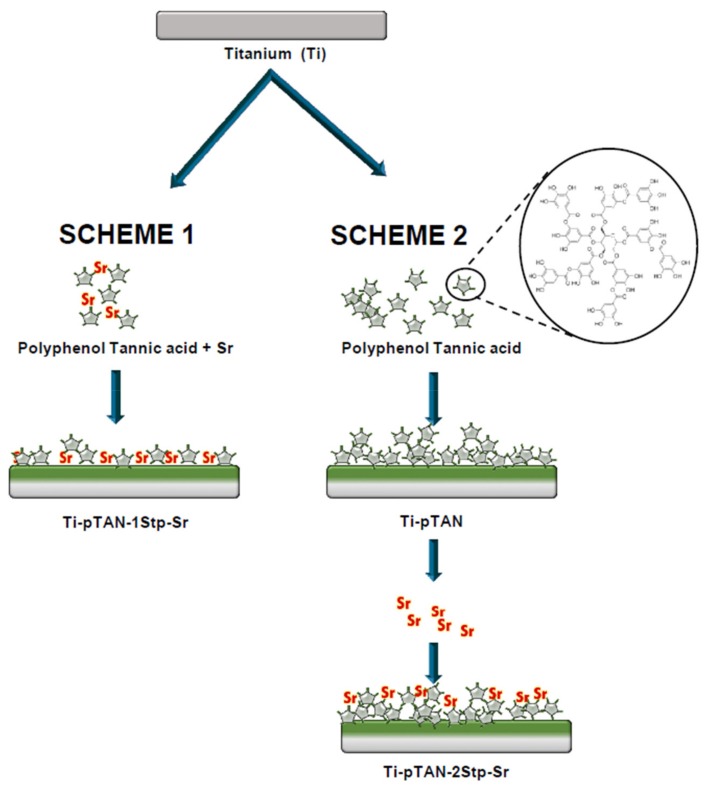
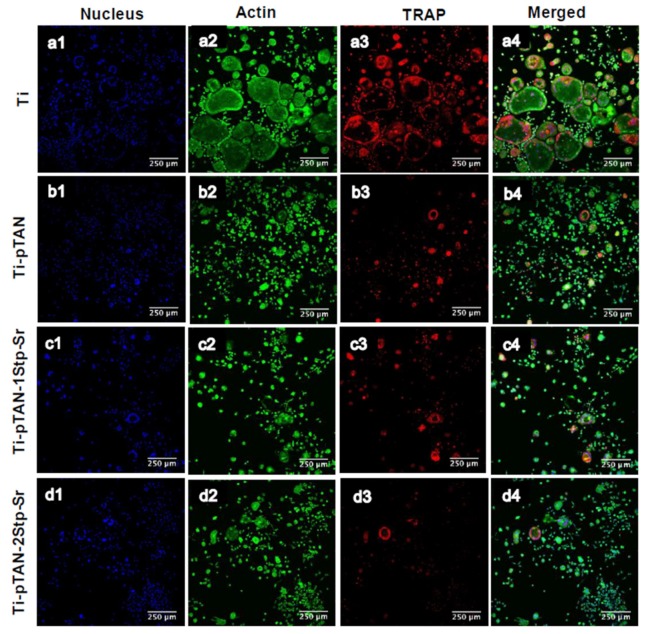
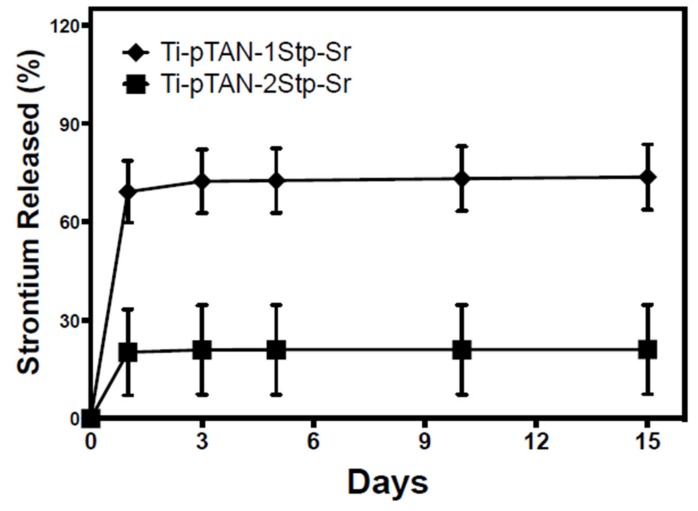
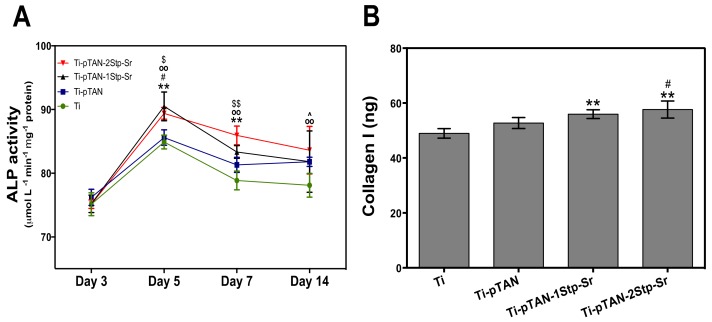
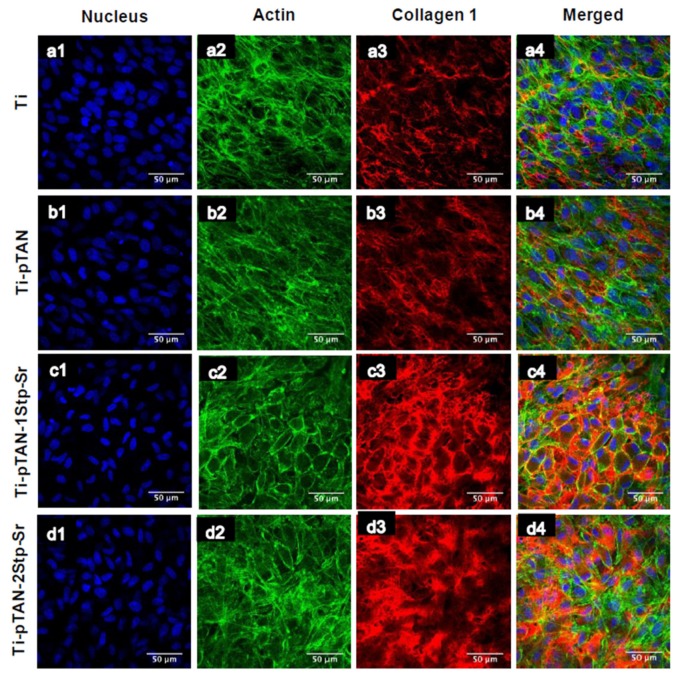
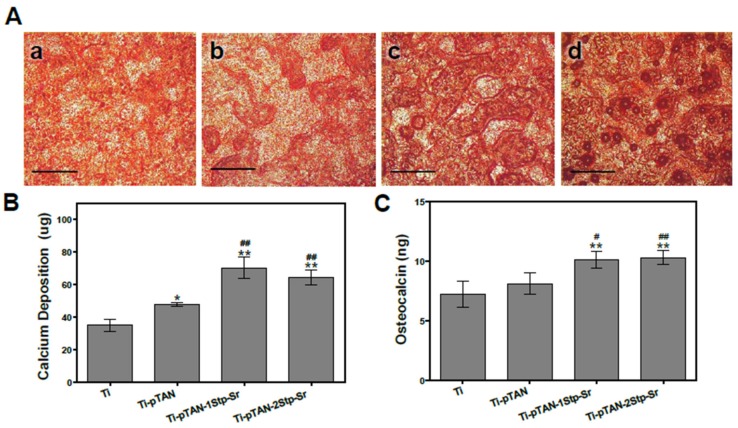
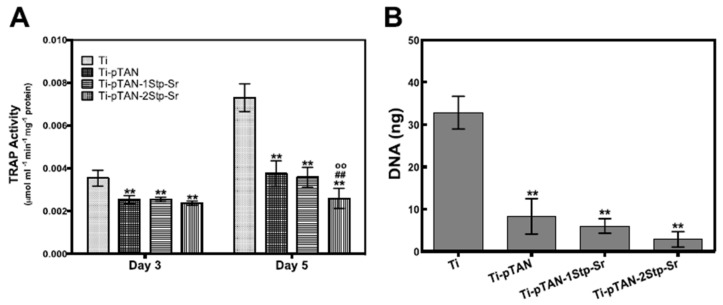
Implant anchorage remains a challenge, especially in porous osteoporotic bone with high osteoclast activity. The implant surface is modified with osteogenic molecules to stimulate osseointegration. Strontium (Sr) is known for its osteogenic and anti-osteoclastogenic effects. In this study, Sr was immobilized on a titanium (Ti) surface using bioinspired polyphenol tannic acid (pTAN) coating as an ad-layer (Ti-pTAN). Two separate coating techniques were employed for comparative analysis. In the first technique, Ti was coated with a tannic acid solution containing Sr (Ti-pTAN-1Stp). In the second method, Ti was first coated with pTAN, before being immersed in a SrCl solution to immobilize Sr on Ti-pTAN (Ti-pTAN-2Stp). Ti-pTAN-1Stp and Ti-pTAN-2Stp augmented the alkaline phosphatase activity, collagen secretion, osteocalcin production and calcium deposition of MC3T3-E1 cells as compared to those of Ti and Ti-pTAN. However, osteoclast differentiation of RAW 264.7, as studied by TRAP activity, total DNA, and multinucleated cell formation, were decreased on Ti-pTAN, Ti-pTAN-1Stp and Ti-pTAN-2Stp as compared to Ti. Of all the substrates, osteoclast activity on Ti-pTAN-2Stp was the lowest. Hence, an economical and simple coating technique using pTAN as an adlayer preserved the dual biological effects of Sr. These results indicate a promising new approach to tailoring the cellular responses of implant surfaces.
种植体锚固仍然是一个挑战,尤其是在破骨细胞活性高的多孔骨质疏松骨中。通过用成骨分子修饰种植体表面来刺激骨整合。锶(Sr)以其成骨和抗破骨细胞生成作用而闻名。在本研究中,使用具有生物启发性的多酚单宁酸(pTAN)涂层作为吸附层将Sr固定在钛(Ti)表面(Ti-pTAN)。采用了两种不同的涂层技术进行对比分析。在第一种技术中,用含Sr的单宁酸溶液涂覆Ti(Ti-pTAN-1Stp)。在第二种方法中,先将Ti用pTAN涂覆,然后浸入SrCl溶液中,将Sr固定在Ti-pTAN上(Ti-pTAN-2Stp)。与Ti和Ti-pTAN相比,Ti-pTAN-1Stp和Ti-pTAN-2Stp增强了MC3T3-E1细胞的碱性磷酸酶活性、胶原蛋白分泌、骨钙素生成和钙沉积。然而,通过抗酒石酸酸性磷酸酶(TRAP)活性、总DNA和多核细胞形成研究发现,与Ti相比,RAW 264.7细胞在Ti-pTAN、Ti-pTAN-1Stp和Ti-pTAN-2Stp上的破骨细胞分化减少。在所有底物中,Ti-pTAN-2Stp上的破骨细胞活性最低。因此,使用pTAN作为吸附层的经济简单的涂层技术保留了Sr的双重生物学效应。这些结果表明了一种定制种植体表面细胞反应的有前景的新方法。