Giordano Vincenzo, Giordano Marcos, Aquino Rodrigo, Grossi João Otávio, Senna Hudson, Koch Hilton Augusto
Serviço de Ortopedia e Traumatologia Prof. Nova Monteiro, Hospital Municipal Miguel Couto, Rio de Janeiro, Brasil.
Clínica São Vicente, Rio de Janeiro, Brasil.
Rev Bras Ortop (Sao Paulo). 2019 May;54(3):288-294. doi: 10.1055/s-0039-1691761. Epub 2019 Jun 27.
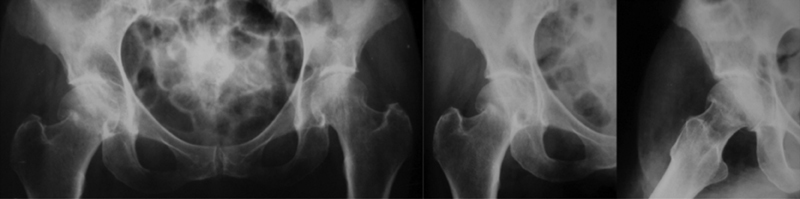
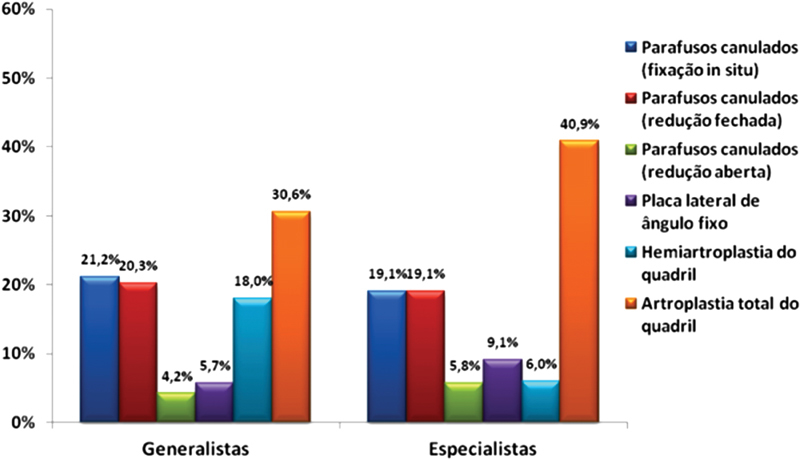
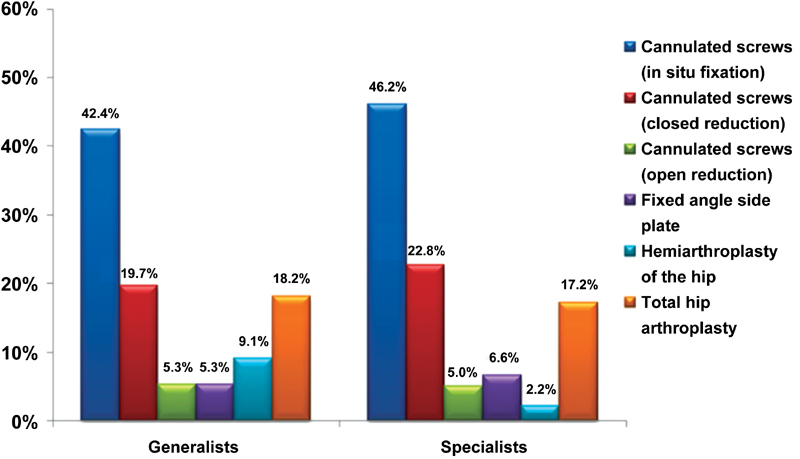
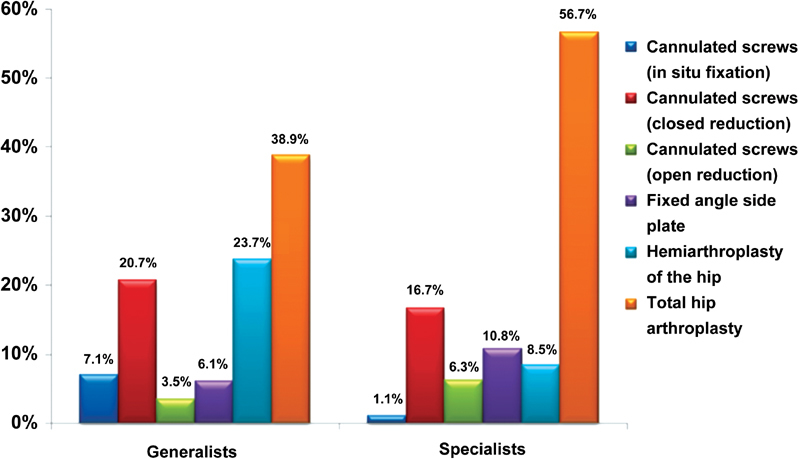
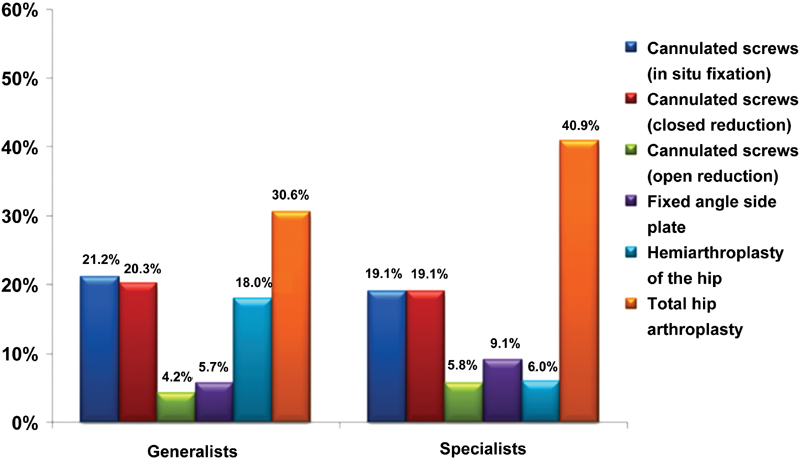
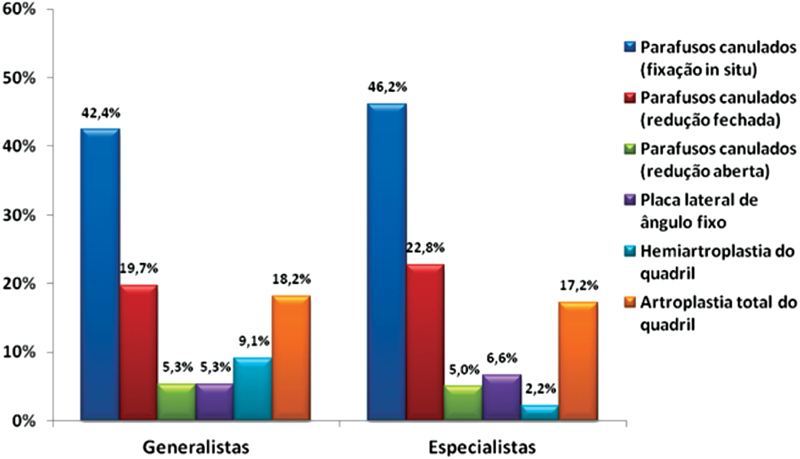
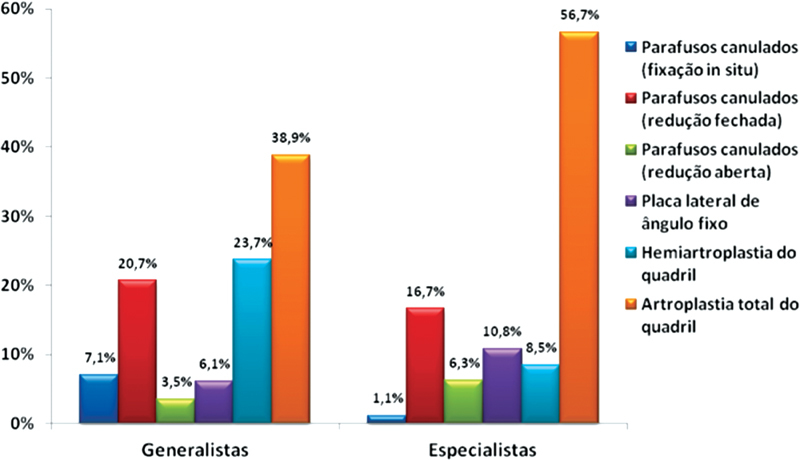
The aim of the present study was to evaluate the practices and preferences of Brazilian orthopedic surgeons for the treatment of femoral neck fractures in middle-aged patients. A survey containing 10 images of femoral neck fractures was sent to a group of 100 orthopedic surgeons, all of them members of the Brazilian Society of Orthopedics and Traumatology. The questionnaire asked the treatment option for cases of nondisplaced and displaced fractures of the femoral neck in middle-aged patients, that is, those between 50 and 69 years old. Descriptive and inferential statistical analyzes were performed using the chi-squared (χ2) and the Fisher exact tests. The level of significance was 5%. The survey was answered by 78% of the orthopedic surgeons invited to participate in the study. There was no significant difference in the treatment method distribution between generalists and specialists ( = 0.16) in the sample of nondisplaced femoral neck fractures. There was a highly significant difference in the treatment method distribution between generalists and specialists ( < 0.0001) in the sample of displaced fractures of the femoral neck. Preservation of the femoral head through multiple cannulated screws fixation is the treatment of choice for nondisplaced femoral neck fractures for both generalists and specialists. Low chronological and/or physiological age are the main factors for this decision-making. In displaced femoral neck fractures, femoral head replacement is preferred for both groups of orthopedists (generalists and specialists). In this situation, specialists prefer total hip arthroplasty (THA), whereas generalists favor partial hip arthroplasty (PHA).
本研究的目的是评估巴西骨科医生治疗中年患者股骨颈骨折的实践和偏好。向100名骨科医生发送了一份包含10张股骨颈骨折图像的调查问卷,他们均为巴西骨科学与创伤学会的成员。该问卷询问了中年患者(即年龄在50至69岁之间)股骨颈无移位和移位骨折病例的治疗选择。使用卡方(χ2)检验和Fisher精确检验进行描述性和推断性统计分析。显著性水平为5%。
受邀参与研究的骨科医生中有78%回答了调查问卷。在无移位股骨颈骨折样本中,全科医生和专科医生之间的治疗方法分布没有显著差异( = 0.16)。在股骨颈移位骨折样本中,全科医生和专科医生之间的治疗方法分布存在高度显著差异( < 0.0001)。
对于无移位股骨颈骨折,全科医生和专科医生的首选治疗方法都是通过多枚空心螺钉固定来保留股骨头。年龄较小和/或生理年龄较低是做出这一决策的主要因素。在股骨颈移位骨折中,两组骨科医生(全科医生和专科医生)都更倾向于股骨头置换。在这种情况下,专科医生更倾向于全髋关节置换术(THA),而全科医生则更倾向于半髋关节置换术(PHA)。